Posts
I wasn’t planning on writing this afternoon, but I saw a post on Twitter from Steven Anderson,

and it really got me thinking. What is innovation? I can see what Steven is getting at. What happens when everyone is innovating…is that not innovation anymore?
I thought for a minute and sent back this reply,

As I teach longer, I keep finding that I think the best practices in the classroom are not necessarily putting the class agenda on the whiteboard or using a word wall to help teach vocabulary or literacy. Those are things…they aren’t at the root of doing what I do. When it comes down to it, I think best practices are really a combination of how we think about teaching and what that thinking causes us to do.
I can dream all day long about how I can innovate in my room…I do that every day. I think that is part of the Achilles heel of technology. There is always something new that we want to try, but we have to have the tech to make it happen. Would I turn down a class set of iPads? No way. But is not having them going to stop me from trying new things? Absolutely not.
Innovation isn’t always thinking about new ways to do things. We aren’t in the business of thinking…we’re in the business of doing. And that includes failure. I am an innovator because I am willing to try those crazy ideas. I may never use them again and I may not change the world with it, but that doesn’t make me any less of an innovator. It’s all in your mind.
The flipped class has been coming up more and more in discussions and blog posts recently. My guess is that it has something to do with Salman Khan’s lucrative relationship with Bill Gates and the media’s attention on their speaking tours. I feel like a broken record with this post, but it is something that needs to be written again.
The flipped class is not about the videos.
Popular media sees the flipped classroom as video being used in the classroom to teach children. I would like to state again that video can be used in the classroom to help differentiate for all learners. The flipped classroom started this way, but it has evolved into so much more than using videos in the class when implemented effectively.
Video itself will not help kids achieve more in your class. The flipped classroom is about making connections with learners and differentiating your instruction. If videos are a part of that multi-faceted plan, great. If they are not, still great. The flipped class is an ideology, not a methodology.
Personally, I use video because it is a tool that helps me meet remediation needs for learners that have missed class or for learners that just need more time with material. For chemistry, I am in my second year using a flipped class, and the video has taken a huge jump to the backseat as I have more time to work on engaging class activities and labs. Again, video is for remediation and review rather than content delivery.
There has been more positive news coming around about the flipped class being used in great ways across the country. For instance, Troy Cockrum was featured in an NPR article that looked at YouTube being used in the classroom. I’m glad Troy brought it around to the connections made with learners, because that is the true power of the model. Another talks about everything except the videos, again, because they are the least important part of the model. Earlier this month, Aaron Sams wrote a fantastic piece of theimplementation styles of a flipped class. Again, none of these methods rely solely on video or even use video at all. It is an idea, not a method.
The video isn’t important. The relationships, the discussions, and the experiences matter. We know that already. Regardless of what methods or ideas you use in your room, let’s continue to focus on what helps learners learn best.
—
This is mainly in response to the #edchat discussion on October 11, 2011 and David Wees’ blog post about using Khan Academy as content delivery in his class. Both the chat and David are great and I appreciate the challenges and direction they’ve both contributed to my growth.
First quarter drew to a close this past Friday. I, along with the rest of the school, have been frantically working to find missing assignments, compile grades, and try to provide meaningful feedback with the pre-determined statements given to us. Such fun.
I’ve been reflecting a lot over how the quarter has gone and I must admit, I have mixed feelings. I feel like there have been some successes to celebrate, but there are still some glaring holes (glaring to me, at least) that need to be filled in.
Foremost, I am not happy with my grading policy. It worked well for me last year, but this year it is far from adequate. As I looked through my grade book, I was not happy with the number of routine assignments that found there way in as the quarter progressed. To be quite honest, I’m disappointed with my lack of diligence in grading only the meaningful assignments. This has led to inflated grades for the learners playing the school game, and deflated grades for the kids that are trying hard (in many cases) but falling short of the “standard.” I need to redefine the standard. To rectify and move forward, I’m going to:
- Focus on assessing skill-based, multi-faceted work that truly displays their understanding.
- Using varied assessments to check learner growth.
- Providing meaningful feedback on everything and anything that affects their grade.
Ideally, grades would not be a part of my class. I don’t feel like they’re the best way to report learner understanding. But, I’m forced to work within a system and I need to do better to bridge my ideal and actual learning spaces.
Second, the learning sequence thus far (when looking back) seems disconnected and a little scattered. I’m afraid some learners are confused about where we are and how we arrived there. If they can’t see what the current topic is, how can they begin to build a larger schema to accept where we’re going? I’m working with younger learners this year and I need to scaffold more than I normally would. There needs to be a more prominent map of the content and how things tie in to one another to form the larger picture. I’m not sure how I’ll be doing this yet, but I would like to have some kind of ongoing mind-map or learning tree that learners can refer to. We’ll see.
Third and finally, I think I need to raise standards for myself. I’ve fallen into some habits that I’m not happy with when it comes to dealing with learners. This is probably going to be the hardest component to correct because it affects the day-to-day interaction with learners. I think I’ve been too loose and that has translated to my learners as “easy.” I know the old adage that says “Start tough and then ease up because you can’t start easy and then tough up,” but that’s where I feel like I am right now. I’m not easy, but I am not convinced I’ve pushed my learners hard enough on the important things. I need to find a way to do this in a supportive and constructive manner so I don’t lose my classes completely.
I am by no means disappointed with this first nine weeks. I am happy with the progress we’ve made together, but there are some issues that need attention.

D Sharon Pruitt, Flickr CC
As I was walking back to my classroom this afternoon, I passed a couple of learners in the hall talking about their grades. I don’t have either of these individuals in my class, nor do I know what class they were discussing, but that is beside the point.
What stuck in my head is when the girl said, “I’m afraid to look at my grade…I don’t even want to know.”
I began to wonder if kids talk about my class that way. How am I using grades? Are they punitive and discouraging, or is it a report of current progress in the class? I would hope that it is the latter, but I’m not sure.
Something to chew on.
As some of my followers noticed near the end of last week, I had a moment of weakness after my toughest class. I’ve been very frustrated with having to micromanage their learning using a flipped model, and it really has made me think hard. Long story short, I’m not giving up on a flipped class or a standards-based model, but I do need to make some major adjustments.
Scott MacClintic was great enough to take some of his afternoon to talk with me directly, and he strongly suggested that I read Daniel Pink’s Drive as it has to do with motivation in a variety of settings.
I bought the book that night.
I’m only about 1/3 of the way through right now, but I’ve learned some very important lessons already.
- I use too many “carrots and sticks” with my learners. I ask for creative, insightful work, but then I slap a grade on it, taking away all meaning of the work they’re doing. I’m trying to use bits and pieces from two conflicting worlds. No wonder I’ve been having problems.
- Grades and extra credit cannot be used to push learners forward. I find myself defaulting to the “you’re being graded on this” line to “motivate” my kids to do the work they’re supposed to be doing at the moment. Again, external pushing does not lead to higher thinking from learners. If they don’t see the value in it, why am I pushing it?
- Resist the urge to tighten my grip. I need to stop micromanaging the class and learn to co-manage with the learners. I want them to be self-directed, but I’m giving fewer and fewer opportunities rather than more and more. Learning from mistakes is important, but I need to give them chances to make mistakes in the first place.
Again, I’m only 1/3 of the way through, but I need to make some major shifts if I want to achieve my goals. RSA animate did a good video on the gist of the book that you can see
here.I’m sure this will be sparking more posts in the future.
I’ve been struggling to find time to write recently. This has been a good and a bad thing. For one, I’m busy with learners during the day and I’m spending more time planning new activities and recording new and updated podcasts. I’m also doing multiple presentations this month and next, so I’ve been working on planning for those as well.
But, on the other hand, my head is about as full as it can get. I haven’t had much time to process any one thought from the past week, so I figured I would do a “systems purge” or sorts to start some thoughts and see where they go this week.
I’ve felt convicted about grading lately, and it usually comes around when I open my grade book to put more marks in. I really need to take some time to sit down and think through my philosophy of grading, because I think I am most unhappy about that right now. I don’t think the grades are representative of learner progress, and that is a major problem. I’m reading a lot of Frank Noschese’s writing on standards based grading as well as Audrey McLaren‘s writing on using Google Docs as checklists and tracking of learner progress. I want to use both bad, but I can’t find the time to do my own learning.
The fall conference season is upon us and I have one of the busiest schedules I’ve ever had. I’m travelling to the Indiana Computer Educators Conference in Indianapolis next week to do a Flipped Classroom workshop with Troy Cockrum and Brett Clark. This will be my first “panel” presentation and I’m looking forward to the new dynamic.
Then, on October 26th, I’m doing an in-service session for new teachers in the district on some of the Flipped Classroom basics each of us can use to move toward a more engaging class.
Thirdly, I’m going to EdCamp: Grand Rapids, and to be totally honest, I’m more excited about that one than any of the other. I’ll get to work with Dan Spencer again and I’m excited because he’s always got good things to share.
Oh, then there’s the ISTE proposal I’m still mulling over. Can’t forget about that.
- I wish I had more handheld devices in my room. Learners interact better with touch-interface now rather than computer interfaces. Still trying to figure out how to solve that problem.
- I’ve started using Andy Schwen’s Google Documents assessment templates to collect data and I’m amazed at some of the numbers coming through. If you don’t click on any other links today, click this one…it will blow your mind.
I think that’s it. I have another post [STRIKEOUT:fermenting] ripening in my notebook and hopefully, I’ll be able to put that up this week as well.
Thanks for mishmashing with me today.
I borrowed an idea from John Spencer about using a photo writing prompt to get some creative juices flowing in learners. There is a Tumblr page that has a collection of writing prompts to help start that process. Tumblr is blocked, so I hopped on to compfight.com and searched the word “quiet.”
I got this image. I put it up, gave some brief instructions, and said “go.”
“Do we describe the picture?”
“No.”
“Should we explain it?”
“No.”
“I want you to look at it, settle your head, and then just write.”
“Can I write a poem?”
“Absolutely.”
I’m trying to show my freshman that the world is not “right” and “wrong.” There is no black and white. Each of them is a lens into the world and they need to 1) be given a chance to share that lens, and 2) know how to articulate what they are seeing.
Here are some excerpts:
I used to play in a park near my house; there was a huge (or at least it seemed huge) tree in the park with old wooden steps nailed to it, so I could climb it. I always ended up getting too scared; I would stop halfway up and come down.
I think the picture is kind of mysterious in a way, because it leaves people thinking and wondering about what it is supposed to mean or if it is even supposed to mean anything. Maybe it doesn’t have a meaning or a point. Maybe someone just wanted to take a picture.
Even though you are grown, everyone has their own place of peace, their own place to be still and quiet. This is the place they go to, to get away from the crazy lives we live and go back to those days of our childhood.
Who says you can’t teach writing in science?
—–
You can read more of the excerpts above by Laura, Dannie, and Erin.
Here is what I’m look at for the middle steps of The Ladder I’m trying to build up for my learners. You can read Part 1 here.
Obviously, before we begin these steps (3 and 4), we’ve given them the learning objectives for the chapter we’re moving to and they’ve taken some form of pre-assessment that will give learners the information they need to make informed decisions. This will also allow you to make sure they’re targeting the correct objectives for learning and not just taking shots in the dark.
In a straw poll, about half of my learners said they liked paper copies of materials, while the other half said they liked being able to do their work digitally. I’ll be keeping paper copies of these forms on hand if a learner needs one, and they’ll also be available for download to their computers or Google Docs if they want to go that route.
You can see the document here.
I have spaces for each of the standards they need to improve on and they systematically break down the content based on their needs.
In order to track each learner, they will be using a couple new forms. First, they’ll have to fill one out that mimics their weekly planning. I can keep a digital copy for quick recall each day if someone loses their paper, or if I need to get someone back on track with their learning. The second is a daily “What did I learn” form. They simply tell me what they learned…whether they did a lab, looked at some videos, ran a simulation…they need to articulate specifically what they worked on and how it applies to their learning plan.
As an added layer of tracking, I’ll also be initialing their work each week. So, it’ll take away the opportunity for excuses to be made for not progressing.
Again, this is all very fluid right now and I haven’t begun implementation yet. I’d appreciate comments and thoughts on this middle part as to how I could improve or tweak this to help learners progress through the content.
It’s been a week since I’ve written. That is both good and bad…I got a lot more work done this week, but now I have about 1000 ideas flying through my brain, and I have to organize some of them in order to keep functioning. This is my grandest idea out of all of them, and it will be a short series on how I think it will flesh out once I try it out.
First, some background: I’ve felt very convicted lately about what a true mastery class should look like. Right now, it is learner-centered in the sense that I am not standing up front and teaching everyone at the same time. But, I am still dictating the learning and the achievement by giving the assignments and expecting certain outcomes (ie 75% to move on). In Korea, this worked well, mainly because all of my learners were driven to do well in school. Here, in the US, I am having more of a battle with learners about their learning. I’ve come to grips with the fact that I cannot direct everyone’s learning.
But, I can help them direct their own. That’s what really spurred me to think this through a little more thoroughly. I’m calling it The Ladder.
Step 1 – Objectives. We still live in an objectives and standards-based world. I have certain topics I have to cover in my curriculum. My first step is to translate these standards into English for my learners and scaffold for them for each topic. This will be a generic form where they can see individual learning objectives that all connect back to a given state standard. This step is more for me and book keeping, but it is still good to expose the learners to standards and objectives.
Step 2 – Pre-Assessment. I am a bad pre-assessor. If I want to see changes in education that move toward measurable gains, I need to begin modeling that philosophy in my own teaching. This will simply be a multiple-choice Google Form that will give them a baseline score against the standards in the unit. I’ll be using Andy Schwen’s templates that he’s shared on his blog. Extremely powerful tools there. Again, this will be a baseline assessment to help the learner pinpoint what areas they need to focus on in their planning phase.
Step 3 – Improvement Plan. This is where the learner really begins to take control. Once they have the feedback from their pre-assessment, they can begin to craft (with guidance from me) their improvement plan to fill in the gaps. The goal here is for a personalized education for each learner that is focused on their own benchmarks and allowing for more freedom to incorporate their interests. They already have their own blog, so I’m also thinking a blog post hashing out their learning goals and strategies will help them think through the process a little bit more and add another layer of accountability.
Step 4 – Learning. This is the nitty gritty. Learners are focusing on the individual skills and benchmarks they have identified as learning goals. As long as they are hitting their objectives, it is up to them how they learn it. If they need a podcast, I am willing to help that way. If they want to find a simulation to walk through, I’m fine with that. I’d be even more fine with them finding someone that works in the field they are learning about and talking with them. This is the broadest step on the ladder and because they have the plan in place, should be the exciting part of the learning. Ultimately, I would like to learn along with them, rather than direct the learning.
Step 5 – Re-assessment. As the learner progresses through their material, re-assessment is paramount in making sure they are hitting each objective and that misconceptions are caught quickly and corrected. This is where the mastery component comes into play. Assessment, reassessment, and reassessment until the concept is well-developed and understood. I’m picturing this as a lot of conversations with me and their peers as they work to put the icing on the cake, so to speak.
Step 6 – Summative Presentation. Not necessarily a stand-up-front-and-talk presentation, but something where they demonstrate their skills. I already have tests written, so that could be one method of demonstration. They could also put a comprehensive unit (content created solely by the learner) to be used in the future. Again, I want the learner to play to their skills and show me what they have learned in one concise, comprehensive fashion.
I realize that this is an extremely ambitious plan. I’m not planning on using it for another 2-3 weeks so I can get the details and the forms put together. I would really appreciate comments and thoughts on the plan above and what you think could be done better or differently.
Update: You can read Part 2, “Planning and Implementation,” here.
This morning I’ve been reflecting on the last year of teaching and what growth I’ve had and what growth I still need to accomplish.
My first attempt at blogging was called Mastering Chemistry and I tried to reason out what it meant to build chemistry students. I wrote mainly about my classes and the blog was usually a space for me to post overflow from my head. But, I didn’t have any way to connect with other chemistry teachers to give thoughts or help. It was stagnant and one-dimensional and as a result, didn’t grow. I didn’t improve much from maintaining it and it fell into the blogging purgatory of marginal and sporadic use.
I realized that to become a better educator, I needed to find a way to continue my own growth. I needed to be a consistent learner. I would participate in monthly PD meetings (run fantastically by our wonderful and talented HR director) that would push me, but it was difficult to find follow-up time to get feedback on the skills we were trying to master in our fields.
Up until March, I had toyed around with joining Twitter to see what it was all about. I tried once or twice to sign up, but I couldn’t bring myself to do it. On the third time around, I committed and joined the conversation. I met some fantastic people right away and I’m continuing to meet amazing educators doing innovative and inspiring work in their schools. More importantly, I went from being an educator to a learner, and I realized that the two must go hand in hand if we want to be the best we can in our schools.
I began blogging more and I built my PLN as fast as I could. I wanted to learn more so I could become a better educator. As I built my identity and learned more about myself, I was hesitant to “name” this space because I didn’t want to pigeon-hole it into one genre of writing like I had done with the first one.
Looking back, this space has really been integral in defining my identity. I am an educator. I am also a learner. The two are intertwined and growth comes from embracing both of those labels.
I hope to continue to lead my learners by example over the next six months and for the rest of my career.
Before I begin, I want you to know that this post began as one thought, turned into a second, and by the end, had gone through a third, fourth, and maybe a fifth…I’m not sure. I think I have it written well, but please forgive me if I don’t.
Most of you know that I practice in a flipped classroom and that an integral part of my class is that learners are given the opportunity to pace their own learning. Now, I do offer guidance and give them more freedom as the year progresses, but the basic idea is that Student A will not always be working on the same thing as Student B, which is fine. I think it is extremely important that learners be given the freedom to take more time when they need it and less when they don’t for any given topic.
I’m also okay with “busy” learning spaces. I like learners up and moving and I like discussion and collaboration. When you have a room full of freshman, the volume can get pretty high, but as long as they’re being productive and challenging one another, its music to my ears. Managing a busy class is tiring, but I’m in there, learning with them.
My blood pressure really begins to build when a learner makes a deliberate decision not to participate in their learning. To me, they are not only halting their own progress, but they are also hurting other learners in the room by omitting the contribution they have to make.
Is it my job to make the learner learn, or is it my job to help the learner want to learn? Unfortunately, I still feel a twinge of the former.
I am not an entertainer. I do not stand up and do a song and dance routine in an effort to keep learners engaged. Rather, I am focusing on providing dynamic learning experiences where each individual can be an integral part in someone else’s learning…not just their own. Just today, my biology classes were working on density. It was fantastic to see small groups collaborating and pulling from one another rather than diving to a computer to look up the “answer.” A snippet of conversation I heard:
_Student A: What’s a regular object?
Student B: I think it’s something you can measure.
Student A: Can’t we solve for volume? How do we calculate that?
Student C: It has something to do with area…I remember this from algebra last year.
Student B: Why are we doing this? This isn’t math…_
…and on it went. They eventually figured out, through discussion and without computers, that you can find volume of regular objects by finding the area of one face and then factoring in a third dimension…depth.
Without the cooperation and engagement of every individual, this conversation would probably have gone much differently. If Student A, B, or C hadn’t participated, would they have been successful in the task? I would like to think so. Would it have been okay for them to have failed at the task? Sure…that’s part of learning.
But, that story changes when one individual drags the group down because of a refusal to progress. It would have been much more difficult pulling from only two experiences. Student C led them down the right path and by working together, they were able to solve the problems and complete the task at hand.
Now, I could have stood up front and taught density. In doing so, I would have effectively removed the influence of those refusing to progress, but it would have been at the expense of true learning. That is not a compromise I am willing to make.
Our learning spaces should foster learning communities. We need to become parts of those learning communities by standing back and encouraging those outsiders to share what they know.
Angela Maiers TEDxDesMoines “You Matter” talk has exploded on Twitter and the internet in general. It is one of my favorite TED talks…ever. She focuses on showing every child that walks through our rooms that they have an important contribution to make and that we want to hear it. Their thoughts matter.
Building learning communities is a great way to help that quiet/shy/defiant/confused/whatever learner embrace the fact that they matter and will promote a culture of learning and collaboration. How can you change your class to incorporate this?
Failure is an option…but don’t forget about progress.
I missed the first half of the Republican debate last night due to a soccer game. I caught the second half, and was a little frustrated that Brian and John focused so much on the four popular candidates, but that’s neither here nor there.
What caught my attention was in the blogs after the debate was over. I saw this blurb as part of a larger article on EdWeek’s website:
U.S. Rep. Ron Paul, R-Texas, said he doesn’t think that schools should have to educate the children of illegal immigrants.
This got me almost as upset as Newt Gingrich’s agenda to increase charter school allowances and broader choices in schools and Rick Perry’s massive budget cuts to education to help close the state budget deficits.
The precedent that would be set by teaching only certain, qualified children is staggering. America is built on opportunities, including opportunity to improve education, livelihood, and safety. I completely understand that there are other major issues with illegal immigration, but I can guarantee you that the solution is not to begin barring these children from our schools. We cannot begin to divide children into “haves” and “have-nots,” least of all along educational lines.
I am a taxpayer. I understand that my taxes pay for public services as well as my own paycheck. I also understand that my taxes are covering (in part) for those individuals that can’t (or don’t) pay taxes. I have students in my class that fall below the minimum tax bracket…yet, they have the opportunity to come to school. When we refuse to teach children of immigrants that don’t pay taxes, we should also refuse to teach children of Americans that don’t pay their taxes.
Both ideas are ludicrous.
When I signed up to teach, I didn’t do so with a caveat that said “I will teach children of parents that pay taxes.” I agreed to teach every child that walked into the school to the best of my ability, regardless of race, religion, economic, or immigration status.
If we are teaching these children, we have an opportunity to build the values of truth and lawfulness while they are young. We have an opportunity to teach them lessons that their parents may or may not be living out. We have an opportunity to be a very powerful, positive influence on their lives. Like it or not, immigrant children will be future leaders along with ours. Should we refuse to build them up?
Every child has the capacity to do something positive in the world. I, for one, will continue to serve every student with that hope in mind.
——
As a sidebar, the article about Gov. Perry’s cuts in education was written by a high school student.
This past weekend my wife and I travelled up to South Bend, IN to spend the weekend with her family. Her youngest brother turned 16, and with both of his older siblings out of the house, we wanted to shake it up a little bit for such a large milestone in his life. My in-laws live out in the country on the west side of the city, and the cold front that blew through the midwest this weekend pushed us outside for the majority of the weekend. It was a great time of relaxing and just enjoying the outdoors without sweating for the first time in months.
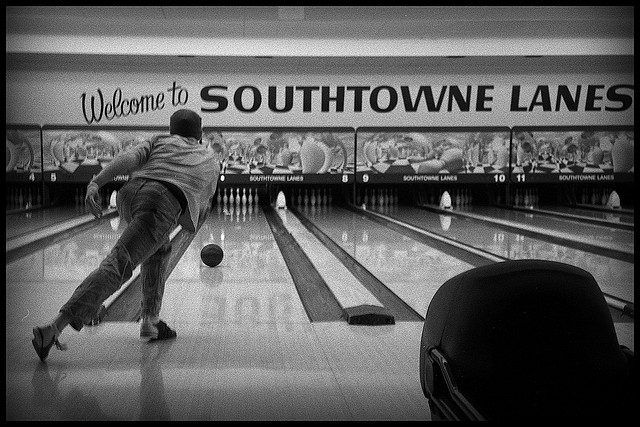
by Greg Nissen, FlickerCC
Sunday evening, we decided to go bowling as one last birthday fling before my wife and I had to head back to Evansville. The alley we like to go to has 12 lanes and usually less than 10 people. Its a nice, quiet place that we usually head to when we get the urge. By no means am I an accomplished (or even mediocre) bowler, so I’ll leave my score out of the discussion…and to be totally honest, I really didn’t even begin thinking about this post until the end of the day today.
If you’re like me, you go bowling once a year…maybe. We all pretend we know what we’re doing, carefully picking out our ball, lacing our shoes, and testing the hand dryer on the ball rack. We spend time preparing and visualizing bowling strike after strike while our friends and family cheer and give us high-fives as we strut back to the benches.
What really happens, is we throw gutter balls for the first couple of frames as we get our feet under us. The weight of the ball is strange and that lane begins to look a lot wider and narrower as we struggle to find a rhythm.
Teaching can be just like that, especially in our first few years. I’m only in my third year, and while I feel much more comfortable in the classroom now than I did when I started, I still struggle to find my rhythm.
I can plan my game all I want, but when it comes down to it, the best way to throw a strike is to relax and let the weight of the ball do the work.
My experience, albeit short, will guide my curriculum, my relationships, my decisions, and everything else that comes along with teaching.
So, what about those of us that have very little [no] experience? That’s when we find the pro in your department or school. They can guide you, give tips, and help keep your aim true while you continue to find your rhythm. There is no shame in asking for help, as long as you ask with humility. Be willing to take some criticism and realize that they have seen just about everything. We can learn from their experience and grow continually into better teachers.
Don’t expect a perfect game your first, second, or even third time out. Continue to work, learn from mistakes, and keep looking down the lane.
Each month, I go to “New Teacher Training” run by our district. It is a monthly meeting for anyone new to the school district, regardless of age or experience. Many of the teachers are new teachers and we spend time discussing many of the “little things” that can come up during your first year that they don’t necessarily teach you in college.
We began yesterday with a couple questions, one being: “What was your biggest disappointment thus far?” Responses varied from parents not coming to open house to being cussed out by a student. I was talking with one of the teachers near me when I heard one person in the group say, “I was very disappointed when I found out that some of my 3rd graders have Facebook accounts.”
Without getting into a major debate over lying about your age to get one and what role the parents play, this comment really made me sad because I think there is a learning opportunity that is being missed by teachers, just because it is Facebook. I do understand the age requirements and the issues that can arise from signing your child up (or the child signing themselves up). Those issues aside, my question is why shouldn’t 3rd graders (or any learner) be exposed to social media in the classroom?
The reason I asked myself this question stems from the truth in that children will learn about social networking _some_where…why shouldn’t it be in school? That way, a responsible adult can help them work through things like their digital footprint, social etiquette, and the responsibilities associated with being a digital and global citizen. If we don’t take the time to teach or even model social networking skills in our classes, learners will be left to navigate the jungles of the web on their own, and maybe even make some mistakes that will follow them for the rest of their lives. I don’t mean to be heavy or alarmist, but that really is the nature of the world today.
Inevitably, there is the question of how to expose learners to social media without asking them to sign up for an account? I don’t mean showing them your Facebook page, I mean actually bringing learners into the social media world and giving them an opportunity to be active participants and contributors.
The easiest way to expose learners is to take a day or a couple of lessons to set up a class Facebook or Twitter account. It becomes a window to the rest of the world, where the sky is the limit. Bring in other classes, create virtual pen-pals, learn a new language…in short, show learners how to use the web as a resource and not a destination. The younger we expose them to this idea and help foster responsible use, the better off they’ll be in middle and high school when they have their own accounts and are on their own.
Social networking can also be used to build literacy skills. I find, many times, learners are too “wordy” in responses. You can use a class Twitter account to help them communicate concisely, with vibrant and descriptive vocabulary while following a 140 character limit. Another idea I had is a problem solving activity of sorts…maybe set up a mystery in which someone can only send clues through tweets, and the class has to solve the problem using the short clues they get. You can ask them to consider context, the audience, tone, word choice…again, the sky is the limit.
There is more and more evidence showing there is no such thing as a “digital native.”(1, 2) No one is born knowing how to interact and connect using the web…it is a skill that is learned as you use it more and more. Further, learners are great at “cutting and pasting, texting, Googling, and Facebooking, their range of skills does not necessarily extend to more complex technological tasks, such as creating and publishing digital stories or websites.” (3) If we don’t take the time to teach them these skills in school, I can assure you, they will take the time to teach themselves.
Don’t be afraid of using social media in your class. Embrace the connections that can be made. Model good citizenship and networking skills. Encourage children to actively participate and contribute to digital learning networks. Who knows…you could very well be learning something from them someday.
—————
Update: Thanks to Deb Wolf for passing along another article I had a hard time finding: Open University research explodes myth of ‘digital native’
I began thinking about punishment when I was notified yesterday that one of my students would need some work to do as he served in school suspension for two days. I quickly grabbed an article, wrote down some questions and prompts for him and walked down to the ISS room.
I’m assuming most ISS rooms are the same…students sitting separated from one another, silent, staring at a blank wall or whiteboard. Not being counseled, not allowed to talk, and not allowed to do much of anything other than work with paper and pencil or sit in silence. It really made sad, more than anything else.
I understand teachers are busy, and that it isn’t always easy to get work down to the students serving their punishment. What made me more upset is when I took a minute to talk to my student. He is a bright kid and pleasant to speak to. He is responsive and aware of his actions. I asked him, straight out, why he landed in ISS. His shy answer told me that he understands what he did was wrong and that he needs to serve the consequences of his actions. I encouraged him, explained his assignment, and then promised to swing by and check on him during my plan period.
Honestly, I didn’t expect him to actually complete the work that I had left. When I went back later in the day, he excitedly hopped up and showed me what he was able to get done. I should also mention that he didn’t just do it…he did it well. He showed depth of thought and explained his opinions well. He answered each item fully and accurately. He also reminded me that I cannot pigeon-hole students serving punishments into a group that doesn’t care. Yes, he made a mistake, but he is still a learner that needs to be nurtured and encouraged.
I took some time to chat with him again about some more questions his responses could bring up. He was thinking hard about what I was asking and he did it well and willingly. I’m so, so proud of his work today, even if it was an isolated incident.
I really got thinking about what punishments learners serve in the school…and what result of their consequences might come around. Is total segregation during the school day the best way to help these kids progress through their mistakes? Shouldn’t we be talking and dialoguing with them about the reasons of their actions and the results of that decision?
I would love to see mediated sessions between teachers and students that land themselves in hot water. Discuss where the tension is and we might, if we embrace cooperation and learning opportunities, be able to build better student-teacher relationships that will reach far beyond the school walls.
What are your thoughts?
Our internet was out at school today (it’s okay, it came back on around lunchtime) and it gave me a chance to slow down a little bit during my plan period to re-arrange my thoughts and take a few deep breaths. I met Jeff Utecht at a conference last March and at his workshop, he gave us a code to download a free copy of his book, Reach. I had all of my lesson plans done and nothing to copy, so with no internet to browse or Twitter to lurk, I took the time to read the book that has been sitting on my desktop since March.
It’s a short book on building professional networks…only about 100 pages. Most of it is about different types of social networking (ie Twitter vs Facebook or Wikis) and how each can play a role in our PLNs. A lot of it I’ve already done, but there were still some good tidbits and thoughts about tools available to build and augment my learning network.
The part that really stood out to me was in Chapter 2 when he writes about building our communities and networks for learning. He used three different terms: print literacy, digital literacy, and network literacy. As I thought about it, I had realized that I knew the difference between print and digital literacy, but my continuum stopped there. I had never thought about what each of those meant. Jeff’s words:
By these definitions digital literacy looks at understanding technologies and their uses. It’’s everything from understanding folder structures on a computer to being able to successfully use e-mail to communicate with others (Reach p 29).
I had always thought digital literacy was so much more, but when I read that, it made a lot of sense that today’s kids are already digital literate. They are probably more literate than me in most cases when it comes to new technology coming out. The problems I see when we’re using the computers are definitely in the network literacy. I’m even more glad now that I decided to go with class blogs this year. Again, Jeff’s words:
Networked literacy is what the web is about. It’’s about understanding how people and communication networks work. It’’s the understanding of how to find information and how to be found. It’’s about how to read hyperlinked text articles, and understand the connections that are made when you become ““friends”” or ““follow”” someone on a network. It’’s the understanding of how to stay safe and how to use the networked knowledge that is the World Wide Web. Networked Literacy is about understanding connections (Reach p. 30).
I am network literate. I have learned how to use Twitter, Google+, blogs, and other tools to build my learning network into something personal and useful for my work. This is what we need to be teaching kids now. They know how to use a computer, but that doesn’t mean they know how to connect with a computer.
Today in class, students were amazed that people from other countries had read some of the blogs. To me, that’s totally normal because I have built that global perspective for myself. The change in perspective is a good reminder that to accomplish my goals this year, I need to be teaching networks and not just focusing on the “digital.”
You can read more of Jeff’s thoughts on network literacy here.
Today I finally had the chance to get my students their blogs. After weeks of trial and error getting the site to work and email after email with IT people to allow my blog through the network, they were finally ready to go today.
A little about my blogs. I had decided from the start that I wanted to host my own blogs on my domain. I figure students already have enough login information to worry about, I might as well be the one with their blog information. I also like that I can set parameters I want and be sure that each student is acting responsibly and appropriately. I can also help them customize it more than the available options if they want.
I've got a few major take-aways from this experience that I think are important things to realize if you're planning on using blogs.
- Take time during class to show them where major controls are. Show them how to log in/out, how to change a password, etc. Make sure they physically watch what you are doing or else you will be answering the same question multiple times. Once I got their eyes, I showed them those major portions, and everything went fine.
- Dialogue with students about the purpose. I teach freshman and my class is definitely already using more technology than most of these students have ever used. We talked about what the purpose of a blog is or what it should be, and I found that many of them just didn't have the experience that I expected. The majority of responses centered around the “fact” that blogs are just diaries. Once they began to think outside the box, they began to take ownership a little bit more.
- Expect slow internet. I tried doing this with 35 kids in my room at once. My server was not happy with me nor was the wireless router in the room. Try to find a way to do half of the class at a time to make sure you have their attention and that the internet is working relatively well. Next time I sign kids up for a blog, we will definitely be doing it in groups rather than all at once.
- Let the students play. Through the class, they kept on asking “what next?”, which is appropriate at times. There was a sequence we needed to go through to get everything done correctly. After that, however, they were a little afraid to do something “wrong.” Take a minute to explain that while we will be using them for class projects, this is their space and it is up to them what it becomes in the long run. I will be giving assignments, but those should not dictate what they use the site for. The freedom scared some, but as they got on board, I saw more excitement than trepidation. Hopefully, some will be posting more than when I ask them to.
I'll be figuring out a way to post a directory for the blogs over the next week so you can check them out if you're interested. Feel free to ask if you have other thoughts and questions.
Today during my plan period I happened to see a tweet from @ThalesDream about today’s Diane Rehm Show being focused on charter schools and education reform. I like the show and I feel like most of the time, it is balanced and includes many experts and good commentary.
Not today.
I was (I hope) one of the public teachers across the country that was trying to call in and e mail about the current state of education and the true effect charters and vouchers are having on education in America. It was heartbreaking to hear an unbalanced, one-sided explanation of charter schools in American education. I’ve tried to break my thoughts down into three parts.
- Charter schools are not the solution to the American education problems. Charters are being heralded as the golden bullet for education with stories of soaring test scores and student achievement. Let me say that there are good charter schools out there. There are schools that are using innovative methods to teach every child and to teach those children that need different challenges to learn. I am not against the idea. What really irks me is that charters are never put in a bad light. There are stories of schools that raise scores on tests by kicking the low-performers out. Artificially raising grades is a disservice to students and parents and is probably the lowest form of education, if you ask me. If you are funded by public funds, you must be public! Test scores cannot be the basis for admittance and retention. Charters were designed to give different opportunities…but not for limited times.
- Teachers do not have absolute job security with no evaluation process. With the changing economy, I hear this more and more, and it made me extremely sad to hear it again this morning with no rebuttal. I am evaluated every year. It isn’t a union thing. If I am not performing my job as required, I will be fired. Teachers are under just as much pressure to perform to the best of their ability as much as the next guy. There are limited situations where teachers “are completely safe, even though they are terrible.” But, that is a very narrow window in the public education system. States are evaluating teachers in a variety of ways, one of which (unfortunately) is leaning more and more on student test scores. We are evaluated. We do not have absolute security.
- Education and corporations are not the same and cannot be treated the same. Education management has been shifting more and more toward a corporate model under the guise of “no-nonsense management” to improve schools. The problem is that corporate goals and education goals are on opposite ends of the spectrum. Corporations deliver products for profits. Education is trying to produce learners that are independent and dynamic. If we begin to produce products that think, talk, and work the same, our society is going to be even farther behind globally than we already are. Schools need good management but from professionals that are educators. Not former CEO’s that took their companies to the Fortune 500 level. The goals are different and until that is realized, education will continue to struggle.
I know this is more of a rant, but I was really concerned about the discussion.
The author being interviewed, Steven Brill, has spent time in schools as an observer…not a teacher. Without proper perspective, education will continue to be skewed.
You can go listen to the segment
here. I really encourage you to
send an e mail to Diane about the episode and your thoughts as a teacher. This is an issue teachers need to speak up on in order to show that we are here working our hardest to continue to provide students with a quality, dynamic, and meaningful education.
I’ve heard a lot of information in the last week, especially since moving to a new district. They had district-wide staff training for those of us that are new to the district. The meetings were fine, and the district really has a mindset to lead the state in utilizing and implementing 21st century learning techniques. I’m going to be able to continue using a flipped classroom and that involves re-writing the biology curriculum so we can roll it out school-wide (hopefully) during the 2012-2013 school year. It’s a long-range plan, but I’m happy and proud to be able to work with the district in moving classes forward.
One thing that stood out to me over the last week was the constant discussion of data and the collection of data in the classroom. Every example used had to do with student testing and performance, which in some situations, is completely appropriate. But, as the sessions moved on, the testing theme continued.
I know the state of the American education system right now is totally on testing and I’m working hard in my classes not to emulate that model in everything I do. Yes, I still teach the importance of “testing,” but it isn’t with a do-or-die mindset. Tests, when written correctly and designed to meet specific learning objectives, can give valuable information about learning and misconceptions. I am not against testing as a method of collecting data…I am against testing being the only method schools are using to collect data.
I was fortunate to be employed before this position, so I understand that data comes from a variety of sources, not just from test scores. But, there were also 70 brand new teachers in the room that don’t have that experience and the presentation they got was one side of the coin. We cannot pigeon-hole learners into a one-time performance. Allow me to use baseball as an example:
Ty Cobb is still credited with the highest ever batting average. He averaged 0.366 (or 0.367, depending on the source) with 11,429 (or 11,434 based on source) at bats. So, that means, for every 10 pitches he saw, he would hit almost 4 of them. That’s really good. But, he also had games where he didn’t have any hits at all. Looking at one game is not representative of his batting skill…we shouldn’t do the same thing to students by quantifying their entire learning experience on one day of testing.
The data we collect should be continuous and diverse. There is numeric data and there is emotional data; formal and informal.
I want to implore all of the veteran teachers that read this…please take time to talk to a new teacher in your building this year about collecting meaningful data from students. Don’t focus on testing alone…construct a base that is built in personal interaction and questioning, successes and failures, and then some testing. Let’s find balance in our learning spaces this fall.
Have a great first week of school!
I got a tweet from Dan this morning:
“Good news! @bennettscience @tebotweets @missscott CitPat letting me run full version of my article online. Only print has to be < 500 words.” It looks like the article should be online soon. I’ll post a link when its up.