Posts
Today’s post is actually from Dan Spencer, a technology coordinator in Michigan. Dan was recently asked to write an article for a local newspaper about student literacy in the digital age. Dan was kind enough to let me post this on my blog as well because it is that good. This is longer than what I usually post, but please do take time to read the entire article.
Cit Pat article – “Are texting and social media sites harming our children’s literacy skills?” <http://techtoolsforteachers.edublogs.org/2011/07/31/cit-pat-article-are-texting-and-social-media-sites-harming-our-childrens-literacy-skills/>
Alright gang! Here’s my article for the Jackson Cit Pat. It was supposed to only be 500 words (it’s currently close to 900) but I can’t think of what to cut without losing important details. Please tell me what you think.
I was blessed with a phenomenal English teacher in high school. Mrs. Wilcox had a gift for pushing us beyond multiple-choice tests and regurgitating lines from Macbethor mindlessly churning out five-paragraph essays about For Whom the Bell Tolls. Her focus was to have us take those works and create something that applied to our world. The common medium of expression at that time was pen and paper, but we were content with that because it was all we knew. Given the explosion of social media and other Web 2.0 tools available today, I wonder what Mrs. Wilcox would have inspired us to create to express our ideas if we had tools like podcasts, blogs, YouTube, and even Twitter or Facebook at our disposal.You see, many view literacy as simply being able to read and write, but it’s really much more. At the very least, literacy means being able to communicate clearly regardless of the medium. But in a world where effective communication is so vital, literacy should imply being able to take an idea or message and understand, critique, and explain how it effects you and your world. However, with the recent boom in social media, the way we communicate with others is permanently recorded and available for all to see at any time. Because of this, social media sites and texting are easy targets for those who want to label the rising generation as lazy, ignorant, or out-of-touch. While examples of people (and not just students) using social media poorly are plentiful, we need to be very careful to not confuse “correlation” with “causation”.It would be foolish to suggest all students were mini-Hemmingways in waiting until Facebook, Twitter and texting wandered onto the scene and corrupted them. Social media didn’t cause those deficiencies, but it does display them for all to see. Those are the sites many students visit and interact when they aren’t in school. Which is what makes the supposed tension between learning, literacy, and social media so intriguing. The frustration many students express with school is that it doesn’t apply to their world. In my opinion, schools have an obligation to make learning relevant to the real world. If we choose to pretend that these forms of communication and media don’t exist or aren’t important to them, we force students into a dichotomy of choosing between “School World” or “Their World”. If students have to pick one or the other, “their world” wins every time. But why can’t educators find ways to promote literacy using the tools that are already shown to engage students? Why can’t we help students see how “school” prepares them for the “real world” by using “their world” to engage them? Now let me be blunt. There are appropriate and inappropriate ways to use social media in schools just as there are appropriate and inappropriate ways to use a paper and pencil. What I am advocating is using the social media tools available today in a monitored, educational setting to help make literacy relevant for students.
Here are a few examples of educators and students using social media tools the right way to promote literacy.
- Texting in the Classroom
- There are many free tools like http://www.polleverywhere.com which allow teachers to poll students during lessons through text messages. Rather than basing whether students understand or not on one person raising her hand and answering questions, this allows a teacher a glimpse at what the whole class understands in a matter of seconds.
- Facebook in the Classroom
- With parent permission, Michigan Center chemistry teacher Matt Withers set up a Facebook group for his chemistry class where they could go for information about the class after school. The student-to-student collaboration and communication that resulted were great examples of how social media can be used the right way in education.
- Sylvia’s Super Awesome-Maker Show
- Mathtrain.tv – Kids Teaching Kids
- http://mathtrain.tv
- Want to see if a student really understands math? You could assign problems 1-25 at the end of the chapter or have them create a video (aka “screencast”) showing how to work out a math problem in their own words. They can then post it on iTunes or a classroom blog so their classmates can access them whenever they need help outside of school. The 6th graders who originally began creating these tutorials struggled in math before they started doing this. Now they pour their heart and soul into creating their mini-lessons outside of class because they know their work will be available for the entire world to see.
- Shakespeare in 140 characters
- Did you really understand Shakespeare? You can’t paraphrase what you don’t understand. Have students use Twitter to paraphrase what is happening in 140 characters or less. You’ll be amazed by their increased interest, level of understanding and creativity when they get to use a social media site that is normally reserved only for outside of school.
Can students learn to read, write and express their ideas without social media – of course! But schools have an obligation to be relevant for students and social media is an important part of their world. In the second decade of the 21st century there are amazing tools available that, when used the right way, can inspire students to see how their world really can prepare them for the real world.
I saw this update from Dan today:
[Sigh] CitPat “kindly” asked me to change the article they asked me to write for them on student literacy and social media to focus on the traditional definition of literacy (being able to read and write). I felt like I had made a great argument that with so many digital tools out there now for people to express their ideas that digital literacy is a type of literacy. Guess that wasn’t what they wanted.
Personally, I think the newspaper is nuts and I’ll probably write the editor an e mail. They’re missing the big picture and this is one of those things that really pushed my buttons. I’ll post the editor’s contact information if you’d like to send a letter as well.
Dan Spencer is currently the Educational Technology Coordinator at the Jackson County ISD. Before that he taught chemistry and physics and coached cross country and track at Michigan Center High School. He can be reached by e-mail atdan.spencer@jcisd.org or on Twitter at @runfardvs. Feel free to continue the conversation on his blog www.techtoolsforteachers.edublogs.org <http://www.techtoolsforteachers.edublogs.org/>.
As I've been playing with Google+ over the last day or two, I've been figuring out some of the nuances reading articles from other bloggers and even from the Google discussion boards. One thing I've come across is that only webpages you +1 show up in your profile's +1 feed. Comments, posts, etc that you +1 in your G+ feed don't show up on your profile.
After I realized this, I began looking for the +1 button on articles and blogs. Some have it, some don't. I've found a couple of solutions to do this…
For WordPress, this article explains step-by-step how to modify your theme to include the button.
If you edit posts in HTML, you can simply do the following:
Copy and paste the following code just before the body close tag in the HTML editor of your page.
Then, paste this simple HTML tag in the post where you want the button.
There are also different sizes you can use and you can see more about how to tweak your button here.
Unfortunately, this isn't a native sharing feature for most blogs yet, but I'm hoping some developers will release some simple drag-and-drop widgets that include the +1 button soon.
I know there have been a deluge of Google+ blog posts written in the past 3 weeks or so, but I’m going to hop on the bandwagon this morning and give a couple of my initial thoughts about its use as a professional and in the classroom.
- Google+ will let educators across the globe collaborate more easily. With their “Hangouts” feature and the selective publishing to different Circles of people you are associated with, I can easily connect in real time with someone across the country. I don’t need third-party software (which, granted, is usually free, but I’ve seemed to have had more connection issues with those third-party downloads than Google Talk) and you don’t need any special equipment. Plus, you can talk with up to 10 other people at the same time, a feature not available on most other programs. Educators should be chomping at the bit to get at this tool…I expect to see more impromptu “webinars” popping up, where people have more freedom to chat about the latest thing they’re doing in their class or to talk about common problems with something.
- Since its Google, we know integration is coming. The one drawback, I believe right now, of Google+ is the lack of integration with other Google software from what I can find. Once GoogleDocs is integrated with the G+ service, I think there will be an explosion of collaboration and connections even more than there are now. I would love to be able to hop on to G+, start a Hangout, and then work on an article, lesson plan, project, etc. all through the same social platform.
- More people will move to Google+ as they think about online professional networking. Facebook is great, but it is becoming more and more childish every day with a focus on games, apps, and casual connections between people. Twitter is also great, but it is confusing at first, and the pace may be prohibitive for some people to really grab hold of. Google+, on the other hand, combines the power and strengths of both Facebook and Twitter and then adds some more on top of that. It is more professional looking and has more professional controls we all wish Facebook had. I see professional networks, especially in schools and businesses (once Google Apps accounts are enabled) flocking to G+ to serve their connectivity needs.
While I think Google+ is fantastic already and I’m itching to get more contacts, I do think we need to continue to scrutinize what we do digitally. Yes, Google+ is awesome, but I’m afraid administrators and district offices will see it only as a social network, and then it falls into that relegation zone of banned at school. Those of us that are currently using G+ need to step out and show the positive impact it has the potential to bring to schools. Show administrators, other teachers, and parents about the connections that will be fostered in a positive light with this new tool. Tell your friends and send them an invite to help work out the kinks of the system.
I’m excited about the possibilities and the changes that will be coming in the next couple of months.
Since April 18th, I have been sending out job applications all over the midwest. Few options were panning out as July rolled around. I was starting to get extremely nervous about the coming school year and if I would even be teaching this fall.
I got an e mail from Brett Clark (twitter @Mr_Brett_Clark) asking if I would Skype in to a webinar with Jonathan Bergmann about the Flipped Classroom. Of course, I’m always looking for ways to talk to teachers interested in using a flipped approach, so I readily took the offer. As I was talking with Brett and Jon about the webinar, I mentioned that I was looking for work. Jon had already been a huge help to me, sending my name out to his contacts, and Brett was eager to help as well. His district also happened to have a couple of science openings available, so he got in touch with those principals and they ended up sitting in on the webinar session.
Long story short, after the presentation, I had an interview with the principal and a job offer that night to teach biology. I’ve just accepted the position and I’ll be the new biology teacher at Harrison High School in Evansville, IN.
As I was talking with the principal, she really stressed that I was hired to help push the science department with technology use and designing meaningful, technology-integrating instruction. I’m extremely excited about not only having a job come August, but also having the freedom to continue what I’ve done in the last year and the freedom to refine and push the flipped classroom strategy. Now that I’m teaching biology, I’m excited to begin to move away from the videos and more into guided inquiry, POGIL, and other tools that can be used in a flipped setting.
Thank you so much to everyone that has helped in my job search. It wouldn’t have been possible without people taking time to send my name around and to send names to me. Its just another example of how having a PLN can really come through when you need it.
It is the morning of July 8th and I just now have time to sit down with some coffee and put some thoughts down that have been flying through my head for the last 10 days or so. This will be more like a “digest” blog post with some half-started thoughts on a few different topics.
- While visiting my family last week in Kentucky, we decided to go out for dinner at the Cracker Barrel. My parents love the Cracker Barrel and its turned into somewhat of a tradition for us when my wife and I are in town. We were chatting and waiting for our food when my wife nudged me and pointed to the table next to us where all three people were sitting silently, engrossed in their games on two iPhones and an iPad.

via jjprojects, Flickr CC
Don’t get me wrong, I’ve done my share of gaming while waiting on the train or bus in Seoul, but it made me kind of sad seeing a family out, but not enjoying each other’s company. Technology can really do a lot to bring people together…but this showed me how powerful it can also be at isolation. I’m all for using technology in schools, in parks, in libraries, wherever. But, as a teacher, it is my responsibility to teach learners that technology is a tool and it should not completely take place of face to face interaction. I have to model the ability to put the phone away when I’m with another person.
Technology can bring two people together from opposite corners of the world. But, it can also separate two people just as far even when they’re in the same room.
- My in-laws got me a new pair of binoculars for my birthday this year, which is great. I’ve never really owned a good pair and I’m excited to be able to start doing some new things. I’ve always been into astronomy and I’m planning on doing some more amateur stargazing with the binoculars. As I get better, I want to get into some small telescopes and then even hooking those up to my computer to do some nighttime photography. I inherited a 300mm Nikkor zoom lens a couple of years ago from a job and I took it outside last night to play with it a little bit. I took a picture of the moon that I’m really proud of and I’m afraid I’m already addicted to this new hobby.
As always, learning something new pointed two things out to me: A) the pride of discovery and creation that I felt last night with that photo is exactly what I want my students to experience throughout the year, and B) when I had no idea how to photograph the moon, I went to YouTube and looked it up. We all like the chance to check out tutorials online when they’re learning new things…the same goes for me. There is a great blog post from a follower I have on twitter, @MrSchwen about how the flipped class is not only beneficial to students, but that it can benefit teachers as well. I would write more on this, but he covered it really well…I suggest you go check it out.
- I need to be outside more. I miss Seoul and being in the city, but being home in the country has really helped remind me how much I appreciate open spaces. Being able to walk around barefoot in the backyard has done wonders for me this summer. Having the summer off is a blessing for teachers. If you’re like me, you don’t like being idle. I do have an itch to get back to work, but I do appreciate and enjoy the break. Take some time today to go outside and get some grass stains on your knees…you won’t regret it.
…or, “More Reflections on the Flipped Class.”
I’ve been inundating myself with discussion on the Flipped Classroom recently. First, there was the FlipClass11 conference where we had about 140 teachers come from around the US and Canada (and even one Londoner I heard) to learn about the flipped classroom. I was honored to be selected to be a member of the presenting team for that conference and I am still sorting through a lot of discussions I had with teachers about what a flipped class looks like.
Then, I was honored to co-write a 3-part article on the flipped class, hosted by The Daily Riff. You can see all three parts in sequence on The Daily Riff’s website still.
Today, Jon Bergmann asked if I would set aside time for #edchat because it was going to be on…the flipped class and its implications in education.
The #edchat session was awesome with great thoughts coming from John Bernia, Michael Thornton, and Tyler Rice, especially. The biggest question was “If you’re trying to move away from lecture, don’t your videos keep the lecture component as a major part of the class?” To that question, I would unquestionably answer “yes, BUT…” because while I still have a “lecture” component, I can now do so much more with my class time. Allow me to back up for a moment.
I’m only a second year teacher, so I know next to nothing compared to some of the veterans I get to talk with every day. I was taught to stand and deliver, as were most other teachers working today. It is deep-rooted tradition in American education, and there is nothing wrong with that. I began to question, though, how I can get more collaborative work and inquiry learning into my curriculum. That slowly transformed into: “How can I use technology to enhance my class?” I found a partial answer in flipping…but I didn’t know it was a partial answer until very recently. I saw amazing things happening in my class as I flipped that (unfortunately) probably wouldn’t have happened otherwise. Students self-grouping and collaborating, “low-achieving” students finding more success than they’ve ever found, and kids that were terrified of chemistry growing to love it.
That being said, using video podcasts to deliver instruction may be lecture in spirit, but it is a stepping stone that allows us lecturers to move toward more inquiry and collaborative work in our classes. Without that time freed up, I never would have discovered other ways to help kids learn chemistry. The flipped class is so much more than the name implies, and that is the message I’m trying to spread now.
Yeah, videos work great…but I’m already bored with them and I’ve found other, more meaningful ways to help kids learn the material. Will I still keep videos? Maybe, because they can be useful for review or for learning very algorithmic processes. Will I keep them all? Probably not. I’d rather use my time (and have my learners use their time) to do more meaningful, collaborative work than sit and listen to me talk from their iPod.
So, is the “Flipped Classroom” a misnomer? Maybe. But don’t look at the name and instantly turn away because we’re all “hypocrites” (and yes, I have been called a hypocrite). Think beyond the videos and try to work out ways you can use some of the ideas the flipped class will give you time for. If videos won’t work for you, please don’t use them. If they will, then maybe they’re a good starting point.
Just don’t judge a book by its title.
—-
More flipped class resources:
The Teacher Vodcasting Network: Over 1200 educators (and growing) using the flip or that are interested in flipping some of their classes.
Global Learning: My personal website elaborating on technology needs, philosophies, etc on flipping.
Learning4Mastery: Jon Bergmann and Aaron Sams’ page devoted to sharing the Flipped Classroom and the resources they’ve built around this model.
The following is a co-post from The Daily Riff on what a good flipped classroom looks like:
The Flipped Class
What Does a Good One Look Like?
“The classroom environment and learning culture play
a large role in determining the best pedagogical strategy.”
by Brian Bennett, Jason Kern, April Gudenrath and Philip McIntosh
The idea of the flipped class started with lecture and direct instruction being done at home via video and/or audio, and what was once considered homework is done in class. So, the order of the “lecture” and “homework” components of the class are, well — flipped.
Now, it is becoming much more than that.
The main reason, maybe the only reason, to flip a class is to provide more class time for learning and that is the major shift that we are seeing as the flip gains popularity across content areas. Other than that, a good flipped class should be like any other in which good teaching and effective learning take place. Flipping the class is not the end-all solution to finding the “best use” of class time, but it does allow for varied forms of instruction. And after all, doesn’t anything that results in more in-class learning a move in the right direction?
A lot of flipped class discussions focus on moving away from a traditional lecture format. While some lessons lend themselves better to a lecture format, others will be more appropriate as a flipped lesson. The classroom environment and learning culture play a large role in determining the best pedagogical strategy. This decision-making is a vital part of providing a constructive learning environment for students.
Switching from a traditional classroom to a flipped classroom can be daunting because there are a lack of effective models. So, what should an effective flipped classroom look like? In our experience, effective flipped classrooms share many of these characteristics:
- Discussions are led by the students where outside content is brought in and expanded.
- These discussions typically reach higher orders of critical thinking.
- Collaborative work is fluid with students shifting between various simultaneous discussions depending on their needs and interests.
- Content is given context as it relates to real-world scenarios.
- Students challenge one another during class on content.
- Student-led tutoring and collaborative learning forms spontaneously.
- Students take ownership of the material and use their knowledge to lead one another without prompting from the teacher.
- Students ask exploratory questions and have the freedom to delve beyond core curriculum.
- Students are actively engaged in problem solving and critical thinking that reaches beyond the traditional scope of the course.
- Students are transforming from passive listeners to active learners.
The flipped class is not for everyone, but it offers the best way we know of to maximize in-class learning opportunities. If an individual learner or group of learners needs something akin to lecture, that can be done. Small group discussions? No problem. Plenty of time for interaction with the teacher? You bet.
The best way to understand how the method works is to see it in action. If you are interested in the Flipped Classroom, you are not alone…find and begin building a support network at The Flipped Class Network. Look at the network resources, connect with other professionals, or even visit a class and see what the buzz is about. Chances are the flip will be coming soon to a school near you, if it hasn’t already.
—-
Once again, we recognize that the flipped class does not and cannot end with the flip itself. You, as a teacher, have to make intentional decisions about how to best meet the needs of your students. It might begin with videos, but it might (and probably should) move away from them as you and your learners figure out how they learn best. There is no one “correct” model of a flipped classroom. If you ask me, I would say a “flipped” class is one where the majority of class time is spent working collaboratively and intentionally to give learners a chance to explore, explain, and create content.
The vocabulary and title of the class are the biggest talking points. Let’s stop focusing on the title of the class and start talking about all the opportunities students have in school, wether its in a “flipped” class or not.
I was at Woodland Park High School in Woodland Park, CO last week at the 2011 Flipped Class Conference. This is my second year at the conference (last year, attendee, this year, presenter) and I was extremely excited about the size of the conference this year…around 130 participants! We talked about everything from what a flipped class is to how to more effectively run your flipped classroom.
At the pre-conference, the presenters sat down to write a “Flipped Class Manifesto” of sorts to try and answer some of the major concerns that have been brought up about the flipped classroom. You can read some [STRIKEOUT:opposition] articles that raise valid questions about flipclass and its implementation here and here. In response to this, we decided to begin drafting this document.
Essentially, too much discussion has been given to the videos in the classroom (Sal Khan, anyone?) and not nearly enough on what happens inside an effective flipped classroom.
The Daily Riff has agreed to post this article in a three-day series on the Flipped Classroom from the perspective of teachers that use it effectively. Each day will focus on a particular aspect, starting with what do you need to flip and ending with what a good, effective class looks like.
You can read part 1 and part 2 on the Daily Riff’s website. I’ll be co-posting part 3 (my part) after it is published on their site.
Let’s start to pull away from what mass media is saying and show what a true, effective flipped classroom looks like.
—
Note – I unintentionally misrepresented Dr. Jackie Gerstein’s article as opposition. I apologize for the mistake and I’ve made the appropriate correction. You can read more of her posts at User Generated Education
As my website and work has grown, I’ve tried to organize my resources and files a little bit better. There were some in my blog, on the main page, and on my Learn page. So, here’s a quick breakdown of what’s going on:
ohheybrian.com
This is the landing page and will house all of my professional files. If you want to know about me, my philosophy, see resumes, or read summaries of work and presentations, this is the place to go. You can also find contact information for me if you would like to track me down for something.
the Blog
If you like to read ramblings, thoughts, opinions, or the occasional epiphany, you want to check out the blog. I’ll post links to interesting stories, my thoughts on class/curriculum/education-at-large, or even see some occasional student work. Probably the least formal of my pages, but maybe the most transparent.
Global Learning
Finally, this is where many of my files, presentations, and resources (both student and teacher) resources will end up. We are all learners and we live in a global learning community, and I’m trying to promote that throughout my curriculum. For presentations, I’ll usually link the presentation file for reference only. If you need the actual file, we’ll need to do some talking. For resources, you will be able to find those and use them however you want. This site is probably the most layered with sections for teachers and students, both organized independently.
Thanks to everyone for all the support I’ve gotten though the spring. I’m excited that the flipped classroom is gaining some attention in education and I’m going to continue to work hard to work with teachers and students on building a culture of active and productive learning.
Unfortunately, I need to leave the conference early today, so I’m writing before I hop on an airplane for a few hours.
There is some great stuff being shared again and the attendees are much more vocal with their ideas and thoughts as they get more confident with the ideas we’re trying to present.
I got drafted this morning to put a video together today highlighting some teachers as they think through some things they’re going to be doing. It is very inspirational to me (as a presenter) to see people excited about the prospects of turning their classrooms around. And, it isn’t even all teachers here. There are technology directors, district-level employees, and other here that aren’t in the classroom but are committed to improving their methods. You can watch the video in a pop-up player here or you can watch it on YouTube.
Right now, my presentations are sort of all over the place, and I will be working on consolidating them all on my Learn page. I’ll tweet it out when everything is consolidated for sure.
If you were at the conference, thank you SO MUCH for all of the discussion, encouragement, and inspiration you’ve given me this week. Please always feel free to write or comment because we need to continue the collaboration.
As we headed into day 2 of the flipped class conference, I was really excited about some of the discussions that are coming up with educators from all over the place. Some of the big takeaways from today:
LiveScribe – If you can write with a pen, you can do a screencast. This is a great tool if you’re not into using a tablet. You can still have the feel of paper and pen without having to mess with learning how to use a tablet.
- Pros – Easy to use, low learning curve, cheap ($50 for 2GB pen), all videos are taken care of LiveScribe (hosting, etc), very portable.
- Cons – No editing power (what you do is what you get), no images or video can be included, audio and pen writing only.
—
I am not a Moodle user, but I’ve wanted to be and I am planning on working on using it on my own next year (unless my district has it already). I’ve already tried to look at adding test questions with a lot of variation, but I couldn’t figure the interface out. Then, I met Phil McIntosh. He teaches MS pre-algebra and algebra and is the Moodle WHIZ. You can connect with him on twitter by following @MisterMcIntosh.
Just to give you an idea, he has test banks that have almost 9,000 combined questions. He has worked very, very hard over the last year to develop well-balanced, reliable, test questions that focus on best practices. His seminar was incredibly precise and organized and you definitely need to get in touch with him if you’re having trouble with Moodle or if you want help setting up a thorough, well-organized test bank.
—
Again, today was a great time of collaboration with other educators and some great ideas being shared. Its very exciting for me as I continue to meet other teachers that are feeling challenged and excited about flipping their class. Tomorrow is the last day and I’m hoping we can make some new connections that will continue to push teachers to try and improve their methodology.
I haven’t written in a long time and it is primarily because I’ve been traveling for a couple of weeks from Korea. I have another longer post slated for later this week, so this is just a quickie with some good stuff from the first part of the day at the Flipped Class Conference in Woodland Park, CO. You can follow some of the discussion here or you can follow the Twitter hashtag #flipclass11.
I presented this morning on making accommodations in the flipped classroom (or in any classroom for that matter) and the topic of mobile devices came up. Some resources I’ve not heard of before are:
Cellular Education – From their website:
Cellular Education is primarily focused on consulting with Teachers, Administrators, and IT personnel to increase the use and effectiveness of wireless devices in Elementary and Secondary classrooms.
You can follow the founder, Victor Fitzjerrald, on twitter.
Mobile Learning Group – This is a branch of ISTE and they focus on bringing mobile devices into the classroom in professional and manageable ways.
SIGML is the ISTE special interest group that is an advocate for mobile learning worldwide, and promotes meaningful integration of mobile devices in teaching and learning in formal and informal learning environments.
Both groups work to promote mobile learning, especially in schools. As students become more and more connected, education should be shifting that direction as well. But, we can’t latch on to the technology as the perfect solution. We still need to make sure we’re using the technology in a meaningful way, and not just for the sake of it.
More to come as the conference progresses.
This week in #edchat we spent time discussing how to change teacher’s images in the media, community, etc. Its a great topic and one that is certainly worth discussing. Teachers are facing more and more scrutiny about testing results, summer break schedules, pay…you name it. So the question that begs asking becomes: “How do we as teachers show that good work is happening inside schools today?”
I posted the following tweet when I joined in on Tuesday:
Schools need to adopt an open-door policy that allows other comm. members to see good teachers in action. #
edchat
It was like the floodgates had opened. I received tweets about “safety issues” and “security concerns” that can arise from opening school doors. There are bigger ideas behind that tweet than what people initially read.
Don’t get me wrong, I’m all for safety and security for children in schools. But we can’t let that fear of something going wrong stop us from making meaningful connections outside of school. Open doors aren’t always a physical requirement. To even begin to actually open those front doors, we have to be mentally prepared to make that shift.
How do we prepare to open doors?
First, stop worrying about what can go wrong. If you’re afraid of people seeing your classroom, there are probably bigger issues at hand. Learning is collaborative…we all know this from experience. Why can’t we be okay with people – our colleagues, administrators, friends – stopping into our rooms? We shouldn’t be afraid of sharing what we do with people that can push us to be better teachers. Teachers complain all the time about being evaluated by test scores, but then they refuse meaningful evaluation when someone steps into the room. There is a severe problem that needs to be addressed concerning this disconnect.
Second, step out digitally before you open up physically. It can be intimidating to share thoughts and ideas openly without knowing you’ll have encouragement from someone. There are a TON of resources tutoring newcomers through Twitter, blogging, and connecting with other educators. It takes some practice and commitment, but the connections that can be made really will build your confidence in your trade and you will come away feeling encouraged and supported by other teachers working for the same goals.
Third, be proactive. Education has always been very private…but that isn’t the way people work in the 21st century. We need to make meaningful connections in order to stay relevant, but it doesn’t just happen. No one is going to bug you about the way you teach unless you ask them to…and even then, it might take some prodding. Be vocal about your desire to be more open to the public. Take time to meet with administrators, parents, and other members of the community and let them know you want to build relationships, not just talk at their kids every day.
The mental shift is the hardest to make because you have to make it happen. Be the change at your school and you’ll start to see amazing things happen.
I love opportunities to brag on students that do some great work. As often as I can, I’ll send something in to Twitter or other teachers in our school. It’s always great sending something out, but it’s even better when it is a student that blindsides you with an amazing project…and that happened to me today.
I assigned a research project where students picked any topic, as long as it related to chemistry. They chose three essential questions and then did a project sharing what they learned. A lot of students build a Blogger site or a Wix page, and some did powerpoint presentations in front of a small group of students. Others chose to do videos, and the video I’ve linked below from a student really blew me away with its simplicity and the personality of the student that comes through.
Take a couple minutes to watch these…I’d love to be able to pass some comments along to this student about her work.
We see more clearly in retrospect…sometimes it’s good, sometimes it’s not so good.
Thinking back on this year, I realized that I’ve gotten lazy with some of my favorite chemical demonstrations. They’re small things, but in a flipped class, it is so easy to come to school, remind kids of the benchmarks they have to meet, and then move away. Mark Siegel wrote about this and how he also missed this aspect of chemistry. He implemented Demo Wednesday to make sure he still included all of the fun stuff for chemistry that is too dangerous for labs, but still great illustrations of chemical principles. I loved this idea, but never really implemented it.
A good friend of mine is an English teacher at our school and he has had a hard time with one particular class. This morning, I decided it would be fun to go in, interrupt class, and have a brief chemistry teachable moment. I did a demo with potassium permanganate and glycerin. It produces a lot of smoke and bright purple flames. I had fun, he had fun, and his class seemed to wake up a little bit when it was over.
I say loosen up because we get so caught up in the content that we forget that school is supposed to be fun. Should we wait until the end of the school year to do this? I don’t think so. I wish I had done more like this during the year, just to build relationship with other teachers and help spread the fun in school.
It is so easy to go day by day and think about content…getting it in for the sake of doing it. Be sure to connect with your colleagues. Take 5 minutes to do something fun with the kids on a random day. It is all part of having an open mentality about education.
Don’t limit yourself to your classroom.
My AP Chemistry class has published their final draft of a general chemistry lab manual. You can see and download the student edition here or you can ask me on twitter for the teacher’s edition (problems worked, etc).
As I continue musing and thinking about the last year using a flipped classroom, ideology and philosophy changes that I’ve made flood my thoughts. At the beginning of the flipped class, I really sold the idea hard to parents and students…harder than I had to sell it to administration (a HUGE blessing).
I think the biggest selling point of the class is that I was going to work very, very hard to make sure students have every opportunity to succeed in my class.

John Martinez Pavliga, Flickr CC
Once the ball got rolling, students realized that this would not be a walk in the park class and that I meant business. They were still expected to work hard to learn the material and that leaving their work until the last minute would hurt their progress. I mean business in my classroom…and now my students mean business about their learning. They are not content to be fed information…they want to be challenged and pushed to their potential.
Another major shift I’ve had is that I want people stopping by my room…interrupting students…asking questions. I remember prior to flipping, it would be a major inconvenience to me if someone stopped in. Now, I can’t get enough people to drop by! I’m trying to show people how powerful this tool can be, but the interest isn’t there or I’m selling it wrong.
This isn’t just a whimsical idea that putters out after a year. I feel more on fire for teaching than I was after graduation from university. I want to share ideas and create new ways of doing things. I want to collaborate, challenge, question, and encourage other teachers interested in the same things. I want to have a classroom that is open to discussion, dissonance, and new ideas.
I do my best to encourage other teachers to open up and share through “unconferences,” meetings, or even lunch. But, its going to take more than that. We need to change the entire attitude about sharing our materials and really work to make connections to help kids.
It has been an insane three weeks for my wife and I and I am just now getting back to writing and following Twitter again.
Coaching has changed my life. I am the varsity soccer coach for our school and I had the opportunity to take our team to a tournament with schools from all over Korea and Japan. We ended up winning the tournament (one of the team goals this year) but there was also a lot of good time talking with players about school, soccer, food…you name it.
The most poignant moment came when one my seniors called me out during a halftime meeting.

from www.stripes.com
We were in the finals and our first half was a little rough. During halftime, many of my players looked angry, so I asked what was wrong (thinking they would be working things out with one another).
Jona (in white), a senior on the team, told me that the game wasn’t fun because all I had been doing for the past few games was telling them constantly what they had been doing wrong. He also said a few guys on the team (underclassmen) had been down because I had ridden them pretty hard in one particular game.
I didn’t expect that at all. Our midfield and defense weren’t working well together and I expected the conversation to focus more on that…not on how I was acting.
It made me think about my attitude in the classroom versus on the field. In the classroom, I’m a teacher…I’m supportive and encouraging to kids that don’t “get it.” I wouldn’t ever dream of telling a student they keep blowing assignments or tasks and that they’d better get their head straight. Why do I do that on the field?
One [cop-out] answer might be that I’m an American and American coaches are big and loud. Another might be that I see coaching and teaching as two different venues that need different personalities…and in one sense, that’s true. I do feel more free to “ride” players a little more vocally or to call someone out on the field. But, my players are still students and I need to teach them the game…I can’t expect more than what I’ve taught, and that’s something I forgot this season.
I’m grateful for the relationships we form each year. I’m very proud of all my students and very proud of my team this year. I’m more proud, though, of the leadership shown by Jona and that he was willing to call me out and speak for his teammates. It was a simple statement and correction that changed the way I think about coaching.
Needless to say, the second half was much quieter from the bench and we went on to win. The victory, however, was built on trust and open communication…and that’s a sweeter feeling than anything.
—-
Jona Park is a senior graduating this year. He plans on attending and playing soccer at Wheaton College in Wheaton, IL next fall.
As we head into the end of the school year, I’ve done a lot of reflecting on the content I was able to finish this year. I am fortunate in that I don’t have standardized testing to worry about and that my principal is very “hands-off” and lets me try new things with my class.

From frankh, Flickr CC
We’re down to 3 weeks before exams and I decided that I’ve taught enough this year. I’m going to be letting my students direct their own learning on a topic of their choice. They still have to apply it to chemistry, but apart from that, it is totally up to them.
I got this idea from Jabiz Raisdana (twitter @intrepidteacher) as he posted links to student surveys and questionnaires during their chosen unit of study. He was kind enough to send me links to his own unit plan for turning the learning over to the students.
I do have to admit, I am terrified of this backfiring totally…like riding a bike without using the handlebars. But, I have faith in my students and that they’ve learned enough about their own learning styles to really grab on to this project. You can follow the updates from my class website if you’re interested in seeing my framework. I’m sure it will also inspire multiple blog posts over the next couple of weeks as I figure out if this was a good idea or not.
Any time the iPad is mentioned, mouths start watering and eyes well with tears as they think about the possibilities…myself included. The iPad has some amazing features (not to mention the iPad2 upgrades) for education and the accessibility of content has opened up enormously. I’m encouraged by teachers that are blogging about their use of iPads and engaging students in new ways.
However, there is a line we need to be aware of.
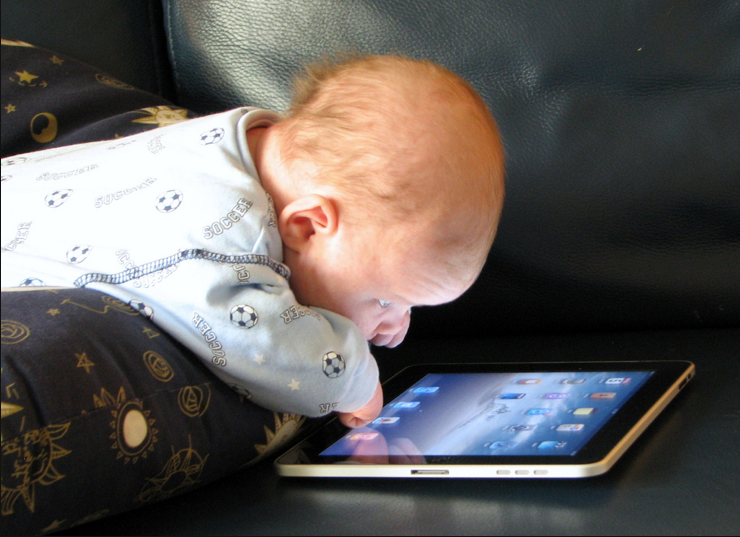
Image via umpcportal.com
I read a column this morning by Mike Elgan as it flooded #edchat on twitter entitled “Why Every Child in America Needs an iPad.”
Naturally, I was curious, so I clicked on the link and began to read.
And my heart fell.
Granted, the post was on a website called “Cult of Mac,” so I wasn’t terribly surprised about the tone of the post. The author leads in with,
Everybody’s asking: Are iPads healthy for children?
I’m here to tell you: That’s the wrong question.
The right question is this: Is the iPad a healthy *replacement* for TV? And I believe the answer is a resounding yes.
He then goes on to make good points about content control available and how games, books, and other interactive content can be used. But, I think he blows right over the questions that arise about constant connectivity.
What happened to tossing kids outside during the weekend to get dirty, run around, and interact with the physical world, rather than sitting inside on their iPad (instead of TV) watching a nature show? I think there is inherent value in figuring out how to climb a tree in real life than how to climb a tree in the game they’re playing.
Why don’t we teach our kids to use technology in a responsible way and in certain contexts instead of handing them a shiny screen and walking away? It is our responsibility as teachers (and especially as parents) to teach discretion. I feel like this post is encouraging parents to disconnect from their kids and allow the iPad to become an “iDad.”
Don’t get me wrong…I would love if someone wanted to give me an iPad, but I would be much more interested in using it in the classroom rather than handing it straight to my kids to replace television. The potential is much larger than using it to entertain…let’s not miss the forest for the trees on this one.
—
Note: I am simply a teacher, not a parent…yet. This is purely my own opinion and in no way do I mean any disrespect to Mr. Elgan or his opinions.