Posts
This week, I was talking with some colleagues about the rate of students using AI to comlpete classwork. The short story is that their students are turning to AI tools for every writing assignment, regardless of topic or genre. A stark - and discouragin - instance was a free-writing assignment where students were asked to write reviews for five of their favorite things. It could be movies, music, tech, food...anything that they found so good that they just had to tell someone else about.
Most went to AI and then copy and pasted it's thoughts.
Another teacher in the group said she had spoken to some recent graduates who said they have varying expectations in their college courses. Some professors have a blanket ban, others require students to use AI tools. I am firmly in the camp of teaching my students as they are now, not necessarily where they'll be in the future, but it really made us wonder if we're neglecting something important by not teaching students explicit skills in using the systems.
They asked how I handle AI in my chemistry classes and my short answer was that I've shifted heavily into labs this year. I don't have them doing much online research and, when I do reach for some kind of writing task, it's linked very tightly to papers which are coupled to what we're doing through instruction. I ask open-ended questions, but they're following specific procedures and protocols that are unique to my room.
Earlier this semester, we were working on unit conversions. I did a little exploration with students considering carbon dioxide release in combustion, measuring the amount of carbon released for every gallon of gas burned in cars. After we realized that we release a ton of carbon dioxide just from driving, I moved the discussion to AI tools. I taught about why it's more expensive per search than a traditional search. We also looked at water use for data centers and looked at the cost - economically - of the two data centers Amazon and Microsoft are building. Students were shocked that both companies were given billions of dollars worth of tax breaks to come and, ultimately, pour CO2 into the air unchecked.
I've written about my discomfort because of known issues as well as some of my exploring local-only models which had mixed results (soon to be revisited). I don't think this is zero-sum where I have to jump in wholesale, but I cannot - and should not - ignore the culture shift that is happening with my students. I think my approach in the short term will be to pair up the task with a specific, targeted analysis of what LLM tools can actually do and contrast it with what students think they can do.
Here's an example:
I'm going to do a March Madness-style element bracket with classes this year to break up the spring monotonmy. If I were to ask them to research an element, every student would take out their phone and copy/paste the first paragraph from the model into their slide or whatever.
This year, I can invite them to do that - use the model to generate some information about the lethality of the element. But then, anything they use must be backed up with a citation. So, use the model to start the process, but dive into actual verification of information and make that the practice. The model becomes an assitant.
Really, what I want to teach students is that by relying on a model to gather ansewrs, it is supplanting their own voice. I want to know what they think, what they care about, what they're frustrated with. I remind my classes that answering questions and taking time to talk is literally my job. I am there to make sure they are learning, not just that they're able to find the right words to answer a question.
Copying and pasting from an AI model might get the answer right, but it's removing the most important part of the answer - their own voice. The social and political climate right now is pushing to remove voices and I want to make sure that every teenager that comes through my room has - and can use - theirs.
I was at the grocery store early this morning getting head cold care supplies. We'd managed to avoid the worst of this spring bout of sickness so far, but it caught up.
The sun was just peeking over the horizon and I heard a cardinal in the trees. I haven't heard a cardinal in weeks. They're there - they don't migrate - but I hadn't heard one in the morning since the late fall.
There was also a tufted titmouse in the distance. You've probably heard one, too. Hopefully, now you have a name to put with it.
All of the kids are quiet in bed. My wife isn't feeling well and I've found myself enjoying the quiet of the house.
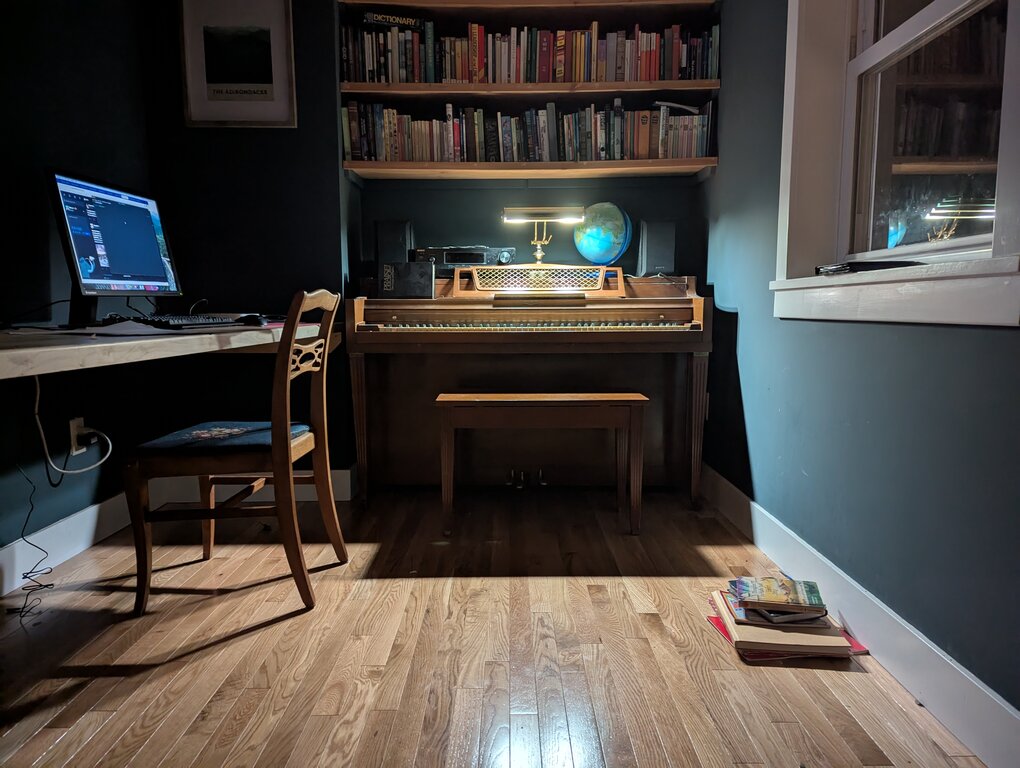
I often have to resist the feeling that I should be doing something.
I think the only something that needs doing is taking these quiet moments as they come.
Toward the end of high school and into college, I developed a tase for metal/metalcore music. Super loud, really intense. One difficult part of being a metal fan is that it's kind of isolating unless you really know the other people in the room like it.
As such, I have a playlist on our Amazon music account called "Dad" which has a collection go-to bangers. My wife knows and tolerates this listening, but I don't really play it for my kids. Today, it came out, they think it's dance music.
I played about 20 seconds of "Beyond Repair" by Johnny Booth (be warned, it's intense). It started with nervous laughter and ended with, "that's enough, it's too screamy."
Good times.
I went on kind of an AI rampage during some professional development yesterday. 24 hours later, I'm feeling just as sad about how it went and more in a mindset to think things through more clearly.
Since starting to pay attention to AI, I’ve found my philosophical training kicking in. This has helped me notice that people tend to conflate things in multiple ways. I’m not immune from these, but I’m trying my best not to let them cloud my judgement.
First, we think through existing tropes that we’ve seen (e.g. ‘Skynet’ in the film The Terminator). Second, we conflate different types of AI (e.g. predictive vs generative). Third, and this is what I want to deal with in this post, we conflate different kinds of ethical concerns about generative AI.
I cought a portion of a discussion between Doug Belshaw and some others following Doug's post. The thread branches a couple times, but they're also worth reading. Doug is right and that categories of ethical concerns are more helpful for framing discussion than just "AI is good/bad." I also appreciate his point (starting here) that there is a difference between platforms and tooling.
In the end, I'm still really stuck on the environmental impact. I am by no means carbon neutral - it isn't a reality for me in my current living situation. But, I can avoid creating more problems by choosing to participate or not participate in certain activites. If (when?) the realities of energy requirements change, then I'll feel better about trying generative tools out more regularly.
New year, new books! I finished three in January and I'm on my way to however far I get in 2025.
Packing for Mars: The Curious Science of Life in the Void - Mary Roach
I enjoyed this book more than the other book I read by Mary Roach, Fuzz. Mary has a ton of sidebar humor thrown in and she covers a lot of the details of space travel that aren't discussed in most publications. Each chapter was dedicated to a particular facet of living in space from hygiene to bone loss in zero gravity. She quotes early astronauts (Jim Lovell and Frank Borman are frequently featured) along with the researchers and engineers who have to solve the problems that come with living in space.
Peter and the Shadow Thieves - Dave Barry
Another read-aloud to my kids, this is the second book in the Peter and the Starcatchers series. This was a sprawling book, going from Mollusk Island (Never Land) to London and beyond. Peter goes to warn Molly and her father of approaching danger and has to figure out how to navigate the dangers of London. Meanwhile, the other Lost Boys are left alone on Mollusk Island to figure out how to make do without Peter.
I don't think it was as good as the first book and several parts felt very drawn out, but my kids and I had fun reading it together.
Children of God - Mary Doria Russell
This is the sequel to The Sparrow, which told the story of Jesuit priests travelling to Alpha Centauri following music heard by SETI. I read that back in 2020, which was an emotional trip. This book was no different. Set years after Emilio Sandoz was returned to Earth, it picks up the story with a second mission of priests returning to Rakhat with Sandoz unwillingly brought along.
I started and stopped a couple times while reading it because the themes were so heavy. New characters emerge and we learn about what happened to both Emilio and the peoples of Rakhat following The Sparrow. Each of the plots wove together seamlessly and brought the entire Rakhat story to a fitting end.
Onward to February! I keep track of current and upcoming reading on LibraryThing if you want to see other books I've read and what I have coming up.
Quick note: I'm going to use AI synonymoulsy with large-language model applications through this whole post. They're not the same thing and artificial intelligence, as a field of study, has much more interesting applications that are generally ignored in the vernacular, particularly in education.
This morning, I attended some professional development that focused on artificial intelligence (ie, chatbots) in education. I ended up posting to Mastodon...a lot...
I've played both roles in this situation. I was an instructional technology coach for many years, so I understand the position the presenters and planners are in. I think, two years back in the classroom now, I have more complex thoughts on that time in my career that will show up in another post. This time, I was the classroom teacher who needed some presenters to tell me about the promise of AI.
The day was bookended with normal edtech hand waving, pretty much textbook - we started off with the "calculator moment" slide which reminded us all that calculators scared the hell out of teachers back in the day. That moved into a reminder that "AI is here to stay, so you're better off just using it" main talking point. It was tech-heavy, focusing on the tools and what they can do and the promise they hold to "change everything." The end of the day sounded like a chance to talk about more of the big picture implications, but those questions and points were either deflected ("We're not here to tell people what to do") or ignored as valid concerns for a teacher ("Yes, the environmental stuff is bad, but it helps with so many things.")
On the whole, sessions led by technology-first folks were all about efficiency, working more productively, and offloading the hard tasks like building assignments, valid assessments, and leaving thoughtful comments for students on report cards and IEPs.
Do not get me started on that last sentence.
All of the ideas shared were low impact and reduced the inflection points of human interaction we should have in our classrooms in the name of efficiency. If you can't talk to every student every day, have a chatbot tutor them til they get it right. Have students paste their story into the bot to get feedback instead of having students pair off and read each other's stories. At one point, when trying to demonstrate how easy it was to get started, a presenter said, "If you're good at talking with people, you'll be good talking with AI."
We go to school so we can work together. We build connections, we share ideas, we challenge...most of today glossed over what we lose as a result of diving in just so we're not "left behind."
All that said, my middle block was led by a split role collegaue. They teach and help with implementation. Their session began by acknowledging the difficult questions of ethical use and not just in the context of cheating. We talked about intellectual property theft, the damages caused to individuals and creatives, the damage to the environment...all of that before starting a discussion about what we've heard or seen with AI in the classroom.
Rather than assuming we need to be taught, they invided us to dialog before moving into a branching workshop where each of those concerns was addressed. There was not ulterior motive and they were prepared with complementary lines of inquiry. They planned it like a teacher and, while I don't agree 100% with their perspective, I felt invited to consider ideas.
I know I'm biased going in, but this was a real eye-opener for me since I've purposefully removed myself from edtech over the last couple of years. I'm discouraged by the overall tone of the day but I'm hoping that we can start to model what we want our students to do, especially when we're in group learning situations.
This year's stoichiometry test has come and gone with less than thrilling results. We're okay on unit conversions, but when we add that extra step of using the balanced reaction to describe ratios between substances, things fall apart.
This is a tough concept that I struggle to teach well. I don't know if more labs/hands on will help - I added one this year and I didn't see better results. Granted, we had several weather interruptions last week that preceeded the test, but even today, there are still large gaps in understanding that I need to do some digging into to figure out what is going on. My hunch tells me that is a "will" issue instead of "skill" issue for 90% of students.
There are many quotable sections in D'Arcy's retrospective on his career in education technology. A few in particular jumped out at me:
Context matters more in education than we initially assumed. A perfect learning object for one instructor might need significant adaptation for another. We learned that reusability often comes at the cost of effectiveness. And the term “Learning Object” became so genericized that it became meaningless.
The promise of having reusable content libraries, even between teachers at the same school, is compelling. But I'm often modifying or adjusting whatever I find, whether it's in the shared Google Drive folder with my colleagues or on the Internet. As they say, all politics are local, so is all teaching. I'm modifying - year over year - the materials I use with students. There is no one-size-fits-all collection of stuff to use with teaching.
But the real story was more complex. [Learning Management Systems] tend to shape pedagogy in subtle ways. Their design implies a certain model of teaching and learning - one based largely on content delivery and assessment.
I had the great fortune of learning to teach from a wonderful mentor who took advantage of early digital learning tools to make it more accessible for students. My first position also encouraged us to develop strategies for using wikis and blogs. I felt frustrated by the push to move into an LMS for coursework because I already had systems and strategies in place for those kinds of interactions.
In the next paragraph, D'Arcy concedes, "That said, LMSs solved real problems. They made online teaching accessible to many more faculty." This is on point because the burden of online teaching tools, at the time, was heavily skewed toward the non-technical teacher. I was comfortable trying new things and figuring systems out. Others either aren't comfortable or don't have the mental energy to do that prep work, which is also fine. Years ago, I felt like the LMS could be used as a stepping stone into other tools that do some things better. And that's a good thing.
If you're in education, go take time to read this.
Where Part 1 ended the story of Paul, Duke of House Atreides, and began the story of Paul, "Muad'Dib," Part 2 ends the story of the Lisan al Gaib and begins the story of a would-be God Emperor’s holy war that he’s not exactly psyched for because Chani’s right to call him out on his bullshit.
This is great take on why Dune Part Two is so powerful. It's not "true to source," but it captures the tragedy playing out through Paul. I think the film adaptations cut through all the extra stuff in the book that couldn't have made it in anyways.
In my mind, the Villeneuve version of Dune is right up there with Peter Jackson's Lord of the Rings adaptations.
Something came over me this weekend and I decided to watch a bunch of movies. We had a long weekend for the Dr. Martin Luther King holiday, so Friday night, I decided to do a rewatch of Dune, Part One. I missed the theater run and watched it on one of the Big Streamers at some point. The rewatch was just as good and, after having finished the book again in 2024, I think the movie holds up really well.
Saturday night, I decided to watch Godzilla Minus One. I remember getting the original Godzilla movies growing up from the public library, so there was a bunch of nostalgia in this for me. I watched it in Japanese with subtitles turned on and it was definitely the way to go. The acting was amazing and I was fully bought into the story.
Sunday night, I re-watched Dune, Part Two. I saw this one in theaters back in April (that was an experience) and I wanted to watch it in closer proximity to finishing Part One. I had forgotten about how well the second part shows Paul's descent and I think the conflict plays out exceptionally well through Chani's story. The ending left me feeling really sad because there is no real path to redemption. I also read Dune Messiah last summer and I'm curious how that particular story will make its way into the (rumored?) third movie.
The artic air settled over us on Monday night and school was cancelled on Tuesday. Feeling melancholy over the other events of January 20th, I decided to watch Oblivion because I had a vague memory of seeing it, but not remembering any of the story. It was a good escape and, pleasently, I did not remember the main story twist, so it was fun.
This is the most I've watched in such a short period in quite a long time, but it was fun to just watch the stories play out. On the other hand, they started to put me in a mood and I've had a hard time focusing on other priorities, so I think that will be it for this time around. Maybe next year, I'll do it all again.
We're neck deep in unit conversions in chemistry and we've come to that bridge, yet again, where we have to wrestle with stoichiometry. Converting between units has gone better this year because I introduced with some models using common units like dozens, grosses, scores, and others. They counted beans, did their multiples and partials, and were able to get to the mol (I'll always leave the "e" off) without too much of a problem.
But then, we got to chemical compound conversions using balanced equations. Every year, this is where we come to an impasse for some students.
In the past, I've used the "mol island" metaphor and associated diagram to help make sense of the conversions that are happening to get from A to B:

Each year, moving from mols of A to mols of B is the hardest part, by far. The idea that you can convert between substances is hard to capture and, really, I should probably develop a new lab to help with the concept, but this year, I don't have time to at the moment.
This year, they're also struggling with procedure recognition - understanding where they are in a given process compared to where they need to go. I started tinkering with the idea of a flowchart, similar to how the old Holt Mini-guide to Problem Solving book models it:

This is nearly the same as my version, just less circley. I needed to do something different, and I ended up with this version:

I wasn't really planning on using it with students this year, but on a whim, I threw it on the board today and most of the class immediately asked for one to put in their notebooks.
I'm not sure what it is, but the yes/no questions along the way help them with the step-by-step processes needed to make it through a conversion, more than the island chart did. I think the connection between the questions and following the path to finish is providing an almost tactile interaction that is helping link ideas.
It's definitely a crutch, but I've always been more interested in teaching processes over fact retention. I think this is a better tool to help them approach novel situations and, with repeated use, they'll start to rely on the diagram less and less.
Frankly, this was born out of frustration and is more or less a happy accident. I'm hoping results actually pan out when I start to assess the skill formally next week.
I've struggled to efficiently grade web dev projects this year. Github Classroom is kind of a pain becuase I need to go to each repo individually and students are struggling with the git workflow. I decided to take that out for now. The next best method is to have them zip project files and then submit the zipped archive that I can extract. It was still a lot of clicking between folders.
Then, I realized (finally) that I can just extract the directories into one parent folder and run Python's built-in HTTP server. It makes clicking around the projects much easier and I can pop open the source tab right in the browser. No more opening and closing files between apps.
I wish I'd thought of this back in September.
I don't normally do blog challenges, but I got pinged by ~hyde with the call, so here goes:
Why did you start blogging in the first place?
I don't remember a specific thing that got me started. My first post talked about students and learning and technology, so it was probably something I heard during a professional development at school. This was my first year teaching and the school was pretty technology-forward, so I was doing a lot of exploring. That early writing is pretty cringy as I read it 15 years later...
My writing really beagin in earnest in 2011 after attending an education technology conference and getting connected to other teachers through social media and blogs.
What platform are you using to manage your blog and why do you use it?
The current version of this site is built with Pelican, a Python static site generator. I've been using this for a little over a year now becuase I moved from a shared hosting provider to a Linode VPS and I needed to cut down on resources. I tried WordPress at first, which is what I had been using for many years, but this new host only has 1GB of RAM and a static site made more sense. I also don't do enough shared writing or management to really necessitate a full CMS.
Have you blogged on other platforms before?
I had a brief stint of running my site with Jekyll in 2018. I also had it running on Anchor CMS a few years before that. I still miss Anchor.
How do you write your posts?
I have a private git repo that I use to sync posts between machines. Pelican turns Markdown files into HTML when the site is generated. I use Helix to write and git to push to the repo. A pre-receive hook on the server extracts the new files and rebuilds the site on each push.
When do you feel most inspired to write?
It depends a little on the week. I've done some work to make short posts easier to publish and I'm trying to make that more the norm. I tend to think about teaching the most because it's what I spend most of my day doing and I'll often chew on those posts for a couple days before actually starting to type. I don't know that I ever have a "fully finished" idea before publishing because this site works best when I use to to process my thinking rather than "publishing" my thinking.
Do you normally publish immediately after writing, or do you let it simmer a bit?
I tend to publish right away. If I have a change of heart, do more thinking, or expand my ideas, I'll either edit the post and note the update or I'll just write a followup post. I don't keep drafts around because if it's not enough of an idea to write it out, I don't need to worry about creating a backlog for myself.
From time to time, I will mark a post as "scheduled" to publish at a later date, but that's pretty rare. More of a nice to be able to do than something I reach for.
What's your favorite post on your blog?
Alan Levine asked a very similar question on his blog, asking which post was a contender for best post. I read it in November when he published it and the tab is still open on my phone becuase I will, someday, go back and comment.
I don't really know. Maybe this one?
I think some of my best writing is the life stuff. Not so much the thoughts on schools or tech, but the post about the time I had to fix a bad car problem or the other time I had to fix a car problem.
I don't think I can pick a single best post, but I think I can say, 15 years, in, that my Life category is my favorite collection now.
Any future plans for the blog?
I've got a couple things I'd like to do, like auto posting new articles to other places and making this the first place of sharing rather than jumping to social media. I want to write more about life stuff and tell more stories of living simply.
Who will participate next?
My fedi circle is pretty small still, but I'd like to see a post from Chris, Alan, and Tom mainly becuase I always make sure to read what they write when it pops up in my reader.
My students were incredible with the iodine clock lab. Given the complexity of the procedure and the accuracy with which they needed to measure, they rose to the occasion.
Everyone split into their groups and immediately read the materials lists and read the procedure before even getting chemicals. They measured stock, asked good questions ("Is tap water okay?") and delegated tasks.
The soft click of glassware and hush of partners cooperating was musical.
I wrestled hard with an iodine clock reaction this week. I haven't taught kinetics in many years, so I was re-learning a lot as I went. I'm still confused a little by the data I got vs what I expected, but I think it's a case of the real world being much messier than practice problems.
D'Arcy manages to say in two sentences the conflict I feel over using an LLM:
If the resource and environmental impact problems were solved, would it suddenly become ethical to use LLMs? If the ethical issues around intellectual property and training of LLMs were solved, would I still be this conflicted? I desperately want a simple answer to all of this, and know that it’s just not possible.
These are my main two holdups, but even if they weren't problems, would I feel the same? I'm not sure.
Simon Willison has a detailed overview of major changes in large-language models from 2024 that I took time to read today. I'm a skeptic, especially because of the copyright and environmental issues that come with creating and running these services at scale. Some items that jumped out:
The really impressive thing about DeepSeek v3 is the training cost. The model was trained on 2,788,000 H800 GPU hours at an estimated cost of $5,576,000. Llama 3.1 405B trained 30,840,000 GPU hours—11x that used by DeepSeek v3, for a model that benchmarks slightly worse.
I don't pretend to understand the complexities of the models and the relationships they're trained to form, but the fact that powerful models can be trained for a reasonable amount (compared to OpenAI raising 6.6 billion dollars to do some of the same work) is interesting. Costs are down, which means that electric use is also going down, which is good. Simon makes the same observation in his section on environmental impacts:
A welcome result of the increased efficiency of the models—both the hosted ones and the ones I can run locally—is that the energy usage and environmental impact of running a prompt has dropped enormously over the past couple of years.
An interesting point of comparison here could be the way railways rolled out around the world in the 1800s. Constructing these required enormous investments and had a massive environmental impact, and many of the lines that were built turned out to be unnecessary—sometimes multiple lines from different companies serving the exact same routes!
The resulting bubbles contributed to several financial crashes, see Wikipedia for Panic of 1873, Panic of 1893, Panic of 1901 and the UK’s Railway Mania. They left us with a lot of useful infrastructure and a great deal of bankruptcies and environmental damage.
I think the last paragraph is where I'm still sticking. Companies are plowing ahead to give us AI in things we don't want it in at the cost of A) an economic bubble and B) massive environmental damage. I'm seeing economic impacts near home with datacenters being built at massive tax discounts which benefits the corporations at the expense of residents. There will be bills to pay and right now it doesn't look like it'll be corporations.
I'm not going to start using an LLM daily, but reading Simon over the last year is helping me think critically. I dabbled with self-hosted models, which was interesting but ultimately not really worth the effort on my lower-end machine. Maybe that will change as systems become more and more optimized for more general use.
If you have time, I would encourage you to go read the entire post.
One of my kids said tonight that they want to have 84 children. Another one of the kids exclaimed, "It'll take, like, five million dollars to feed them." That got me wondering if my wife and I have spent one million dollars in our time together.
Our rough estimate using our general food budget, mortgage payment, and house expenses (electricity, gas, and taxes) would take us 40 years to spend one million dollars. We live modestly, but that number was higher than I expected, honestly.
It reminded me of the "one billion dollars" on MS notepad video (lots of NSFW language, so be careful). The fact that there are people with multiple hundreds of this kind of money is nauseating.
I've made some small tweaks to the blog to kick off the new year. For starters, I made the layout slightly narrower because the original theme took up a ton of horizontal space. I don't do any full-bleed layout elements because of the two-column layout, so this will help keep things nice a neat.
The biggest change is how I'm laying out posts on the main index. Instead of just titles, I'm now showing small excerpts. Jinja templating allows me to pull the text to a certain point and then add the "Read more" link when needed. I also did a little bit of preliminary work for posts that I want to throw in that don't necessarily fit the "traditional" blog post format with a title.
Sidebar: it is wild to me that a blog post has a "traditional" format now.
Lastly, in an attempt to have a more semantic layout, I've added a proper footer element into the article element for the post data. I've included a permalink, a server-rendered word count, and then the category as a link. This will let me remove a little bit of Javascript from the post templates I was using to calculate the word count.
We'll see if these changes stick.