Posts
My wife's cousin sent a wedding invitation last April inviting us to the Grand Canyon for the nuptuals. Lindsey and I had been talking about planning a trip out west with the kids at some point and this seemed like the best opportunity to make it happen. It turns out that October in the west/southwest is the slow season, so we were able to pull off a 9 day, 3,000+ mile road trip with the kids.
Colorado
We left in the early hours of a Saturday morning with the hopes of making it to eastern Colorado. We ended up stopping for the night in Fort Morgan, about 60 miles east of Denver. There isn't much to see in Illinois, Iowa, and Nebraska, so I don't have anything to say other than they're great states for wind farms.
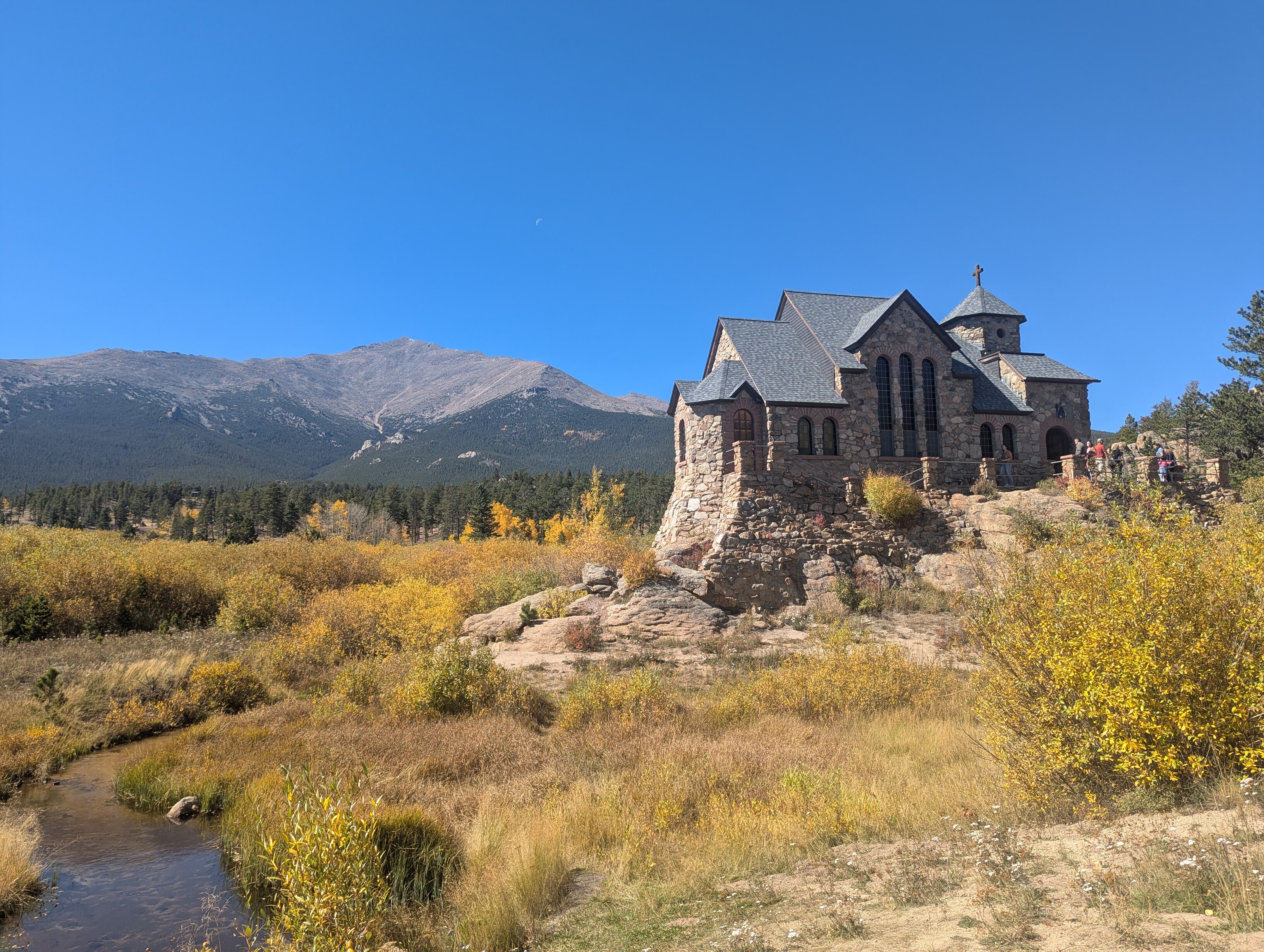
As we headed into the Rocky Mountains, we stopped at St. Catherine's Chapel on the Rock. The church has been there for about 100 years and has survived both wildfires and floods. It was a beautiful location at the base of Mt. Meeker and we enjoyed a few minutes in the silent sanctuary.
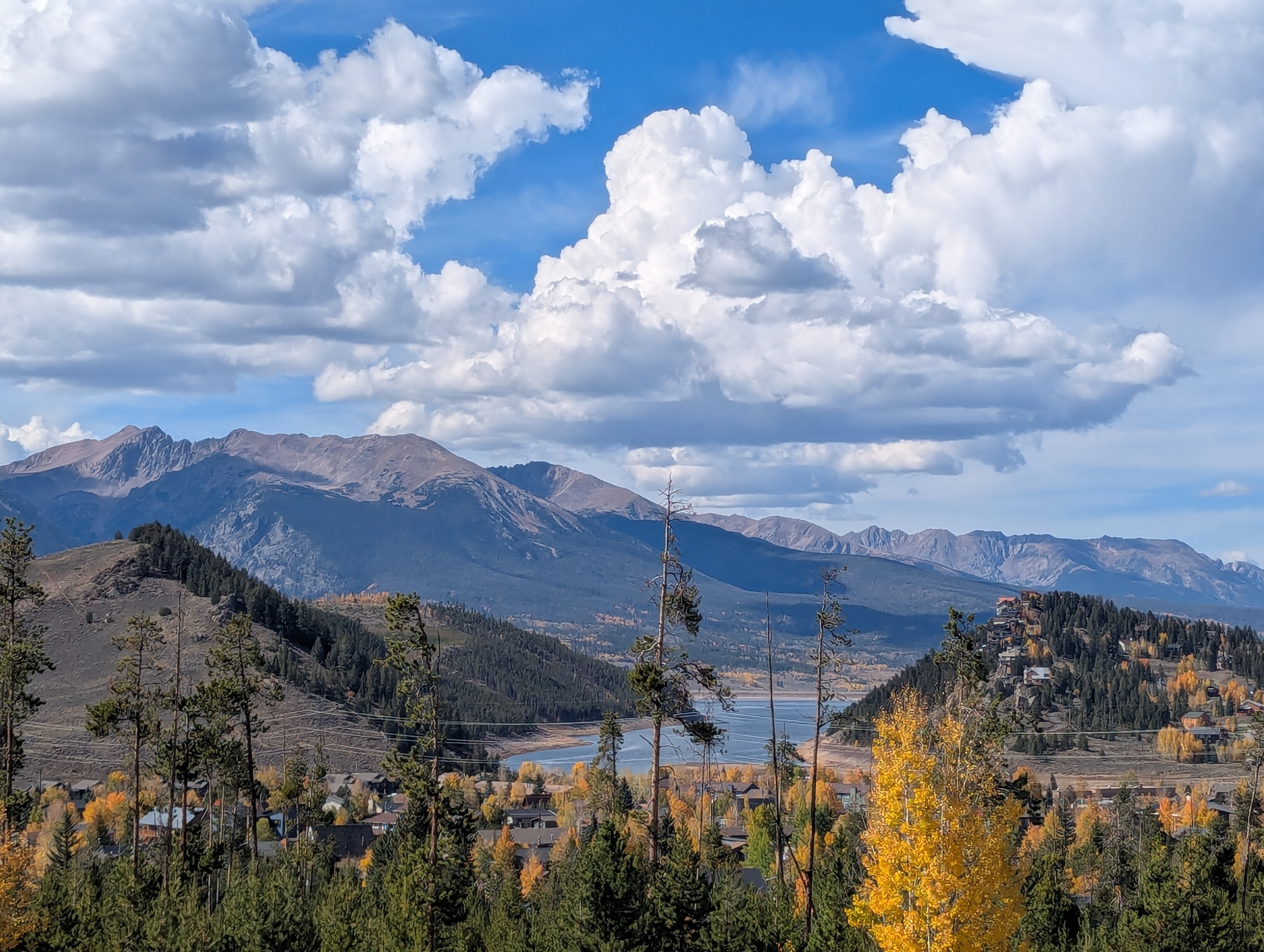
We pushed west into Estes Park and wandered around the craft fair that happened to be going at the time before moving on toward Keystone. We had an apartment on a golf course for the weekend which turned out to be quite nice because the course had shut down for the winter and we were pretty much the only people there. There were some nice hikes around the area which gave a pretty good view of Dillon, the nearest town.
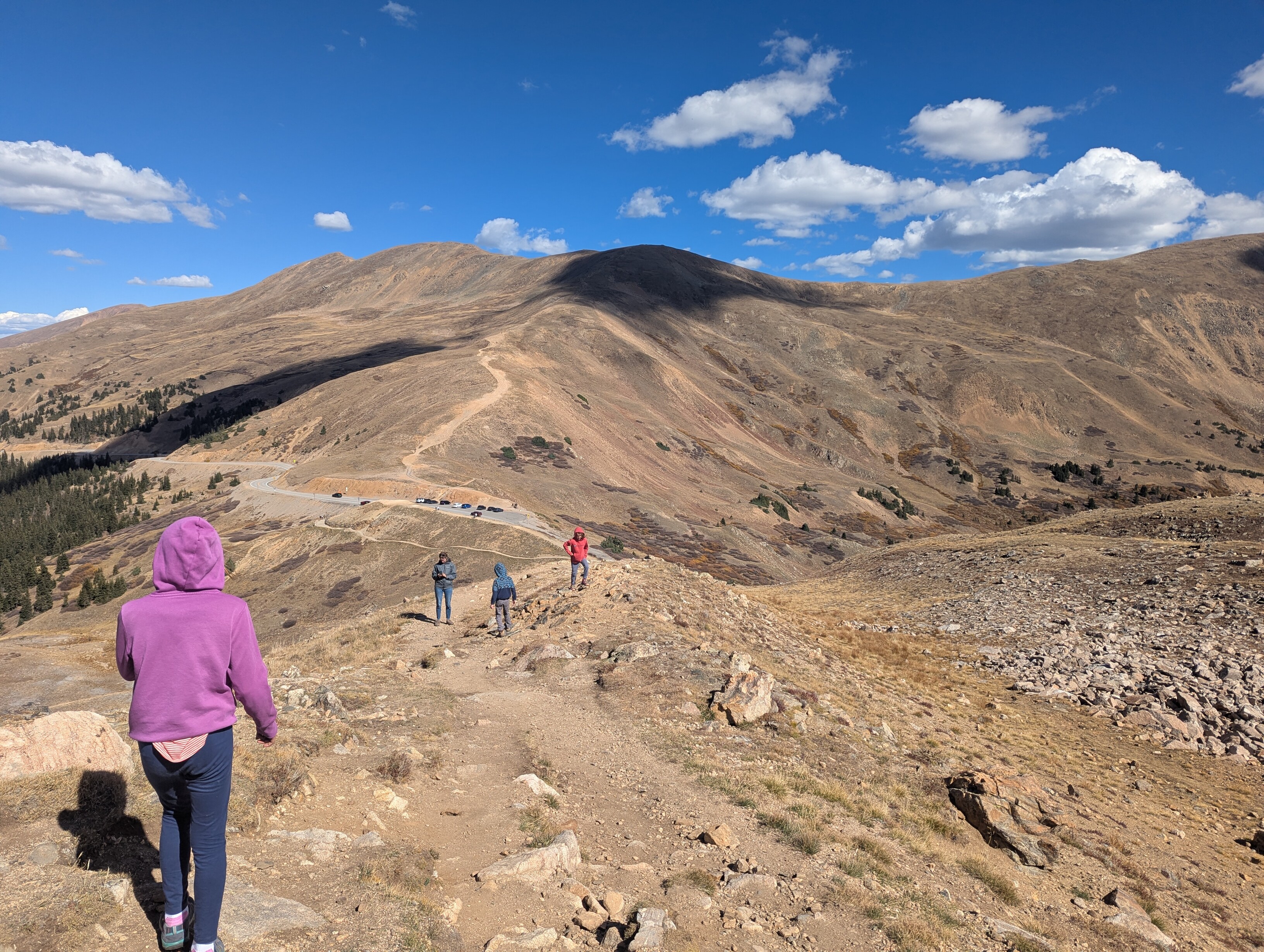
The kids took some time to get used to the altitude (Michigan's 750 ft above sea level is very different than Keystone's 9,500 ft) so we took it easy for a couple days, sticking to drives to scenic overlooks. When they were feeling better, we drove up the Loveland Pass to give them an idea of how tall some of the mountains really are. The parking lot for the pass is at 11,990 feet and a couple of the kids were brave enough to hike up a short path with me to about 12,200 ft. It really sunk in just how high we were when we spotted a helicopter flying below us.
Utah
When our time in Colorado had finished, we headed out of Keystone through the mountains toward Utah. My only western United States experience had been a short trip to California 15 years ago, so I didn't know what to expect. I was blown away at how fast and how dramatically the landscape changed. The sizes of the rock formations in Utah were just staggering. The change from driving up over mountains to down into vallies really threw me off, but I think I enjoyed the scenery more because it just kept surprising me.
We stayed in Orderville, UT, just outside of Zion National Park with the intent of driving into Zion the next day. It turned out that the eastern road into Zion had suffered a rock slide, so the road was closed. Instead of a 20 minute drive in, we had to go nearly two hours around the south end into Springdale. The drive was long, but the scenery didn't disappoint.
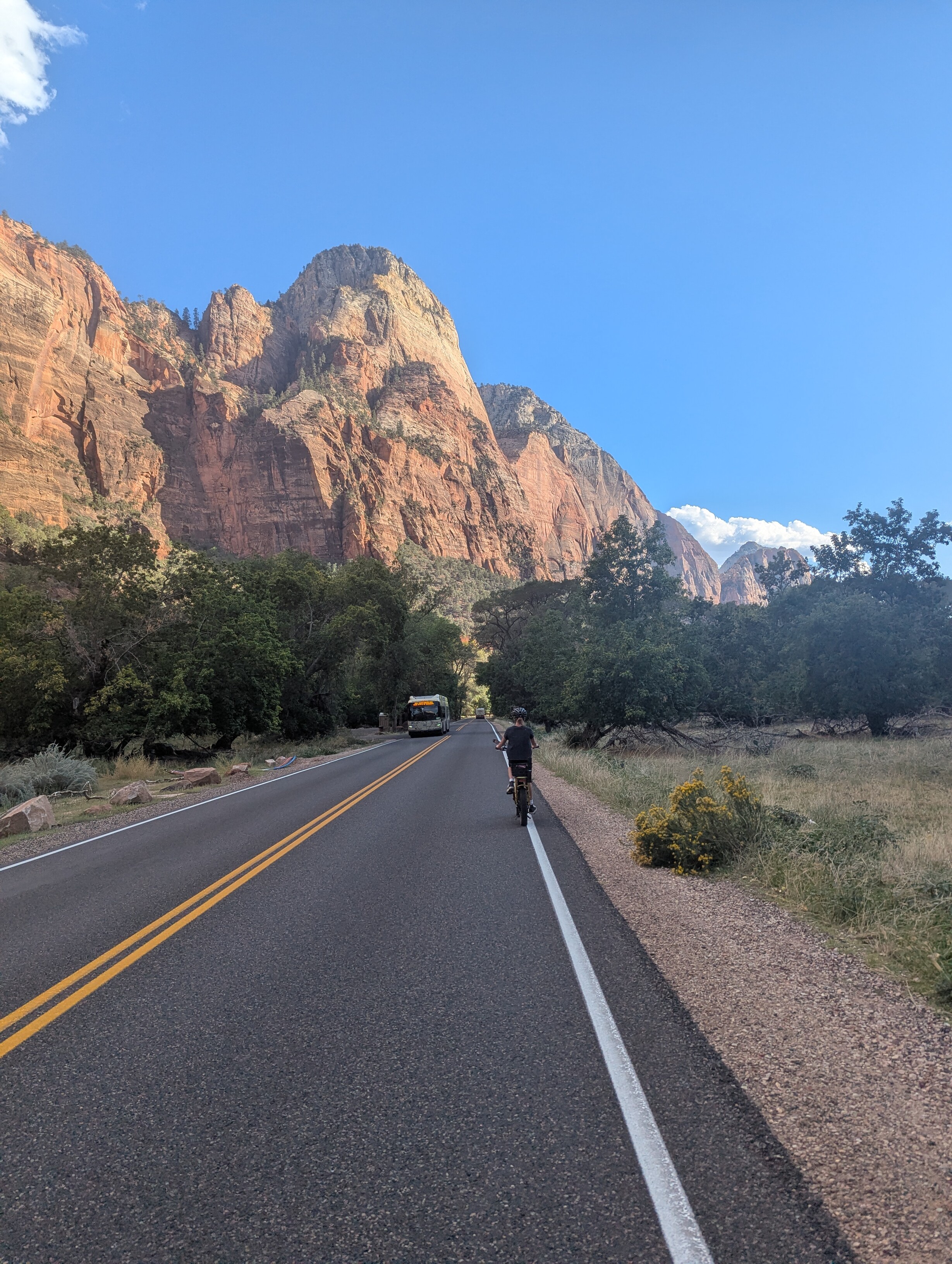
We rented bikes from Utah E-Bike Adventures which was one of the best decisions we'd ever made. We rode about a half mile through town to the park's pedestrian entrance where we bought our pass for the week. Then, we followed a foot path into the park itself and enjoyed the entire day riding up and down the scenic highway, taking in as much as we could.
The altitude was still getting to the kids a little, so hiking was at a minimum, but we did do a short trek to the Lower Emerald Pools (which were more like puddles in the drought) and Weeping Rock. I would love to go back some day and do some of the longer east or west rim trails to see some of the more remote areas of the park.
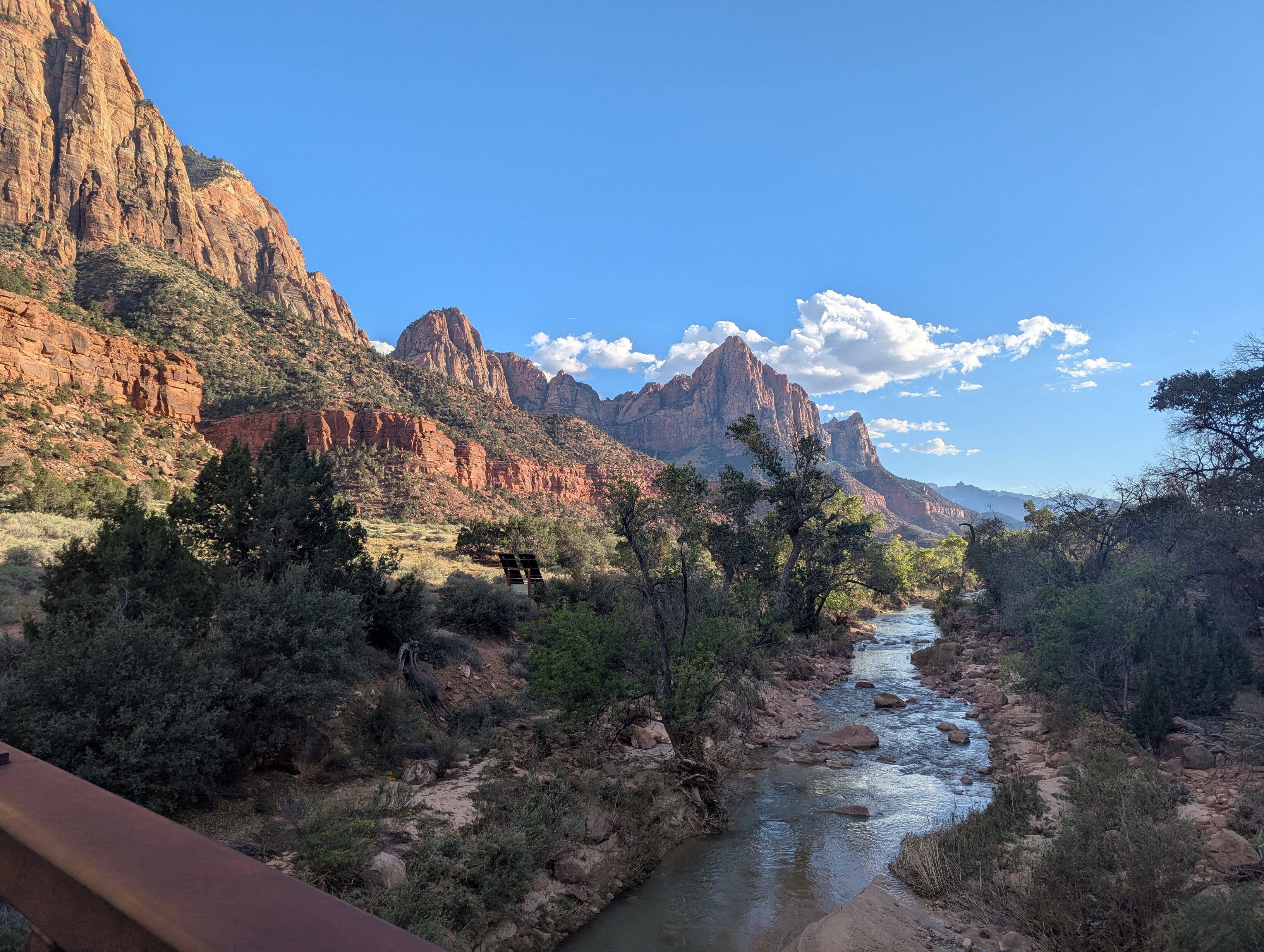
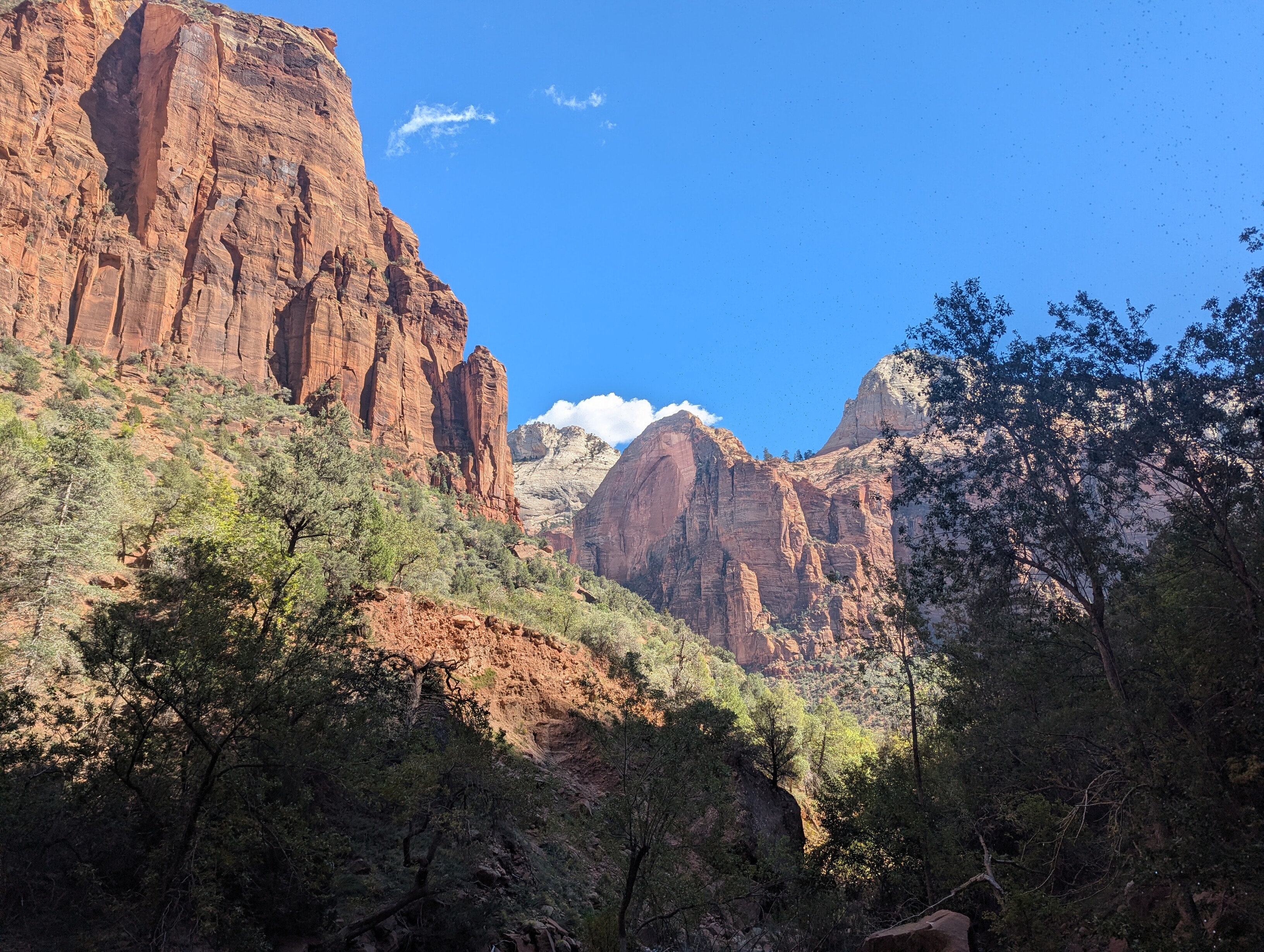
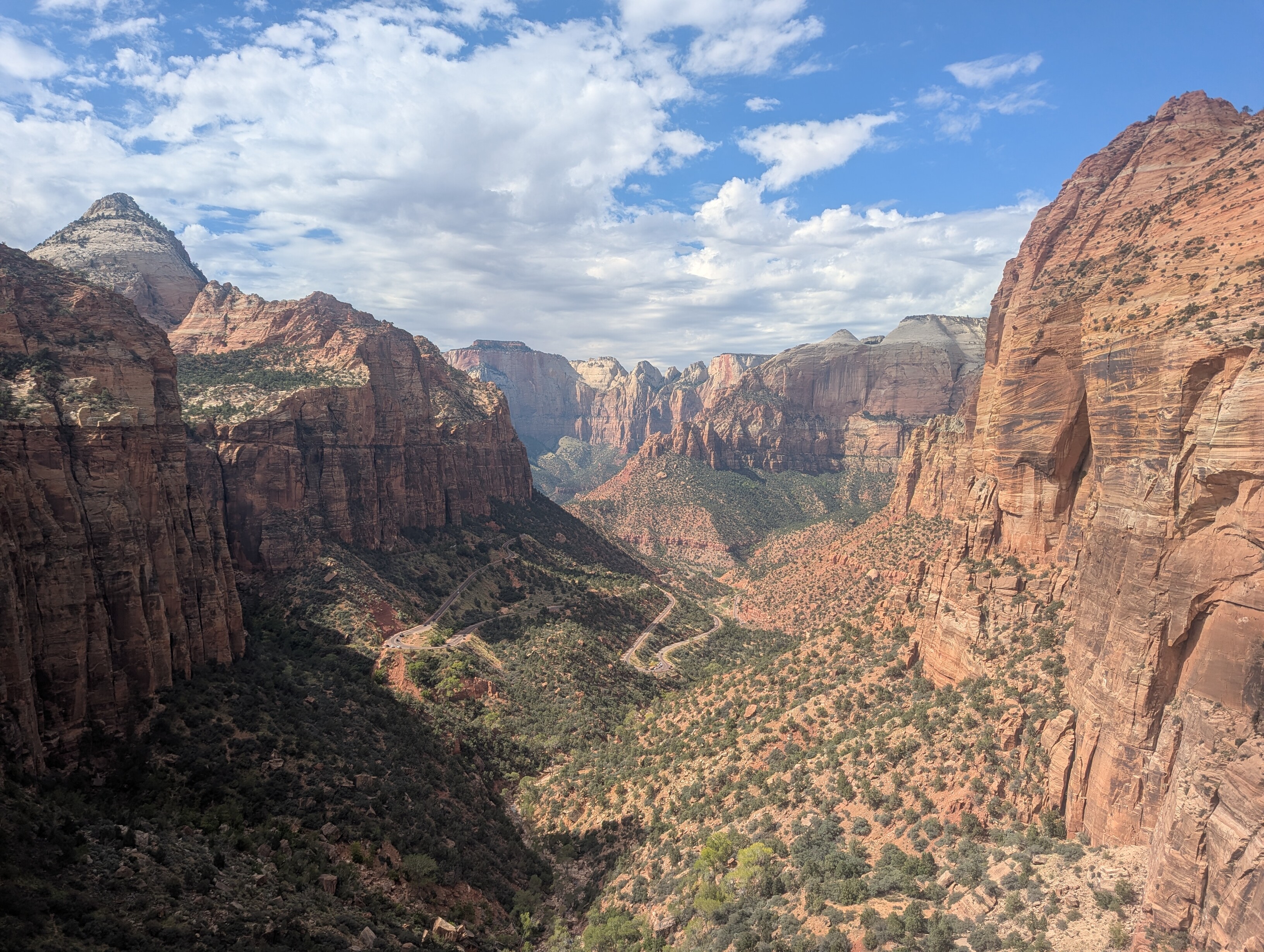
The next day, the east road actually opened back up, so we drove the 20 minutes back to the park and did the Canyon Overlook Trail on the east side and it did not disappoint. The hike was more rugged, but still doable for the kids. Everything about Zion was overwhelming and breathtaking all at once.
Arizona
Finally, we got to the wedding weekend itself. Both my wife's cousin and his wife are Colorado River boat guides in the canyon, so the wedding on the rim felt like the only option. We drove about 50 miles out of Fredonia, AZ, mostly on dirt roads to some public land out in the woods. When we pulled into the clearing, we were greeted by tents, pickup trucks, and dogs. Most people (without kids) were camping in the woods for the party, which was really cool to be a part of. Since they're both working with outfitters, there was a full-blown camp kitchen already set up and churning out food for after the ceremony.
About two hours after arriving, we all piled into more robust vehicles and made the rugged two-mile drive to Crazy Jug Point right on the north rim.
Dear reader, I know in my head that the canyon is large. Grand, even.
The sight of the canyon peeking out through the trees as we hiked to the point was shocking. There were no words for what I was looking at. Everything about the Grand Canyon is overwhelming. Knowing that what I was seeing was a tiny fraction of this place made me stop and just gape. I can't think of anything else I've seen that has made me feel the same way.
All of us - maybe 200 people - piled out on to the point. It was a party. Strangers were laughing and looking, some people just sat and stared. We all felt excited to be there, on the point, waiting for this wedding.
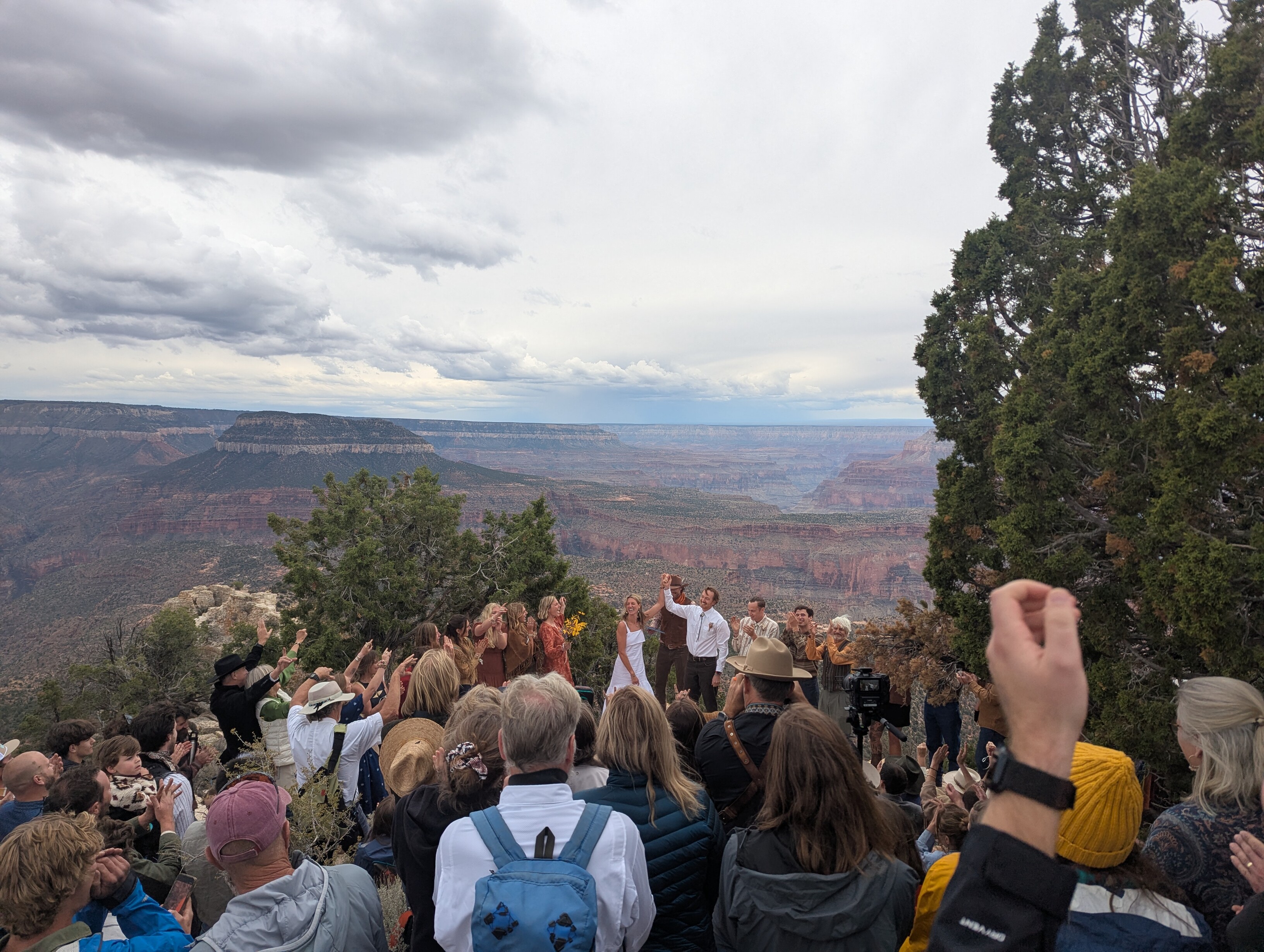
After the ceremony, we all went back into the woods for a huge party. Rain moved in, which only made the party better. Panchos and rain jackets came out of nowhere and pop-up tents flew out of the kitchen trailer, ready to be put up over the tables. Kids were playing flashlight tag and capture the flag as night fell and we all just enjoyed being together in a really special place.
Unfortunately, we had to end our trip there. I had already taken six days off of school (which is unheard of in October in most cases) and we had a 1,700 mile journey ahead of us. We said some tearful goodbyes, piled wet kids into the van, and started our trip home that night.
I can't imagine having done this trip any other way, but we're all looking forward to the next time we get to go explore the southwest again.
I'm several days behind schedule, but I did read a book or two in September.
A Walk in the Park: The True Story of a Spectacular Misadventure in the Grand Canyon - Kevin Fedarko
This is an epic of a travel diary written by a National Geographic reporter. Walking the length of the Grand Canyon - a rare accomplishment measured in just a few dozen people - seemed like something he and his colleague Pete could do given that they've been to the extremes of the world already, but it whipped them, hard.
The book walks through the canyon's geology, history, culture, and current state through the eyes of a true reporter. Wading through each chapter brought new insight, new people, and new stories which paralleled their walk. It's worth tracking down his article in the September 2016 edition of National Geographic which includes more photos and more detail on the Convergence resort fight.
Old Man's War - John Scalzi
This was a little bit of Startship Troopers (the book, not the movie) meets Tom Clancy. In the future, the elderly are able to enlist in the Colonial Defense Forces to protect humanity's fledgling colonies against aggressive alien species across the galaxy. The main character is flung from planet to planet, wrestling with the reality of war and his role in the war machine when his understanding is inverted after meeting someone he doesn't expect.
I've struggled to write recently, so I'm writing now just to get things out of my head.
- The garden is done for the year. We have our final flower delivery this weekend, so there are a few rows still producing, but 2026 is wrapped up. We cleaned out one whole half because it's getting rearranged and rebuilt for perennials. That means rows are changing size, weed control has to move, and I need to re-lay drip line with new spacing. We'll plant seedlings this weekend so they can establish and ride out the winter in place.
- This is also our annual chicken weekend. We pulled equipment out of storage earlier this week and we're prepping the work area for a full day Saturday and a good chunk of Sunday. This is our least expensive protein source for the family and it'll help feed us for the next year.
- School is going well. I'm back to three classes, which is a lot to prepare each week. Chemistry is pretty much under my belt, so that's just staying ahead with copies and making sure materials are ready. I'm in a better flow with the web development course, but I didn't teach it last year, so that one takes a little more time, especially the grading. I have a plan to make that smoother, though. I updated the advanced chemistry course (2nd year students) to AP, so now I have the looming deadline of the exam in May. In the past, I taught it as a college course, but we didn't require the exam. I went ahead and registered the course with College Board so students have that option in May, but I'm not sure I'm happy with the decision. I'll evaluate with my principal at the end of the year about whether or not I want to do that again (or if I want to take a year off from it).
- We leave for a wedding in Utah next week. I was able to get a full week off of school to go because there probably won't be a chance to take a big trip like this with the kids in the near future. We decided to drive because flying is insanely expensive with four kids. Send thoughts and prayers for the adults in the car.
I finished five books in August. Something must have happened and the "Oh no! Summer is almost over and I go back to school soon!" part of my brain kicked into overdrive. Buckle up.
The Forbidden Garden: The Botanists of Besieged Leningrad and Their Impossible Choice - Simon Parkin
A deep history of the siege of Leningrad and the botanists who stuck to principles in the face of starvation to preserve a vast collection of seeds which could prevent another famine after the war. The book was bleak and highlighted the horrible decisions each person in the narrative had to make just to survive.
Sea of Tranquility - Emily St John Mandel
I flew through this book. Four stories of people who have a strange experience linking them together. Each character has their own interpretation based on other current events leaving you wondering how they link up. As the book progresses, each story is woven with the others leading up to a satisfying conclusion.
Relegated: One American's Pints-and-Pies Journey from the Top to the Bottom of English Football - Todd Smith
I'm a sucker for travel memoirs and this one did not disappoint. Each chapter features a city and a club ranging from the top of the English Premiere League to the bottom of the non-league teams in tiny towns across the country. It stands out that American sports allow teams to "be bad indefinitely" because there are no consequences for being bad.
The book is full of moments that made me laugh and Todd Smith does a great job of sharing the people and stories of each stop on his trip to life.
Charlie and the Chocolate Factory - Roald Dahl
I'd never read the actual book, but this was a fun one to read out loud to my kids. Wonka is wild and the kids are even more obnoxious in the book, making sure that everyone understands how to behave when you're invited to a magical factory.
It's definitely filled with some dark moments because it's unclear if the kids will be okay, and at the end, they're left with some lasting marks of their choices.
The Master and Margarita - Mikhail Bulgakov, translated by Richard Pevear and Larissa Volokhonsky
This book...what do I even say about this book? I think I was missing a huge chunk of Soviet backstory to really understand it while I was reading it. After I finished, I did a ton of reading about Bulgakov and Soviet-era repression of art and literature. Having that background made many of the scenes make more sense.
The devil and his entourage come to Moscow and start causing havoc in the literary community after the editor of a literary journal argues that Jesus - and by extension, the devil - don't exist. Taking offense, they begin to draw out the hipocrisy and dark behaviors of the literary elite, making them repent of their choices.
The book is dark. There is humor, despair, horror, and surprisingly, some redemption in the end. I'm not sure I enjoyed the book, but I'm glad I read it.
I'm teaching an intro computer science course again this year and I knew I wanted to revamp how to introduce kids to writing code. Last time, the overhead of learning all the new tools at the same time as learning concepts was a really high barrier that I wanted to remove as much as possible.
The last time I taught the class, Glitch was stuff functioning, so that was the plan. That plan changed when they shut down in July 2025. So, I started looking around for something similar for the low price of $0. Turns out, there isn't much.
Mark Sample is a media professor at Davidson College and he posted a screenshot of his own self-hosted Glitch-like app and I was immediately interested. I waited for a while, watching Mark's account for an "it's ready!" post, but then I remembered that I understand code and could probably find it myself. I was in luck and he had his alpha source in a GitHub repo.
I made a fork and immediately started playing with it.
Glitchlet runs as a traditional web app - scripts are all loaded in order in an index.html page and the user interaction is local-first. Projects are saved in the browser's IndexedDB and localStorage. There is a file manager, code editor, and live preview pane in the editor. If the user has an account, they can publish projects which can then be shared and remixed by other people with accounts. The server-side work happens with PHP and MySQL. The PHP scripts take care of the admin-side and publishing work and there's a small database with an index of published projects.
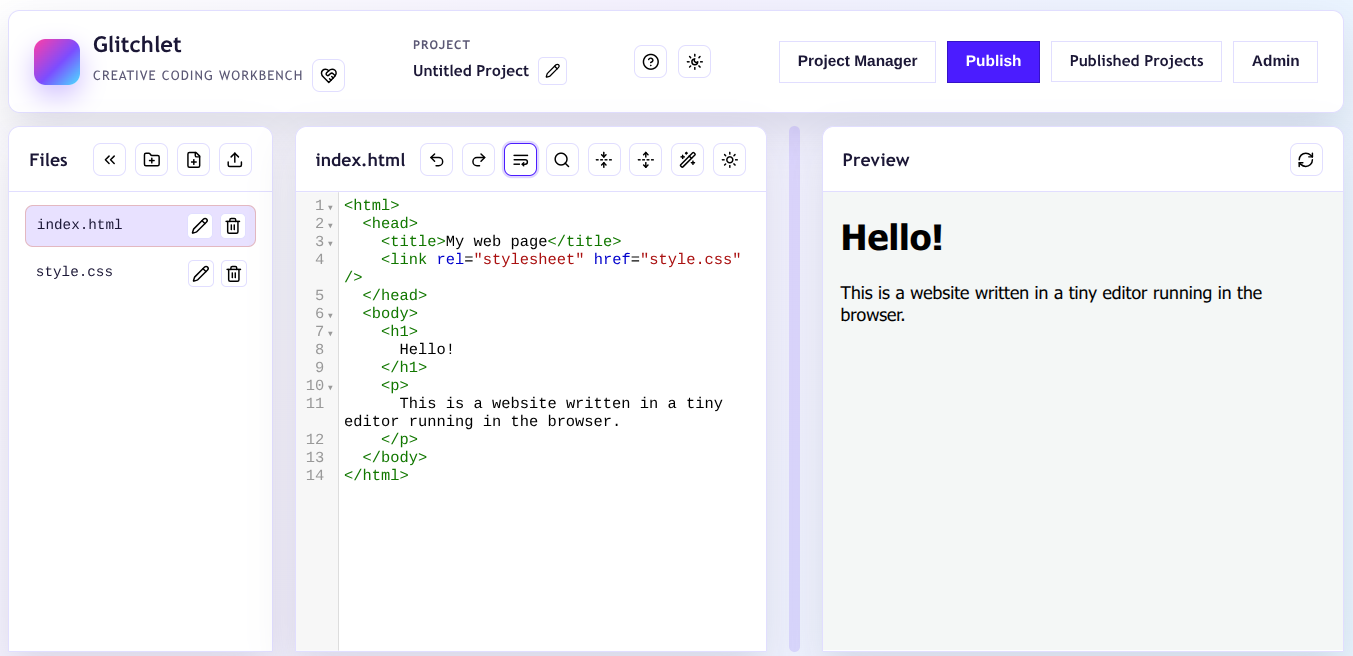
Pretty much the whole deal can be thrown onto a cheap VPS. Sold.
I knew I wanted to make some changes when I got my fork up and running. Some things were superficial, like reducing the whitespace to work a little bit better on a Chromebook. Other things were more significant, which is what led me to maintaing my own fork of the project.
First, all of the PHP scripts were under the /publish directory, which didn't make sense in my head. I started by creating new /admin/ and /public/ directories. admin holds files related to managing settings on the backend. public holds published projects and any project templates.
Speaking of templates, Glitchlet allows admins to pre-populate the editor with template files, but you have to upload a .zip file and it only loads if there isn't an active project in the editor. I wanted a way to better create and share template files with classes, so I updated the database model to include an is_template flag. This flag is only available for admins.
With the templates update, there is a templates.php page for signed-in users. Now, instead of having to distribute .zip files like I had to in the past, I can link to a specific project for students to open, save, and start to remix before publishing their own copy.
There are some other changes I still have on my list, the first being to turn this into a full-fledged PWA. I'm hosting this at school but it is not publicly available on the Internet. So, they can start a project in class, but they can't keep plinking away on it once they're off campus. Wrapping this into a PWA will allow them to continue to work in the editor and then publish once they're back in class.
The other change I'd like to work on is a smoother remix flow. Currently, to remix a project, logged in users have to download a .zip file of the assets and then re-upload those assets into their project editor. I would prefer that it loads directly into the editor taking out the download/upload step.
I've got a few more weeks to get things really fine tuned before students hop in. If you're inclined, I'd be happy to have any help you want to offer to make this a success.
This summer, I got to do a one-night camping trip to Van Buren State Park outside of South Haven, MI. I was also riding my bike.
It's nearly 50 miles one way, which is no big deal if I'm just riding by myself. But, I had never strapped a bunch of stuff to the back of the bike and hauled it with me. All of my own camping stuff is geared for kids, so we have a lot of stuff, none of it very lightweight. Fortunately, our family is full of campers and I was able to get a small(er) tent, a thin sleeping bag, and a very lightweight sleeping pad. I planned on eating dinner out on Wednesday, so I borrowed my brother-in-law's MSR Whisperlite stove and kettle to make hot water for oatmeal and coffee the next morning. I had never used one of those before and it is sweet.
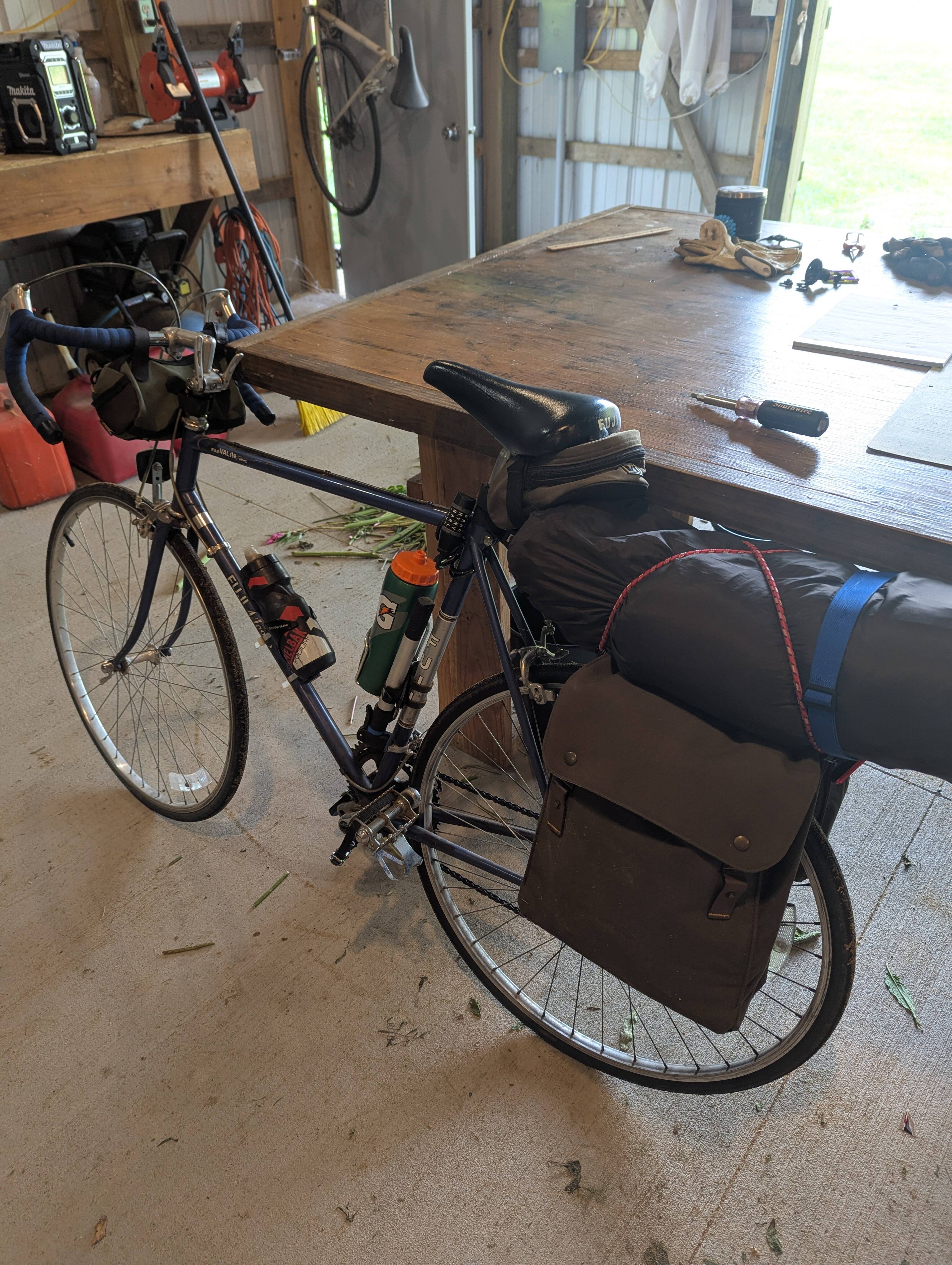
My route had me heading north, through the small town of Baroda and then through St. Joseph, MI before continuing north toward South Haven. The ride was cool but humid, so I took a break at St. Joe for a little while and watched some kids learning how to sal get towed back into the harbor, which was super cute.
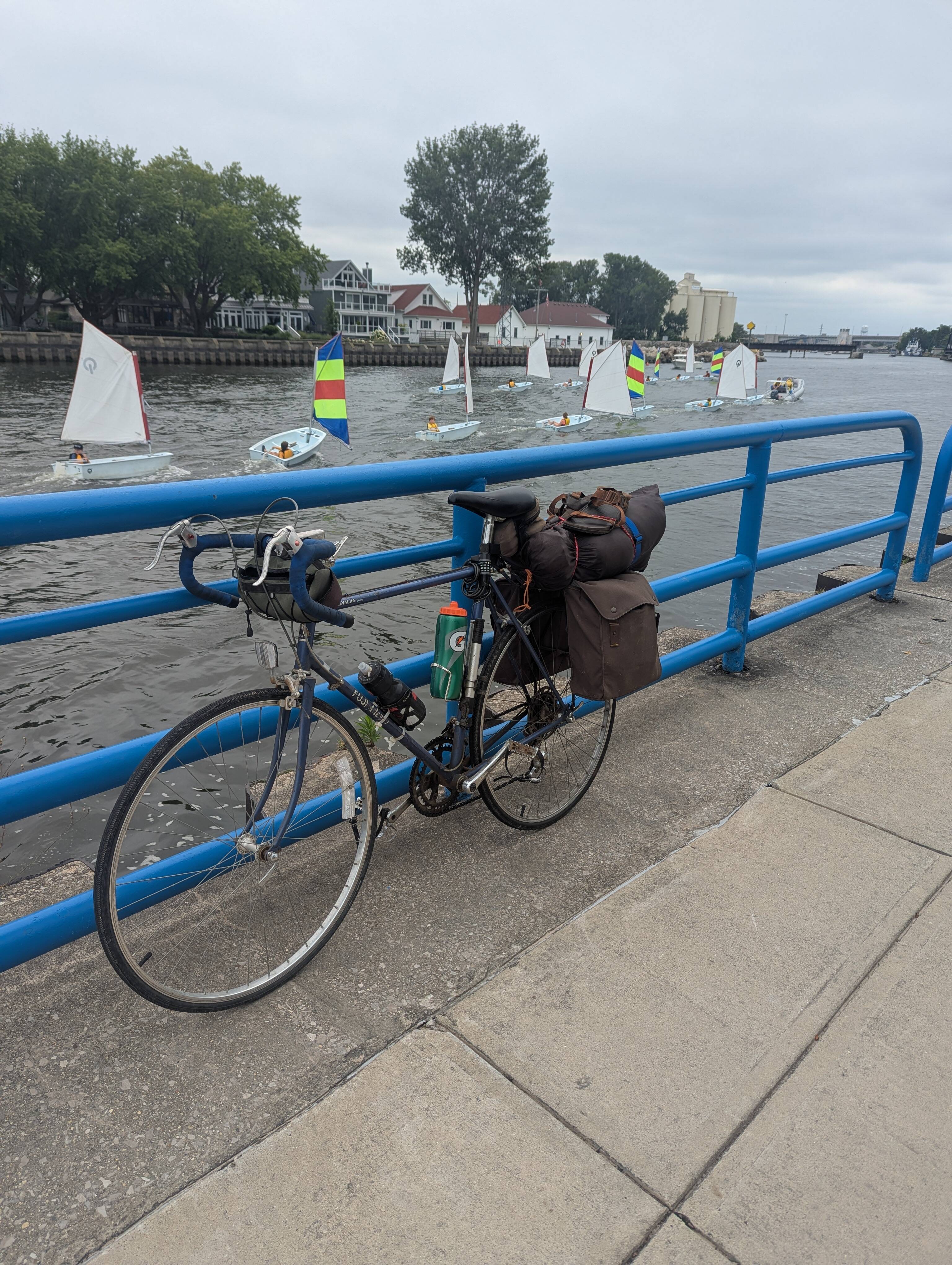
I messed up my directions and ended up crossing the drawbridge with traffic instead of using the pedestrian crossing (oops). It was hairy, but I'm glad I realized my mistake becuase I would not have ridden back the same way. There was a nice trail outside of St. Joe through Benton Harbor, but then I was on M63 proper before turning north on to the Blue Star Highway for the second leg. I was feeling good when I rolled into camp early afternoon.
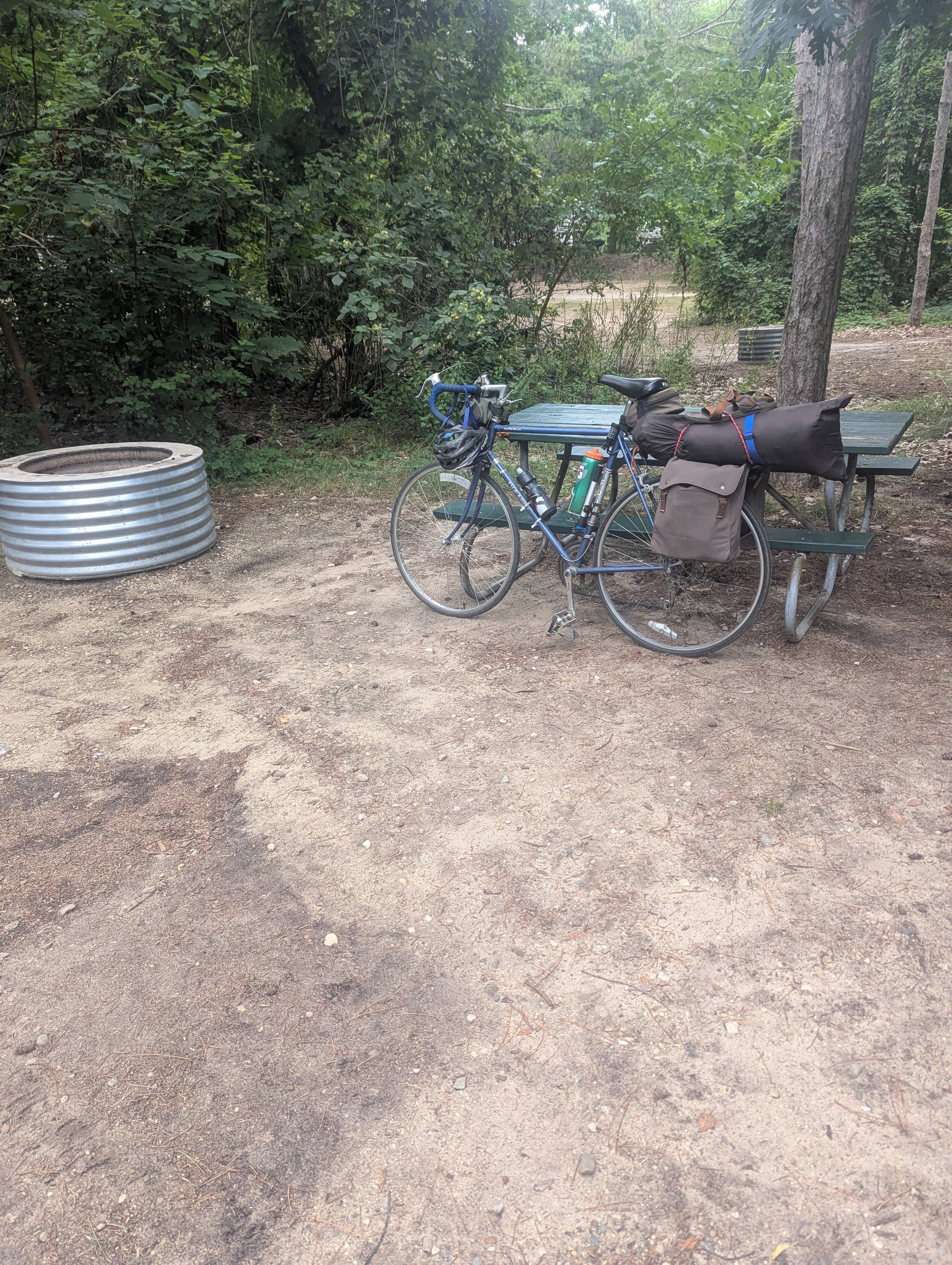
I chose Van Buren partly because it's "comfort camping." Trailers and RVs aplenty with electricity at every site. I didn't have to worry about how to charge my phone for the trip, which took some of the stress away. My neighbors were a cute couple with a beautiful Bernese mountain dog who was happy to just chill. I set up camp while chatting with them about where I rode from and how far it was before taking a much-needed shower.
I had brought a book mentioned by someone on Mastodon, Relegated: One American's Pints-and-Pies Journey from the Top to the Bottom of English Football. I'm a sucker for travel memoirs and this one did not disappoint. I actually ended up finishing the book in one day I was so hooked in.
About 4:00, I was starving, so I rode another six miles into South Haven proper to explore and figure out dinner. That's when I realized I had left my wallet at home. Fortunately, I was able to get Google Wallet set up on my phone, so crisis averted.
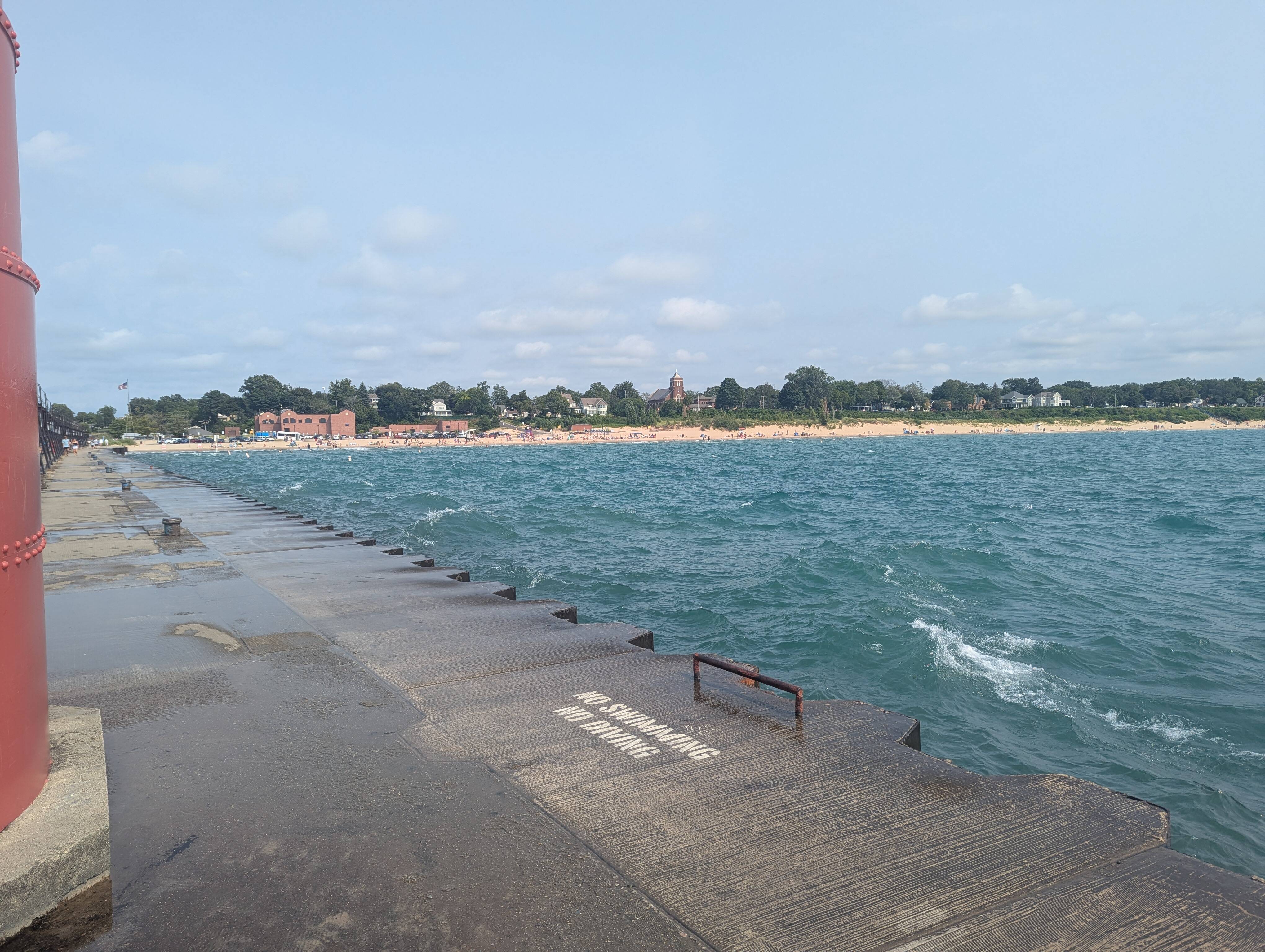
I tooled around the beach and pier for a little bit before succumbing to my hunger. I found a small place, Dash Kitchen, a little out of the way, but they took Google Wallet as payment. I had a fantastic Philly Burger and some even more fantastic fries that had parmesan and pepper as a dressing. I topped it all off with a vanilla milkshake because I knew I would ride it off the next morning.
I rolled my way back to camp and continued reading. My neighbors must have thought I was skipping dinner because they came over and offered me some pizza they had brough back from town, but I was so full I just thanked them for their offer and kept reading. I eventually made my way to the beach to watch the sunset before going back to camp and turning in around 10:00.
I woke up Thursday morning feeling pretty good, but worried about the potential for rain on the way home. I broke camp early and started the ride back south. Hills...the hills on that return trip really pushed me. I kept the bike in low-ish gears and just tried to be consistent with pedaling. I really enjoyed those downhill sections, though.
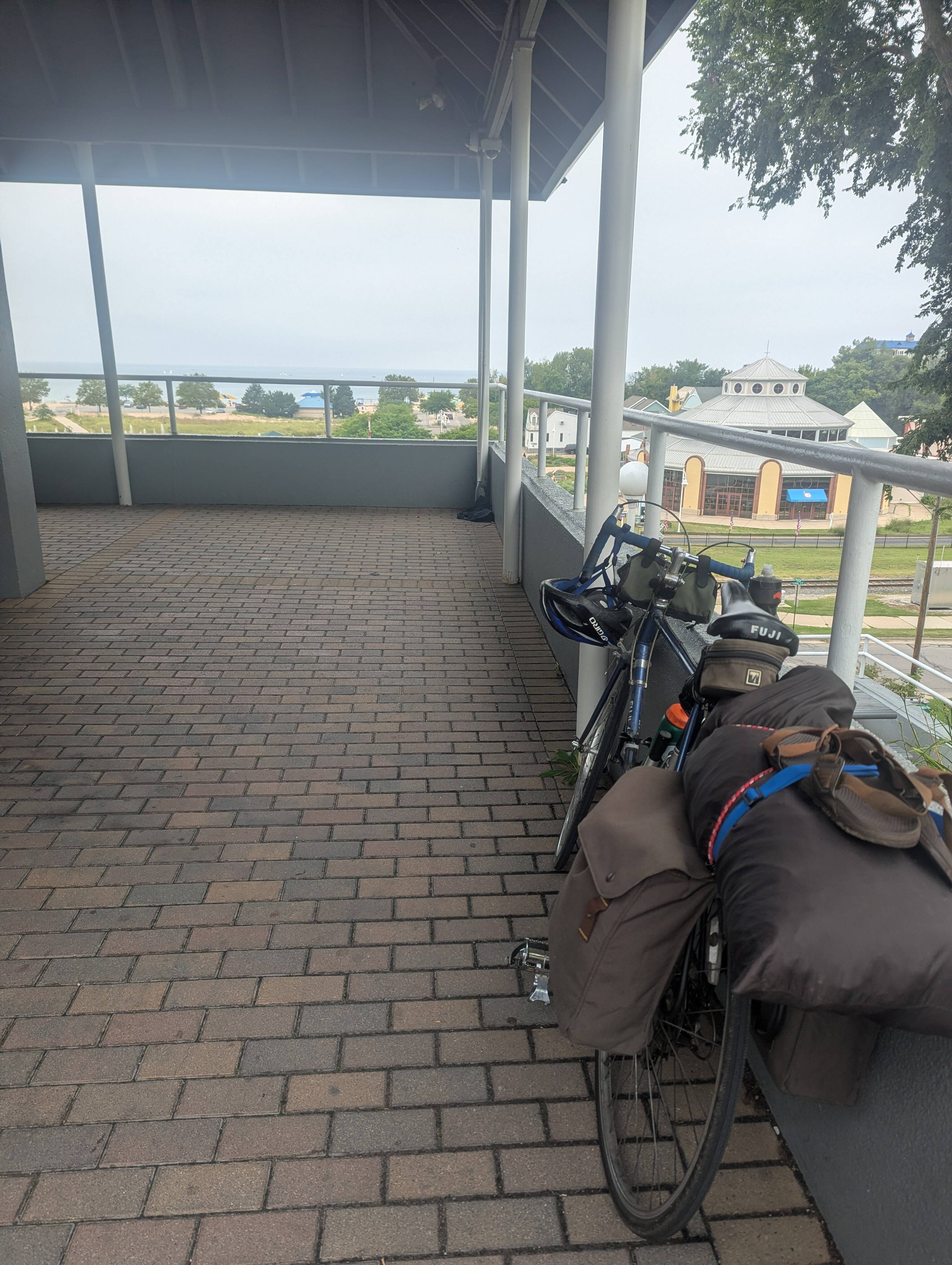
One more stop in St. Joseph for lunch and some rest before slogging back home. The last eight miles or so helped me develop a small sore in an unmentionable area, so I applied the cream liberally to make sure it didn't get worse before I got back.
In all, I logged 97 recorded miles between the way there and the way back. I didn't record my run into South Haven (but it happened - look at the pictures) making these last two days easily my densest riding time so far. I enjoyed the time on the ride and I feel like I accomplished something I wouldn't have even considered just a year ago. I'm looking forward to the next trip, maybe with my wife and kids so they can drive and carry some of the stuff.
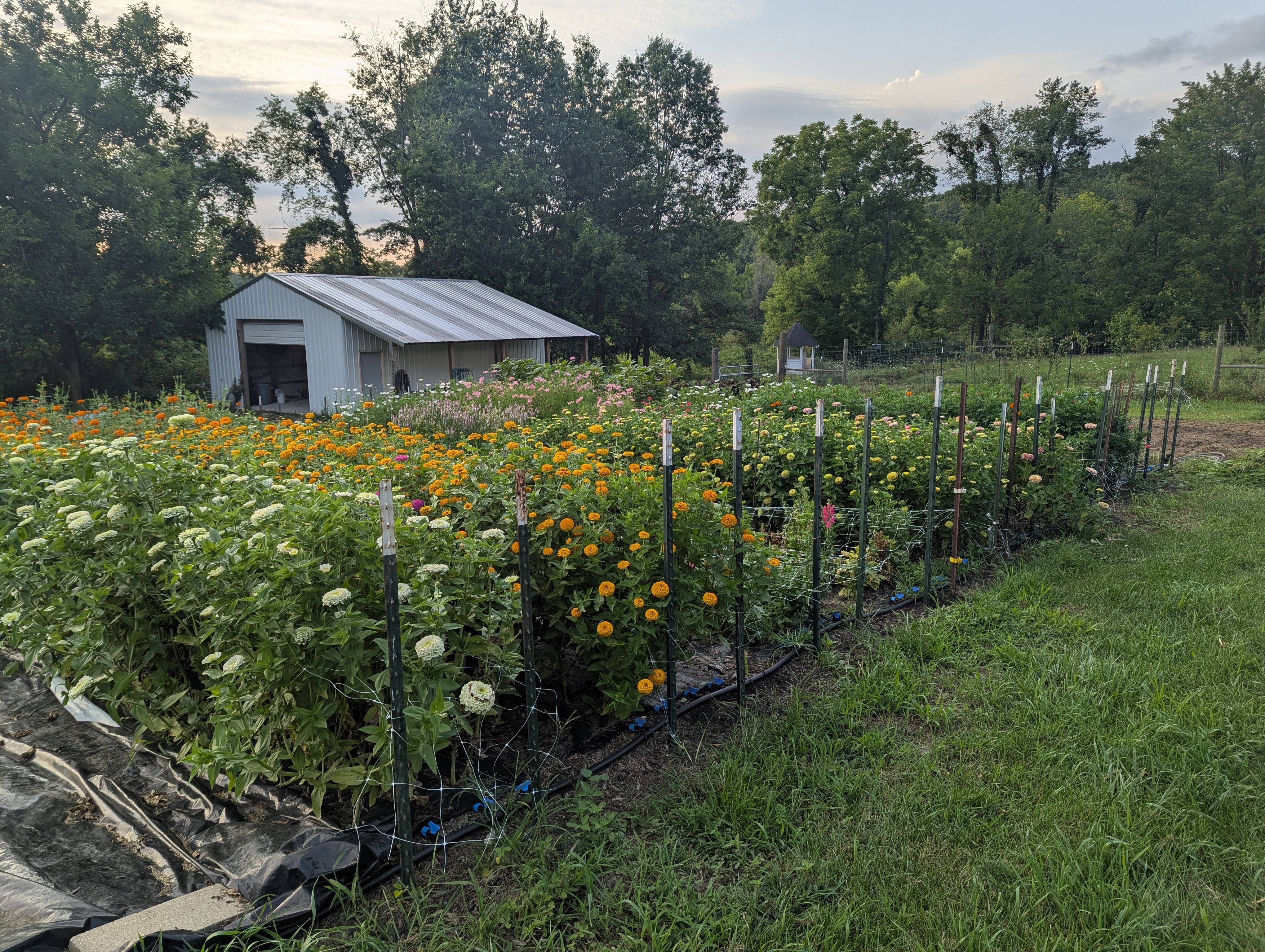
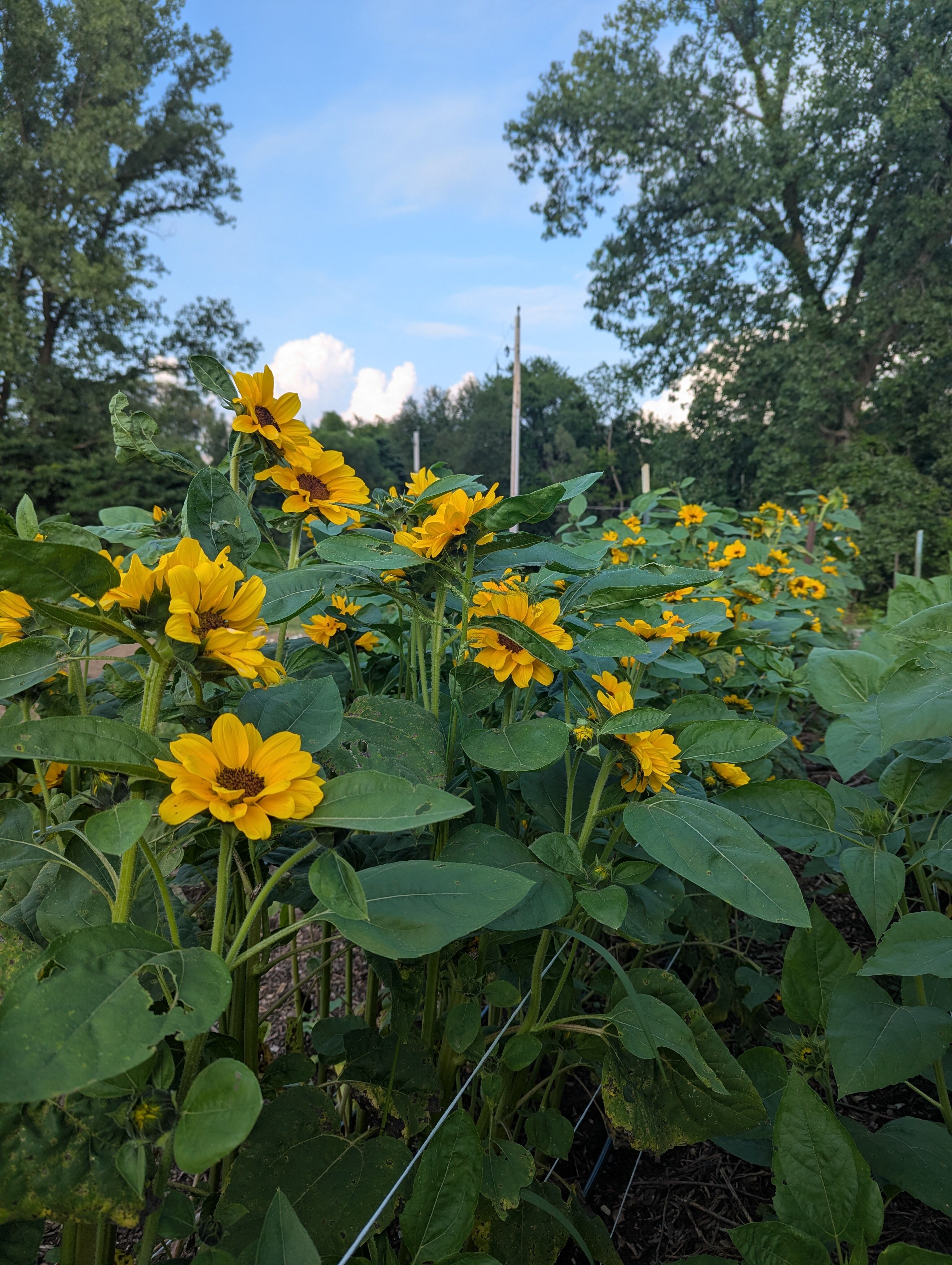
The garden is producing in overdrive right now. Our selling season isn't half over yet and the flowers are just bursting.
My kids have been obsessed with this little thrift store find. Monza is simple on the level of Candyland and surprisingly replayable.
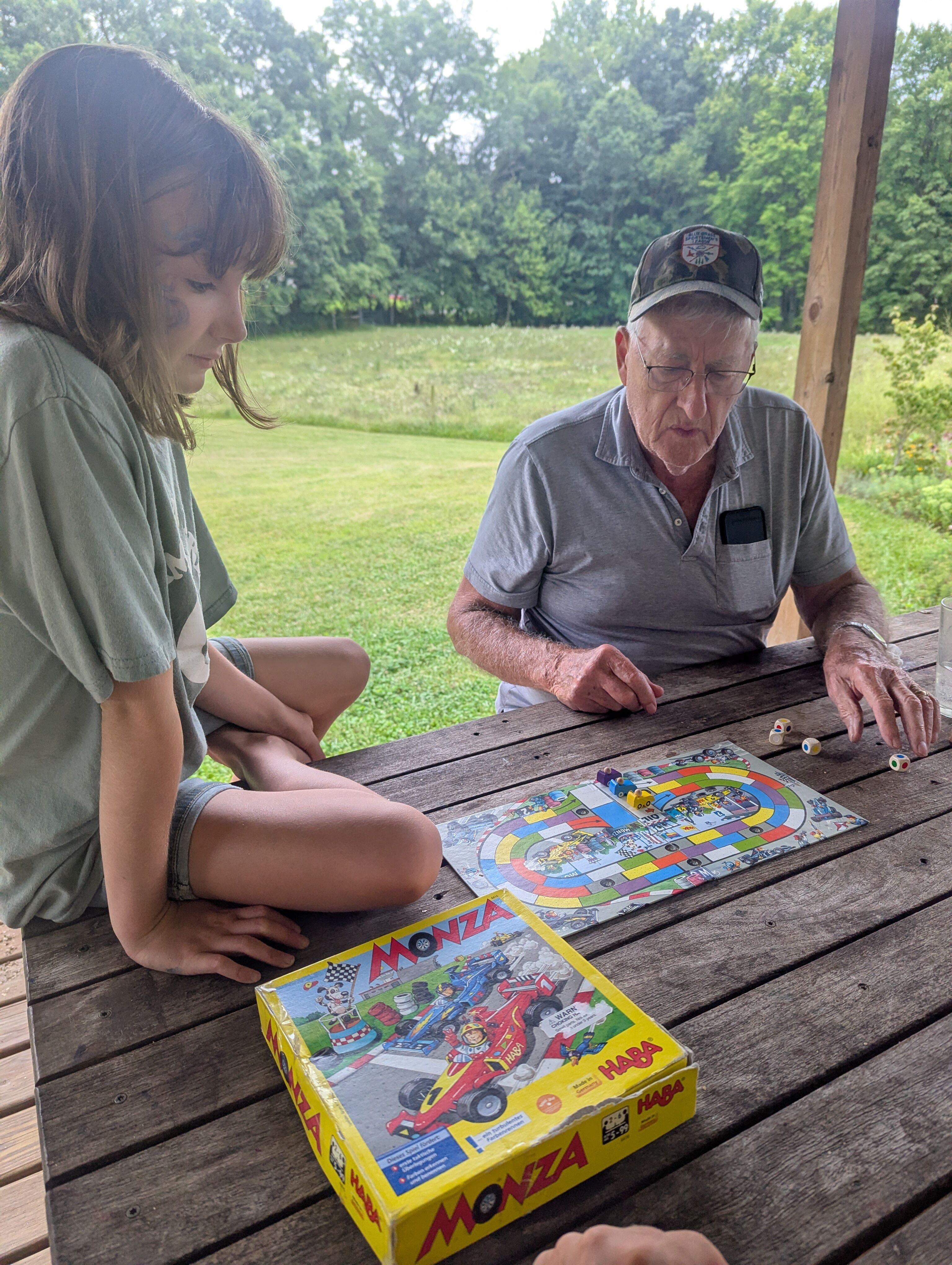
You each choose a car and then roll size dice with different colored dots. There are three lanes you can choose from, each broken into colored blocks. You can use the dice in any order, moving your car forward from block to block. There's a little bit of strategy mixed with luck and it actually leads to some exciting finishes.
Each game is quick enough that playing several in a row makes it more fun. We've also started doing multi-lap races to spice it up. My seven year old is the regining champion.
Books books books. Only two finished in July becuase the third I started is super heavy and just slow to get through.
A Darkling Sea - James Cambias
A space and ocean adventure all wrapped up into one. It's got Star Trek Prime Directive vibes paired up with language learning magic from Arrival as three civilizations try to work out who does what. The start of the book was a little slow, but I was able to suspend disbelief not too far in and enjoy the rest of the book. The tension built steadily up to the climax with an ending that left me with questions rather than answers (and I'm not sure if it was in the good way).
The Faith of Beasts - James SA Corey
Humans are continuing to struggle against the Carryx, the overwhelmingly powerful alien collective which took them from their homes on Anjin to serve the empire. The narrative follows several distinct groups who spread out from the Carryx world to "prove their value to the empire" in different situations. At the same time, the humans remaining on the Carryx world have to figure out how to not just survive, but grow as a beneficial species.
The hardest part was remembering what happened in the first book because it's been so long since I read it. Once I got back into the flow, it read easily and kept me reading late past my bedtime.
Yesterday, I spent the day participating in the Amishland and Lakes ride in LaGrange, IN. My father in law was invited to ride by a friend at church and he, in turn, invited me. It's a sanctioned ride put on by the Michiana Bicycle Association and was way bigger than I expected. It's not a race - the whole point of the ride is to show up with friends and do as much or as little as you want.
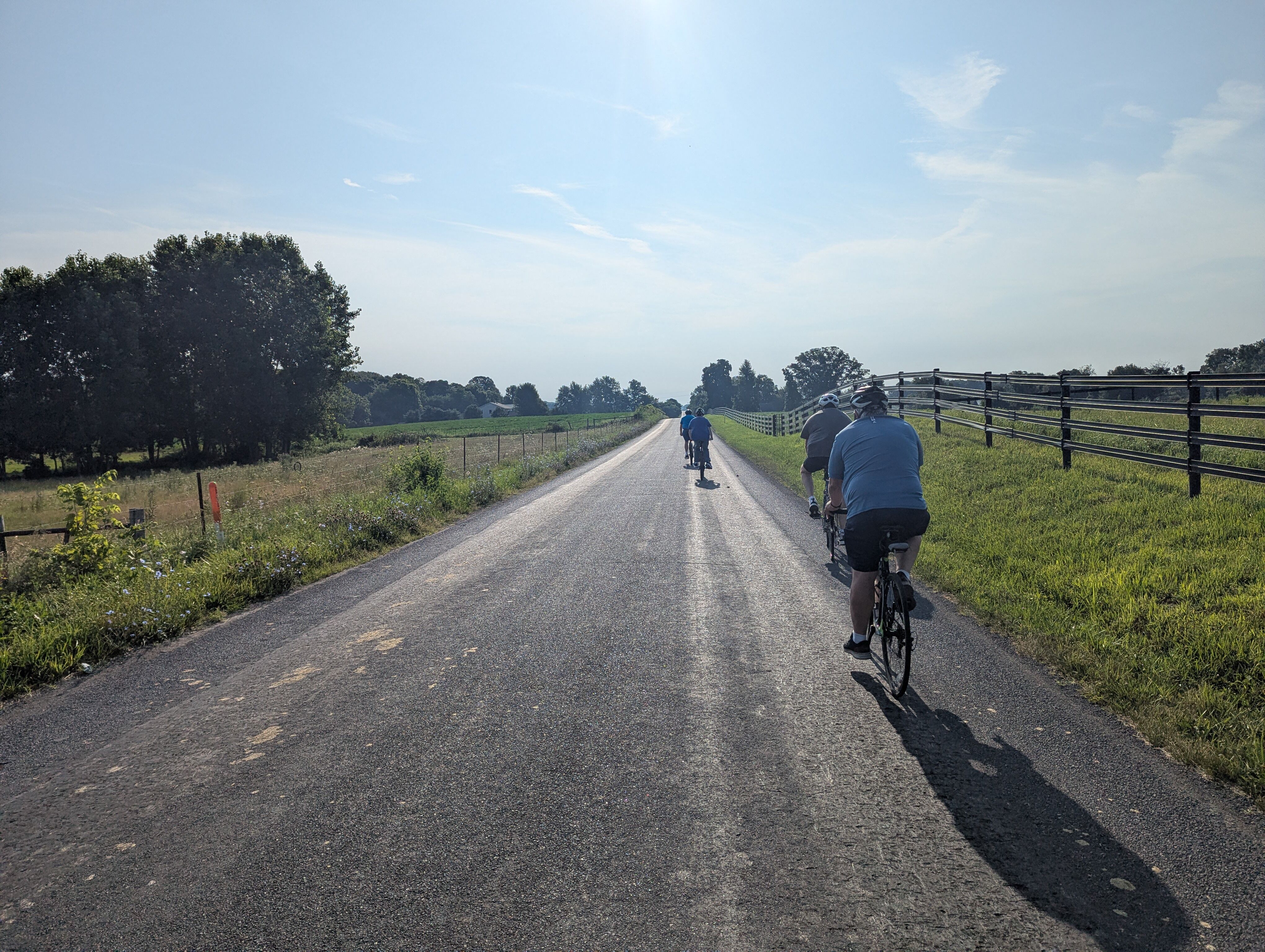
There were five routes ranging from about 20 miles to a full 100. The routes were well marked on the road and took us from central LaGrange through some really beautiful rolling Amish country. About 8 miles into the ride, I realized there were no more electrical poles on the road. We were pedaling through farms that have been in place for multiple generations and enjoying the quietness of the day. Families had set up tables with everything from lemonade and cookies to root beer floats and soft pretzels to sell. Some of the houses were as busy as the official sag stops.
Speaking of stops, they were incredibly well stocked and well staffed. We had a wide selection of snacks from salty to sugary with plenty of very cold water and Gatorade to top off water bottles. There was a lot of laughing, discussing different cycling jerseys, and bike oogling. Each stop felt like a small neighborhood party.
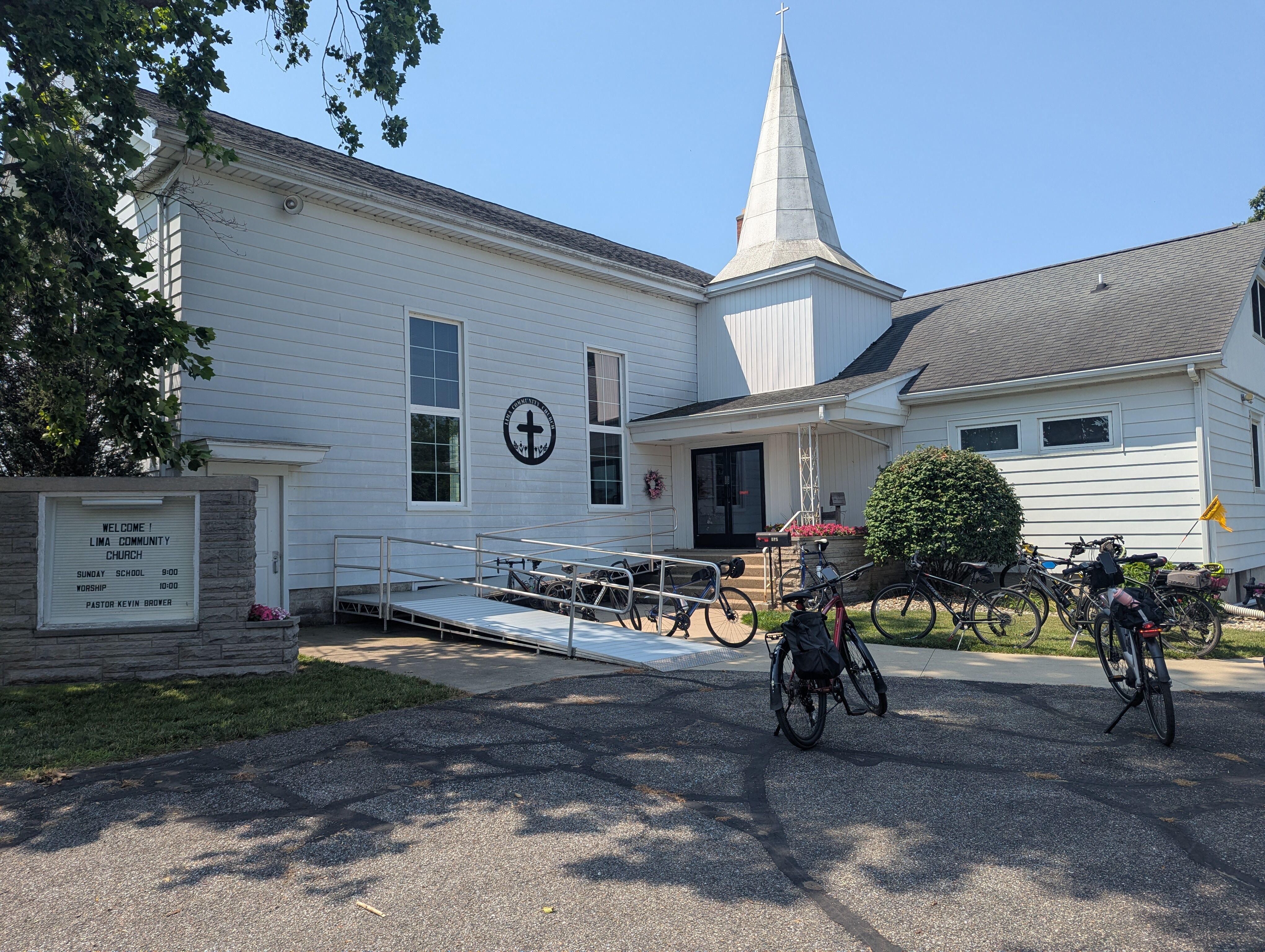
We did 50 miles total and I actually left feeling like I could have gone longer. It was a really nice time with some friends and I'm looking forward to doing it again next year.
I was looking over my ride history for this year and I noticed that today I passed my 2024 riding total. Two years ago when I started riding more regularly, I finished the year with 448 miles over 34 hours of riding. I didn't ride much in 2025 (not really sure why...), so I'm skipping that. This year, I just logged my 449th mile over abour 31 hours of riding. This week also put me over 1,000 career miles, which feels kind of like a big deal even though I know people who log thousands of miles annually with no problem.
Anyways, kind of fun to notice today. I've got some long rides planned for this summer still to come, so that number will continue to bump along.
I've been using Strava for a couple of years and it's always felt a little bit...not right. I couldn't ever really place my finger on what it was until I tried Ride with GPS. It's the same kind of thing - ride tracking and planning - but it felt better.
First, it wasn't trying to upsell me with every scroll. Second, it gives a lot more functionality in the free tier (route planning, in particular). Third - and this was the game changer - nothing was in my face about how fast I was compared to other people (or myself). And that's why I'm going to switch.
The routes are front-and-center. It's easy to throw in a starting point and filter by ride type, length, and other factors - all for free. Routes have reviews, which is nice for vetting different rides as I improve and can go on longer pedals. I'm also able to plan my own routes on the desktop without having to subscribe. Everything felt focused on enjoying the ride rather than performing better. I want to improve and ride longer faster, but it's not my main focus. I'm not training for anything in particular.
I ended up subscribing at the Basic tier because it unlocks turn-by-turn navigation on my phone as well as live ride sharing so my wife can keep half an eye on me especially when I'm alone. I'm really happy to have come across Ride with GPS and I already feel much more relaxed about riding than I ever did using Strava.
If you want to connect, here's my profile.
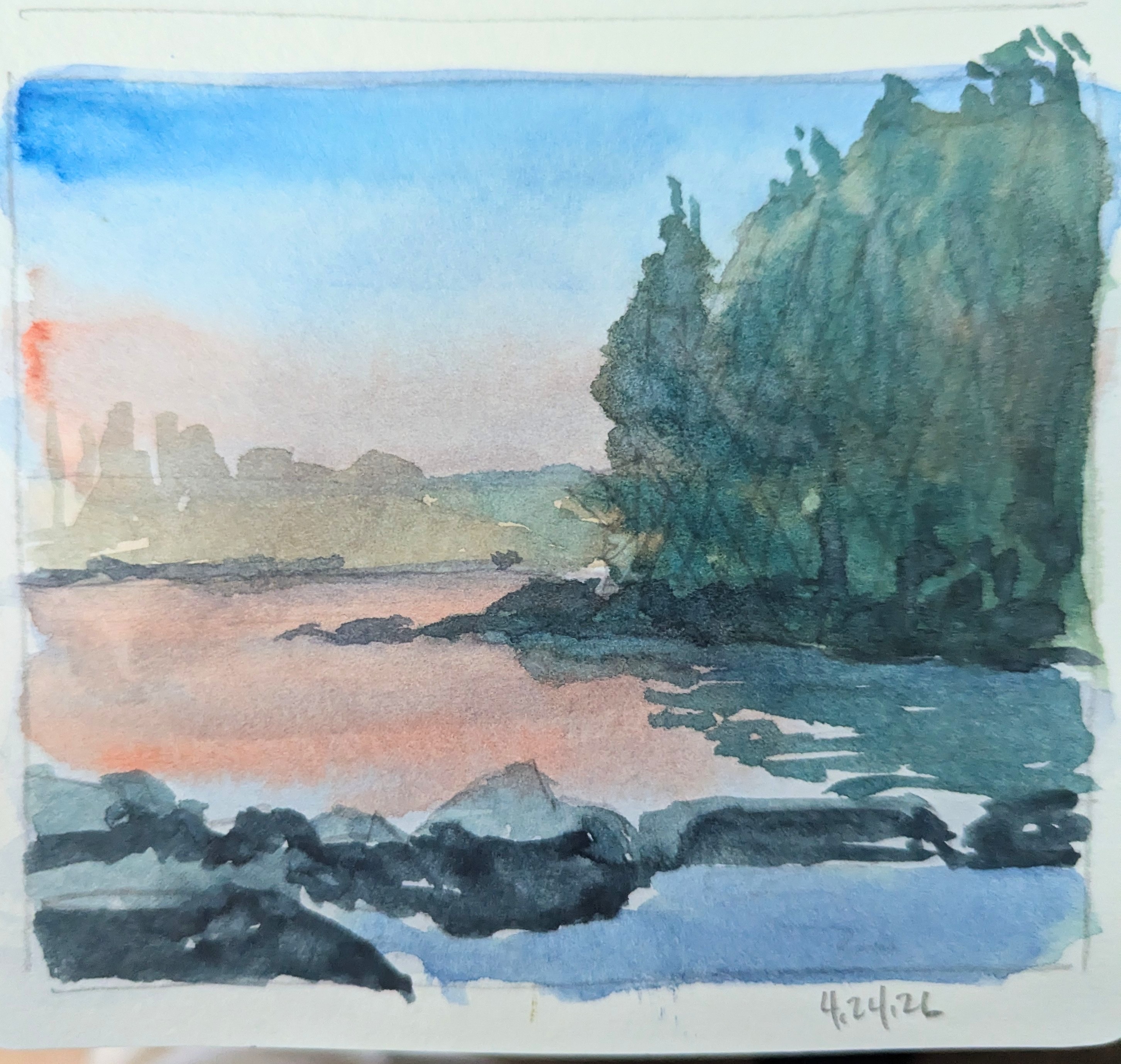
I was thinking about my trip last year to the Boundary Waters and I remembered that I had done a small sketch of Fourtown Lake from our final campsite. It's a small thumbnail, but I think it's become one of my favorite in my sketchbook.
I finished two books in June during my first month off of school for the summer break. Much better than the zero books I finished in May.
Raising Hare: A Memoir - Chloe Dalton
Very similar in tone to James Herriot or James Rebanks, I really enjoyed this slow reflection of rescuing and raising a hare without trying to domesticate the animal. The care given to adapt to the hare's natural requirements gave a lot of points for reflection on how we interact with our own environments.
The Man in the High Castle - Philip K. Dick
I started watching the Amazon Prime TV series before realizing it was based on a book. So, I stopped watching and grabbed the book from the library. It took me two sessions to read because it's just really confusing. There are four main storylines who kind of intersect with one another, but only marginally. The climax felt a little anticlimactic but it might be just because I wasn't really sure why certain things were happening. To be honest, I had to read the Wikipedia page after finishing to make sure I got the whole main plot down.
I've gotten back into riding a lot this year and I'm tracking rides with Strava. I don't like the upselling the app does, but I can overlook it because it also gives me a live link of my route I can send to my wife while I'm out. It's a little extra layer of safety given that I'm riding on backroads most of the time.
One thing that really bugs me about Strava is that my data is locked behind the subscription. I can't filter by time very well, I can't see maps, and I can't really look at historical riding without paying. Luckily, I found a reddit post asking about this same problem which led me to Statshunters.com. It connects to your Strava account and then lets you do all the filtering, mapping, and exploring that you cannot do in Strava itself. So far this year, I've done 340 miles, mostly in May and June. I'm nearing 1000 miles total on my trusty Fuji bicycle, which feels like a big milestone.
I rebuilt my blog last winter during the school break and since then, it's kind of just sat. There a quirks and rough edges, but they're things I can live with. This summer, I'd like to make some updates which will smooth out some of those cut corners.
- Add a media picker for posts. Right now, I can upload pictures to posts directly, but I can't browse pictures which are already on the site.
- Add a live preview in the editor. The post editor right now is a
textarea element. I don't need live preview, but it would make the writing experience a little more smooth. I'd also be faster at catching missing closing markdown elements.
- Clean up templates. I have some weird template names and I can generalize a couple others. Nothing that would change how the site works - just making the code more maintainable.
- Add other post types? This is one I'm on the fence about. I had some custom post types on the last blog which took care of layout and making posts have their own feel. I don't know if I really want to go down that route, but it could be something else to do to build out the platform a little more. These would be some of my old travel posts (here, here, and here for example) which feature many more images than normal in a more journal-y layout.
May was a failure for books. I finished none.
To be fair, I started two or three but gave up because I lost interest or never really figured out what was going on. I tried This is How You Lose the Time War by Amal El-Mohtar, but I was confused for more than the first quarter and decided to give up then. Next, I tried The Will of the Many by James Islington and also felt very confused for most of the first third.
I guess I did finish one - The Fellowship of the Ring by JRR Tolkien. I read this aloud to my older two girls, but it wasn't a first time read for me and I think I forgot to mark my reading dates in LibraryThing. They loved it and then we were able to watch the first film after starting The Two Towers (the first chapter of The Two Towers is actually the last scene of the movie, so we had to push ahead).
I'm into a new book now and I'm anticipating finishing this time. Summer is also starting so I'll have a lot more time and energy to read over the next few months.
Chemistry students are finishing this year with redox reactions (very basic redox) in the context of electrochemical cells. They learn about oxidation numbers, half reactions, reducing/oxidizing agents, and predicting cell potential from reduction tables. It's a lot of conceptual work as well as application. They do well because I have some good hands on labs, but it's a lot to push through.
I've been trying to get more creative work into my class (see the adopt an atom post) and redox is a good time to do some cyanotype paper. It's a pretty complicated reaction, so I really simplify the chemistry in order to connect it to the unit. We start by looking at this simplified equation:
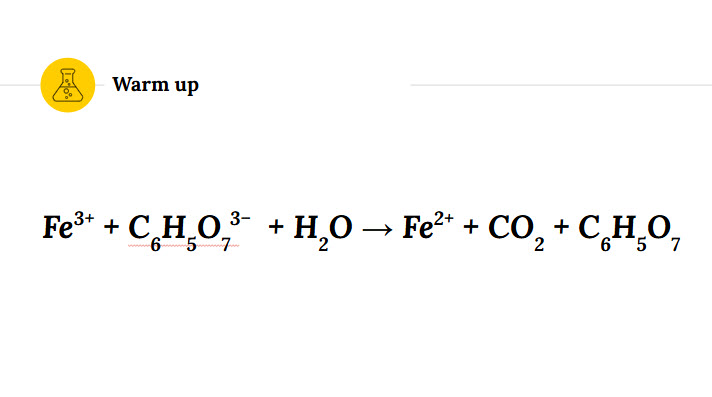
Groups talk about which atoms are changing and how they know. Once we identify the oxidizing and reducing species, I give a break talk over iron's reduction and interaction with the ferrocyanide anion, which forms an insoluble blue color. The point of this lab isn't to have them internalize and describe what's happening - more to show that redox changes - in addition to charge changes - also show the classic signs of chemical change, like color.
I put out watch glasses and sharpie markers for students to design their own plates. Some trace pictures, others freehand their own designs. When the sharpie has dried, I give everyone a prepared piece of cyanotype paper and we go outside. The exposure only takes about 15 minutes, so they're able to enjoy some sunshine and the some much needed vitamin D at the same time.
When they're done, we gently rinse the paper in cold water. This is the part where it can go wrong, especially for students who didn't listen to instructions and wash too hard. I don't have high quality paper, so it really is a very gentle wash. We leave the prints to dry overnight and they take them home the next day.
It's a really fun lab with low stakes that allows them to think about some chemistry and make something fun to take home.
This weekend, we celebrated our 17th year married. We took our annual bike ride, this time on the Pumpkinvine Trail which gives a nice corridor between Elkhart and Shipshwana in northwest Indiana. It was a beautiful ride through farms and had plenty of places to stop and rest to make it more of a meander than a workout. Early into the ride, my wife's handlebar stem was loose and some other trail riders lent me an allen wrench to get it tightened back down, but not without a small amount of shame for cycling without basic tools.
We finished the ride and then had a relaxed dinner at Goshen Brewing Company near the river. It is all pub seating, so we ordered at the bar and then found a picnic table outside. I wish there were more places like that around us because it's definitely more enjoyable to order when we wanted without having to rely on a server to swing back around.
Afterwards, we went home and had dessert with the kids before turning in early. And thus another year begins...
Since I haven't written in a couple weeks, here is a simple list of things happening in life in no particular order.
- The spring planting season has started. We've been starting seeds for several weeks, but now its time for them to move out into the field. We had one major frost scare which led to some last-minute frost cloth, but so far, things are doing well out in the ground. They'll really start to shoot up soon.
- School is winding down. We have about three weeks left and I'm working hard to keep my energy up for classes. Students are starting to check out (some were surprised that yes, we are still learning chemistry before the final exam) and having seniors finish much earlier than the rest of the school doesn't help the underclassmen continue to work hard on new material.
- I've been riding my bike more. I've got about 65 miles in over 6 rides so far with a very windy ride yesterday. They've all felt good and I'm looking forward to more consistent riding this summer (last summer was not good). My wife and I will take a trail ride for our anniversary again this year which is becoming an annual tradition for us.
- We finally poured concrete in the barn. The real floor will be a wonderful upgrade for this year's growing season.
- I'm starting a deep dive into solar power. I don't know if its feasible yet, but that may be our next big upgrade on the farm to help offset some of our summer electricity costs (coolers for flowers are expensive).