Posts
Original link
This Ars Technica article has been breezing around the Internet for a couple days and I finally had some time to sit and read it this morning. It's full of very quotable nuggets that, more than anything, communicate the frustration teachers all over the world are feeling.
But since the appearance of ChatGPT, the instructor’s job isn’t just to teach the subject and frantically attempt to keep every student’s plate spinning. Increasingly, it’s to moonlight as a detective and prosecutor because students without the motivation to do the work don’t have to skip it anymore.
This kind of sums up the essay - there's an enhanced air of suspicion about every piece of work that comes in from students these days. My situation is quite different - I'm face to face with a much smaller number of students. However, using standards based grading, I still look at a lot of student work. I have to see evidence of understanding - can they do the thing described by the current learning goal?
The hard work of lifting weights is the point because that yields physical results. A popular analogy is that using an LLM to write your essay is like driving a forklift into the weight room. Weights get lifted, sure, but nothing is accomplished.
I talk with my students about "productive struggle" all the time. My practice pages don't have points attached in the gradebook because the entire purpose is for me to see authentic work, right or wrong. If it's right, I can confirm their work and give suggestions on clarifying processes or ask follow up questions to help them connect concepts. If it's wrong, I can help them fix those mistakes. If it isn't their work - copied or LLMd or Googled - then I cannot do my job. This is a real mindset change, especially for 10th graders. I remind them that I cannot force anything, but they're still responsible for the skill come assessments.
Many instructors are trying to adapt to this crisis by going back to the only evaluation tools that are pretty much LLM-proof—tests like oral exams or handwritten work created under supervision in the classroom.
None of these solutions are available to instructors of asynchronous online classes. That sucks, since the availability of those classes is important.
This is the hardest part of the article. I don't have online classes and my tests are handwritten, in class, in front of me. I know that the assessment is their best representation of understanding and I can point back to their evidence of learning (ie, the practice they've done before the test) as a way to promote reflection. "What did you do to prepare?" or, "How does this result match your prep work?" are common in my discussions after exams. It brings to the forefront the danger of offloading small tasks because all things come around again.
I don't think education is in the middle of an AI revolution and I don't think I need to radically change what I'm doing. These fads have come and gone and will continue to do so. I think the bigger question is how we'll all weather this current trend and, more importantly, how we'll get students to reflect critically in their participation.
I've got a small app I use to keep track of student progress toward learning goals. I break my chemistry class down into simple "I can" statements for each unit and give feedback on students' abilities on performing those skills. They range from lab skills like "I can prepare a solution at a given concentration" to conceptual material like "I can explain why water's properties allow it to dissolve different substances." This gives students specific goals for making improvements and allows me to actually observe and give feedback on meaningful skills in chemistry.
Since originally building it, I've added little things here and there which help me visualize proficiencies across the year between classes. I'm happy with the overall structure and I can get the information I need, but dang...I can't make a smooth interface. There are some small friction points that I put up with, but I always feel like there's a tweak I could make to help, but I don't know how to turn that feeling into action.
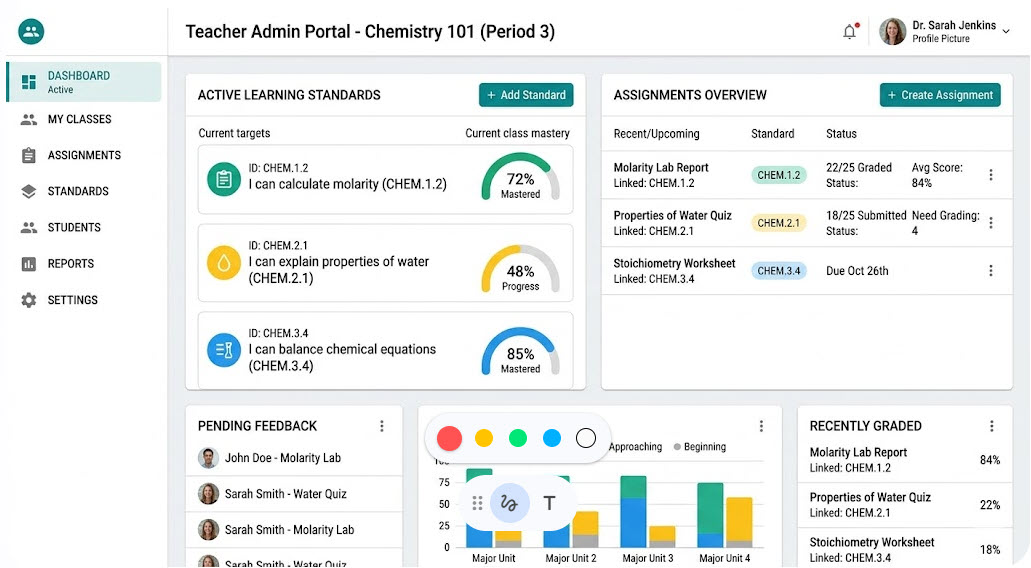
My current dashboard is extremely spartan. I have a card for each standard with a couple action buttons followed by a long list of assignments. The feedback happens in a grid of forms for each student that I can either individually or bulk fill with feedback, but submissions happen individually. I want to make each course page more informative and clean up the feedback process to be more efficient.
I decided to give Gemini the following prompt to see what it could come up with:
Design a web application dashboard used to give students feedback on work. The admin page for a teacher should show the current active learning standards and the assignments linked to that class. Standards are statements like, "I can calculate molarity" or "I can explain properties of water."
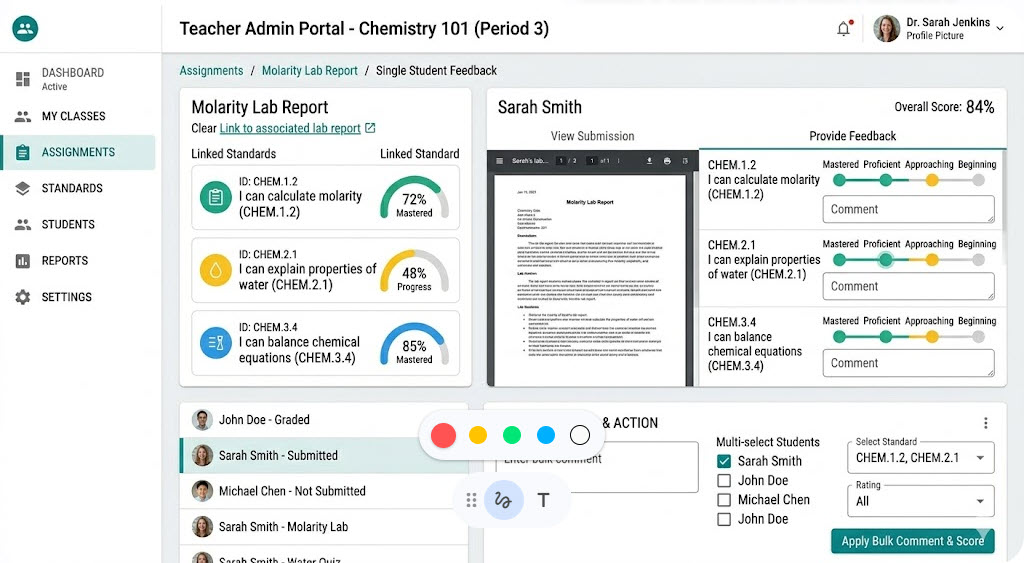
I prompted again for the feedback portion with,
Create a second dashboard mockup showing how feedback could be entered for standards on a single assignment. An assignment page for a teacher should allow for feedback on multiple linked standards. It should also allow the teacher to add either individual feedback or bulk comments on student submissions.
And finally a third prompt for showing aggregate data for a skill in a course:
Create a screen showing specific details for a given standard. It should include students in the course and an overview of their feedback on that standard. It should be easy to browse and provide insight to their performance compared with the class overall.
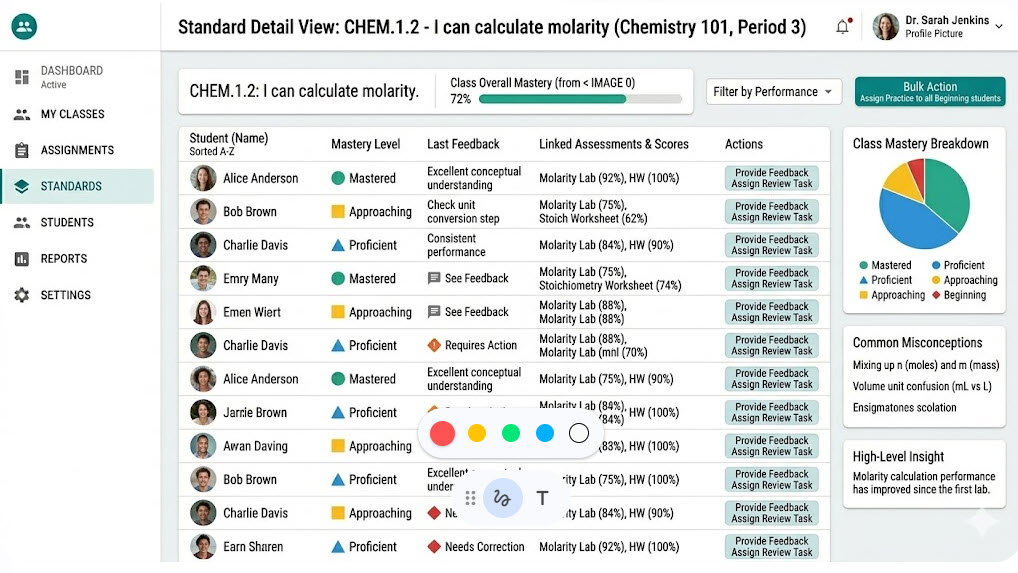
Now, this is very Material Design because it's Google and dashboards are all the rage in material design land, but I'm looking beyond the aesthetic. This little exercise gave me some tangible ideas about how to do some of the improvement work on my own this summer. I think this is one of the first tangible uses I've personally had with LLMs, which is something I'm going to have to think about. I'm not planning on having it generate any code for me, but I think it will help me iterate on what I find helpful and what I could do without.
Only one book finished in March, but it was almost 600 pages long, so there's that.
Eyes of the Void - Adrian Tchaikovsky
What a marathon! The sequel to Shards of Earth took me much longer to read because it goes much, much deeper into the political nature of the conflict between Hugh, the Parthenon, and the Essiel. The ending came so quickly in the final chapters that I had to go back and read a few sections to really understand what happened during the climax. The ending sets up a huge question mark that needs to be answered in the final book.
I've thought some more about the human.json protocol meant to make site authorship more transparent. There are two things that stand out in my mind:
-
There is nothing to prevent AI-generated sites from simply including their own human.json file with a couple links to well-known, individual-run sites. The Chrome/Firefox extension works well and is clear about who a given author vouches for. But, there is nothing to stop anyone from linking to whomever they would like. We're trusting individuals to be a good neighbor and use the system as intended.
-
Network reach is a limiting factor. I know a handful of folks whose sites I read and check regularly. Their blogs land in my reader and I follow/interact with them on a social platform here and there. My network effect is small. There are others who are much more widely connected, so they can provide a much larger list of sites they can vouch for. But the labor is on the individual. There isn't a way to automatically add to your list of known sites - I need to manually go in and update my vouches list. The idea, in principle, is that I'm maintaining my own list of sites whom I would put my own reputation on. In reality, it's another thing I have to manage.
There are some issues open on the repo that address adding a vouch for a site without the human.json file as a way to rubber stamp a website whose owner hasn't gone through the trouble of updating their own. I also came across a small shell script that someone wrote up to add sites to the vouches property automatically. I also toyed around with making a small table here in my own database that would update human.json on demand, kind of like my RSS feed is created.
At the end of the day, verification is hard. We're relying on the goodwill of other humans on the internet to all play nice and make this kind of thing work. In reality, we've seen over and over that AI/LLM inclined businesses and adjacents are unwilling to play nice. Their bots crawl sites without discretion, use content without attribution, and pretty much do whatever they want without participating in norms that make the Internet useful or enjoyable.
I'm going to keep my human.json published and accessible and I'm going to try to stay on top of adding sites when I find something that's truly human created, but I'm not sure what kind of dent it will make in the long run.
I took 20 minutes this afternoon and added my own human.json file to this domain. I'm still a little torn on whether or not this is a realistic solution to verifying which sites are made by people, but it's a start and it is zero overhead. The only thing I would do from time to time is to update my own list of vouches entries.
The entire protocol is short and easy to follow. If you have control over your own domain, this may be worth taking a few minutes to add to your site.
We finally had a nice Saturday where we could spend some time outside and get things ready for this growing season. There are always a lot of chores to do once the weather warms and this year isn't any different.
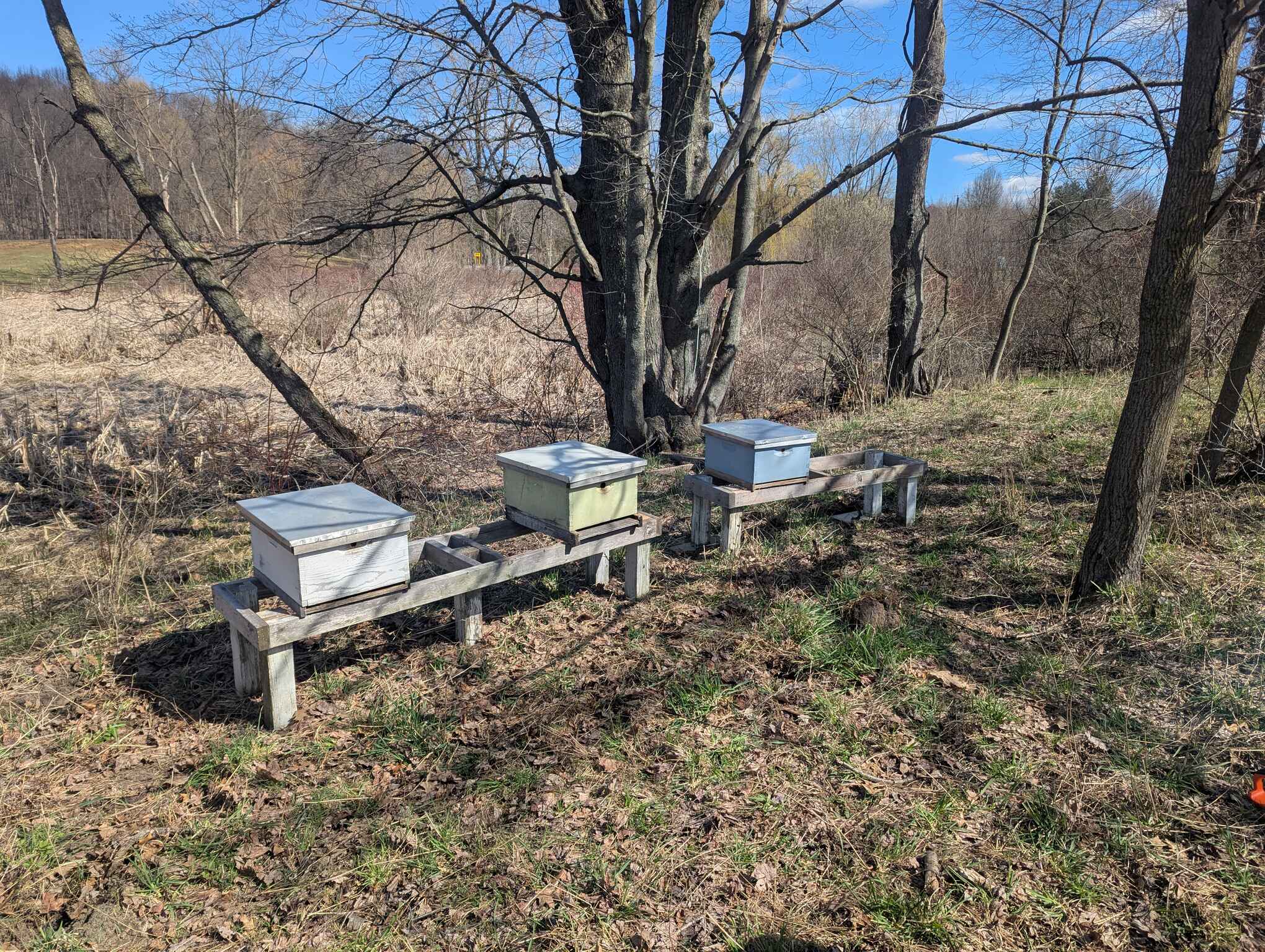
First on the list was to move the beehives to a more secluded location. Unfortunately, I lost hives again over the winter. I'm having a hard time figuring out why I can make it through one winter, but never two in a row. It's actually really discouraging...so much that I'm thinking about taking a season off. I decided to cut back this year and really focus on getting some core hives through several seasons. I'm going to change my mite treatment schedule (though I saw no evidence of mites in my cleanouts of the dead hives) and cut back on how much honey we're harvesting. I also moved the hives back into the treeline to provide a little more wind protection.
We're also doubling our flower growth this year which means we need a second garden bed for growing. We cut a new plot (60' x 70') last fall and covered with with leaf litter collected by the town in the fall. We tilled up the soil and mixed the leaves in to provide a bunch of carbon over the winter while they rotted down. This spring, I remixed the leaves and we started laying new compost in planting rows. We'll use a heavy layer of wood chips in between each row to help keep weeds under control.
This brings us up to about 7,000 square feet of growing space for the farm. Hopefully, we're able to max out what we're able to sell this year with our own farm as well as some local connections who would also like to sell our flowers to their customers.
Up next is getting the new bed finished and then focusing on cleaning out the barn so we can pour a concrete floor and add a small walk in cooler for flower storage between harvest and sale.
Original link: Scientists discover the nutrient bees were missing
Honeybees rely on pollen as their main food source. It contains essential lipids called sterols that are critical for growth and development.
But climate change and intensive farming have reduced the variety of flowers bees depend on. As a result, bees are increasingly missing key nutrients.
Articles that share "breakthrough" science that needed to happen because we're destroying the environment always get under my skin a little.
Another little Daily Create assignment which sent me to the Surrealist Compliment Generator. I reloaded a couple of times to get this:
Never was a man so badly meant to wear corrective glasses.
The world
and all its varied rhythms
framed
through my astigmatism
This is dumb, but I'm kind of proud of my little daily create.
⬜️⬜️⬜️🟥⬜️🟥⬜️🟥⬜️⬜️
⬜️⬜️⬜️🟥⬜️🟥🟥⬜️⬜️⬜️
⬜️⬜️🟥🟥🟥🟥🟥⬜️⬜️⬜️
⬜️⬜️🟥🟥🟥🟥🟥⬜️⬜️⬜️
⬜️⬜️⬛️⬛️⬛️⬛️⬛️⬜️⬜️⬜️
⬜️⬜️⬛️⬜️⬜️⬜️⬛️⬜️⬜️⬜️
⬜️⬜️⬛️⬜️⬜️🟧🟧🟧⬜️⬜️
⬜️⬜️⬛️⬜️⬜️🟧🟧⬜️⬜️⬜️
⬜️⬜️⬛️⬛️⬛️⬛️⬛️⬜️⬜️⬜️
⬜️⬛️⬛️⬛️⬜️⬜️⬛️⬛️⬜️⬜️
The Daily Create posts little creativity prompts every day (and has for the last 14 years which is wild).
I've changed a bunch up in both of my chemistry classes this year. Here's a short list on some things I've tried and what I think about how they've gone.
- Regular repeated practice in second year chem. This second year course builds on first year concepts and gets into college-level material. For kinetics, they struggled with vocabulary and when to do what in labs and calculations. During the equilibrium unit, I made flashcards and I pick random items to start nearly every class. They get regular spaced repetition on the core concepts and that has translated into better retention on quizzes.
- Explain to an elementary student. For an exit ticket, I've started asking students to abstract concepts down to the simplest language they can come up with. It helps me see how they're processing information and how they take it to the basic ideas. It also mixes up the way they recall and rephrase concepts I'm assessing regularly.
- More time between labs. I try to include a lot of wet labs where students are either observing and describing or collecting real data and analyzing. I think I do them too close together and it overwhelms my first year classes. I've slowed down and that's helped them chew on ideas a little more effectively.
- Paper and pencil workspaces. For years I was in the edtech bubble. All of my thinking was about how tech should be in the room. I've swung back the other way and I've focused heavily on problem solving skills through written work. If they can write something down, they can generally figure out what to do next. With digital methods, it's too much clicking without thinking.
- Worked examples instead of following along for notes. Trying to write and listen is a complex skill not many of my 10th graders have developed. I've started using printed worked examples to annotate main ideas rather than writing problems down from scratch. It has helped my classes see the big picture before trying to tackle problems themselves.
- Feedback on everything. This one isn't new, but I work really hard to have next-day feedback on assignments so students can take stock of what they're doing well and what they need to avoid doing wrong on the next task. Whether or not they use the feedback is the next question, but I try to draw their attention to it as much as I can to build up the capacity to learn from mistakes rather than immediately moving on to the next thing without thinking about how they can improve or maintain good habits.
This was a slower reading month for me - just two finished, both science fiction.
Shards of Earth - Adrian Tchaikovsky
This is the first in a series of books introducing a planet-spanning human civilization prompted by the destruction of the Earth. No one really knows why the Architects came to remake the planet, but they're unstoppable and spell a horrible end for anyone in the path. Miraculously, the Architects were stopped by an Intermediary - an altered human who can make contact with the planet-killing beings. The crew of the Vulture God is a rugged mix of human and alien who get caught up in a new threat and their Intermediary pilot finds himself facing an old enemy.
I wasn't sure if I liked the first third, but the middle and ending really hit a stride and I found myself staying up to read later than I should have. I'm looking forward to continuing the series.
The Afterlife Project - Tim Weed
When the earth's systems are collapsing, a group of scientists mounts a last-ditch effort to save the human race. Al, Natalie, James, and Tollie sail across the Atlantic Ocean to find a small enclave of survivors. At the same time, Nick is in suspension, heading into the distant future where the earth has healed itself and he can help restart civilization.
The Afterlife Project is part ecological thriller, mystery, science fiction, and caution. The near future (2068) feels eerily possible and makes you think about what our choices now will mean for the long term. The two timeframes are beautifully written and the narrative is gripping right up until the final pages.
I've been using standards based grading for many, many years. Each year, there are units that make me question whether or not its the right thing to do and it's generally when we write names and formulas for compounds. In theory, it's not a difficult skill - follow the chart to apply the right rule to the right chemical. In reality, there is so much background knowledge a student needs to have to be successful, it ends up being one of the hardest things we do during the year.
This chart tells a clear story of the difficulty:
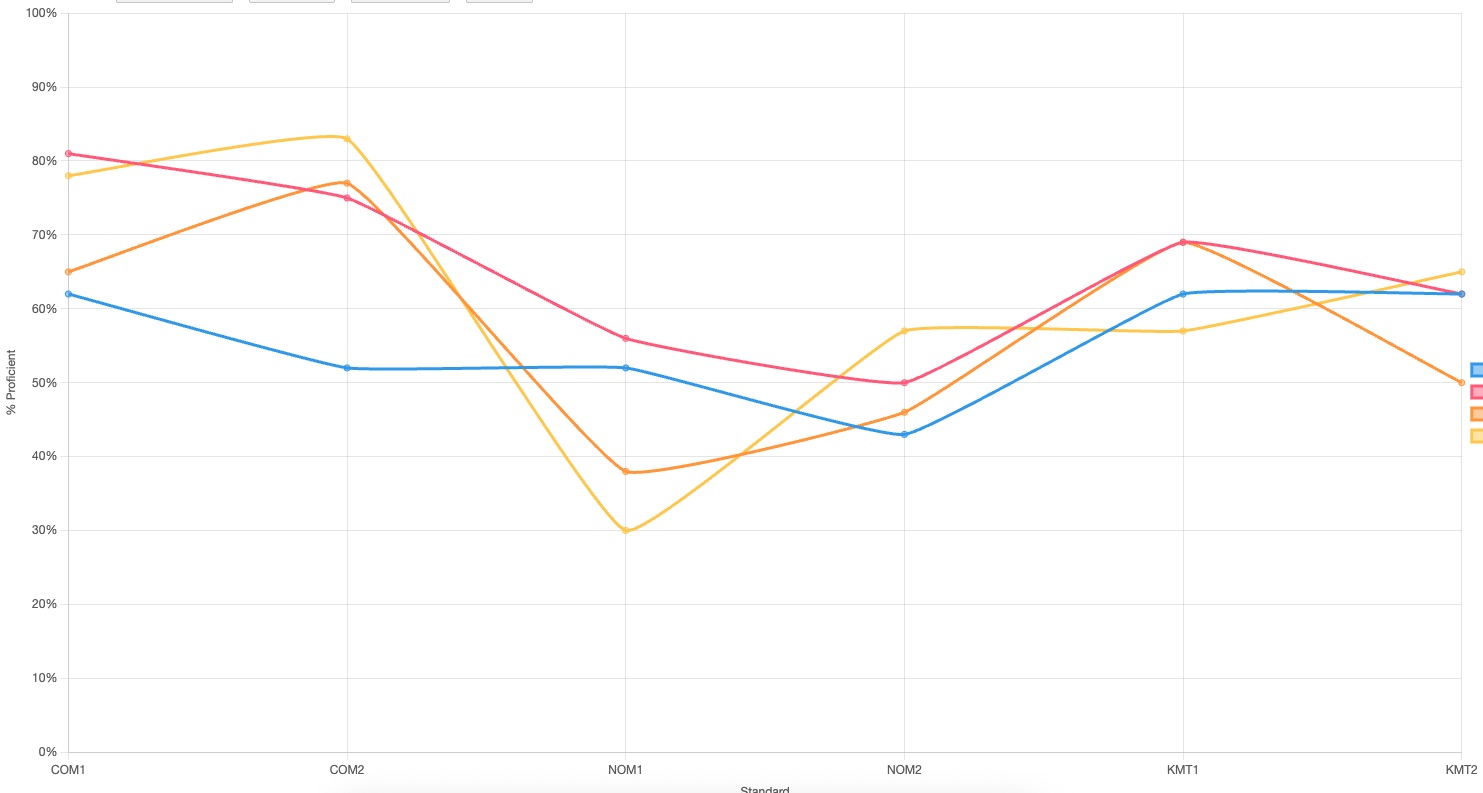
The first two points are for types of compounds...pretty much identifying ionic vs covalent substances using the periodic table and then describing macroscopic properties. The next to points are writing formulas for compounds (ionic and binary covalent) and then writing names for compounds. Ionic compounds really just wreck people.
It's frustrating because each of these standards has a huge impact on the overall grade. Students can test as often as they like with evidence of practice and revisions until they can do the skill. I'm pretty lenient on this unit...I let transition metal charges slide in names and they can use a reference chart of polyatomic ions, but there is still a huge struggle for many. I can point to exactly why each person either has or has not demonstrated proficiency, but it's still a tough unit to be resilient through.
I'm thinking through how I can ease the burden in future years. Eventually, we move on into new material so students get a break, but I'm finding it harder and harder to help them persevere through really hard topics when many will not think about chemistry again this year.
For the last two years, I've done an iodine clock reaction with my second year chemistry students as the main teaching lab for our chemical kinetics unit. We use 0.2M sodium iodate and 0.2M sodium bisulfite as our reagents instead of the classical sodium thiosulfate and iodine. I've found this to be reliable and uses materials I already had in the lab. The amounts of reagent are low enough that I can make enough stock for eight lab groups to have a little extra in case they need to re-run a trial.
I introduce the reaction mechanism and main points the day before so students can read prior to starting. The entire wet procedure can be done during one 60 minute class period with analysis happening in the next class or for homework. The lab protocol gives students a detailed table of reagent amounts for each trial. They essentially perform a serial dilution from the 0.2M stock samples keeping the bisulfite concentration constant for the first trial runs and then keeping the iodate ions constant for the second. Students have to retrieve and manage samples, avoiding cross contamination, in order to complete the 10 trials correctly.
Most groups this year (all except for one) got the expected results of a first order rate for iodate and a second order rate for bisulfite. Here's the full procedure if you want to take a look at the student handout along with sample data and preparation notes on the last page.
I'm late with my reading from last month because I was in the middle of updating my entire blog setup and didn't want to have extra posts to import. Here's a look at my reading from January:
Death from the Skies! - Phil Plait
I like Phil's conversational approach to science writing. He tells stories and paints really clear pictures of what is happening in the deepest parts of the universe. This was a little bit of extra fun because each chapter starts with a small vignette setting the scene for the horrible thing heading toward the earth.
Trail of the Lost - Andrea Lankford
I really enjoy travel/wilderness survival stories, so I grabbed this while browsing at the library. The book follows a multi-year search for three hikers who all disappeared from the Pacific Coast Trail around 2016 and 2017. The author is a nurse and former National Parks ranger and has years of experience in wilderness search and rescue. At first, I thought the book was mainly a vent at official search and rescue protocols, and in some ways it is. She's frustrated with the bureaucracy and secrecy around missing persons in the national and state parks. At the same time, the book details stories of volunteer searchers also needing rescue because they're inexperienced and run into trouble.
In the end, the book walks through three families searching for lost sons. The official outlets are stretched and unofficial groups are often shut out, leaving a weird middle-ground where you cannot make progress. Community and the care of strangers brought together by common cause helps everyone involved keep looking when there is little hope left.
As of today, all traffic from https://blog.ohheybrian.com is now directing to https://ohheybrian.com/blog. I've migrated all of my old posts (I think I got them all) into the new platform and I finally decided that it was just time to redirect and patch up issues as they arise.
I've spent a couple of months, working intermittently, on this change. I'm happy with what I was able to put together and I'll do some detailing about what changes I made and what I had to build to make the switch. The short story is that I'm back with an online-first platform, running on Flask against a SQLite database. I learned a ton and I'm excited to keep building it out.
I came across a post this morning on why AI isn't killing learning. Educators are good at the blame game and I think the overall premise of the post is correct - we need to constantly revise what we do along with our methods, but that's standard practice, not just in response to new tech.
I think he missed the point on skill building, though. I cannot just look at a series of prompts a student gives an LLM to determine what they know or don't know. There is still a place for fundamental knowledge and building skills to develop fluency.
I'm painting almost every day and I'm still taking things a few strokes too far. My latest was good and then I tried to darken more, which muddied it all up. Lightness!
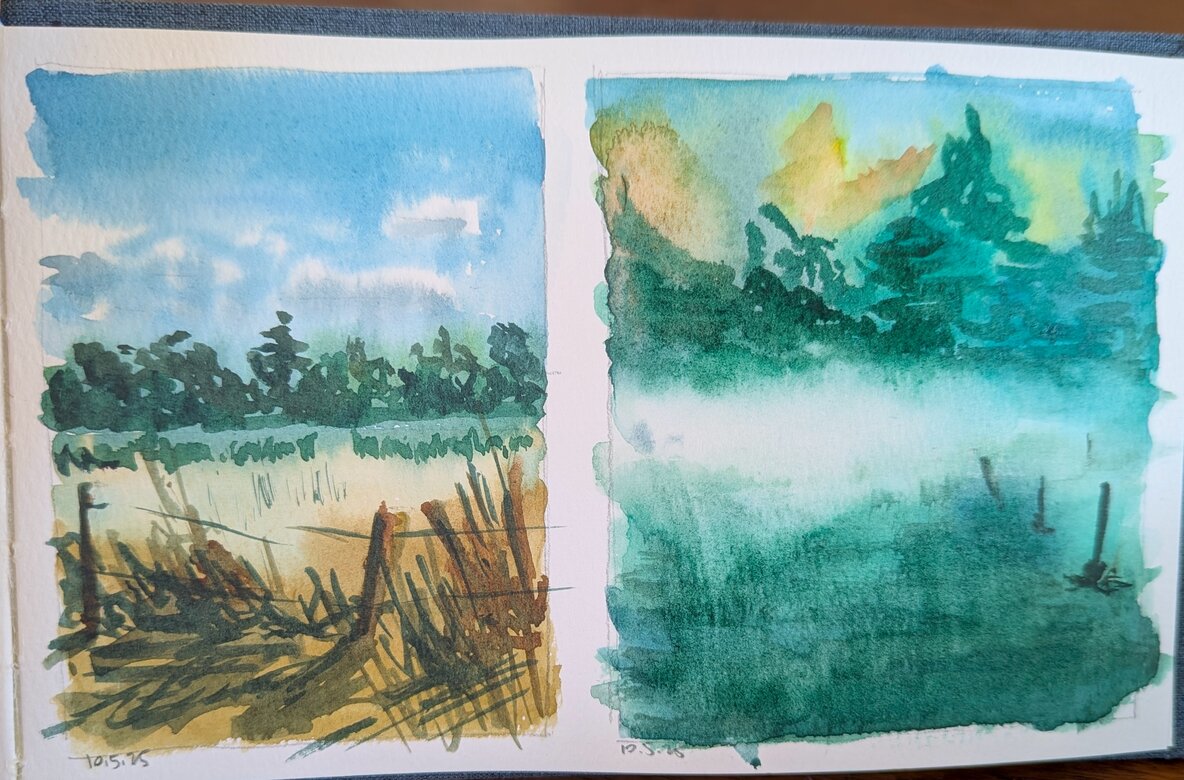
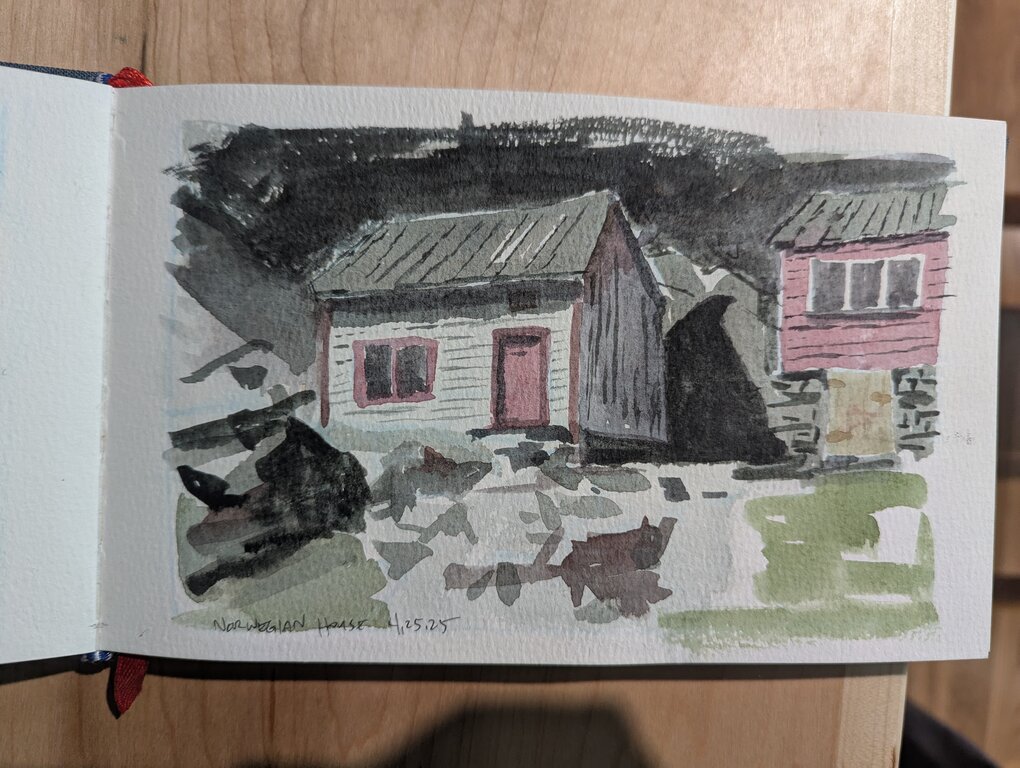
I painted a lot in 2025. I have a couple posts from this year (post 1, post 2, post 3) with some others I never shared. Here are some of my favorites from this year overall.
I had a couple here and there that I was particularly proud of, like this house from back in April.
I really enjoy landscapes, stemming, I think, from just loving being outside. I did a lot of small paintings at the start of the year that have since turned into full-page pieces. I also started to get more bold with my colors and values.
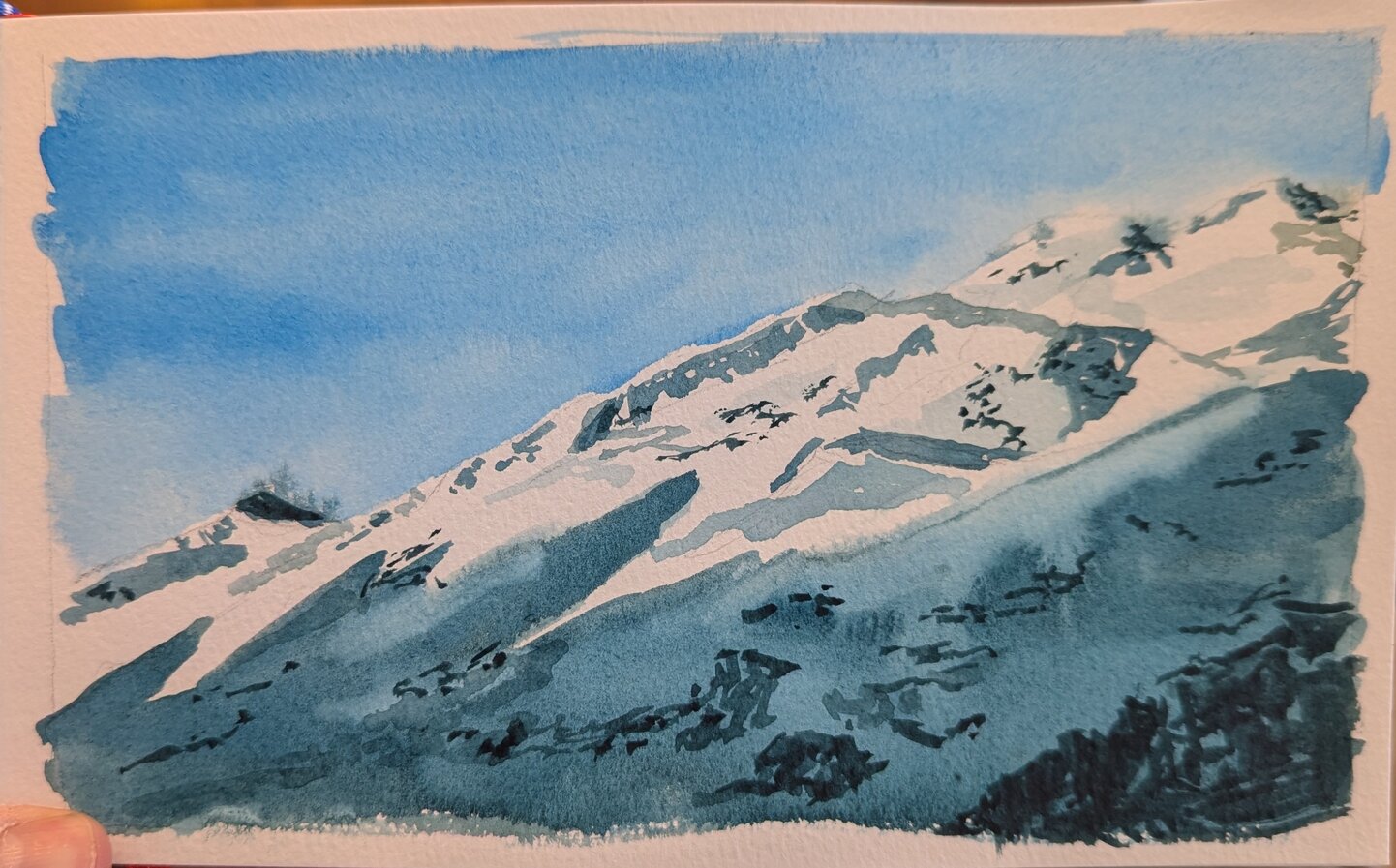
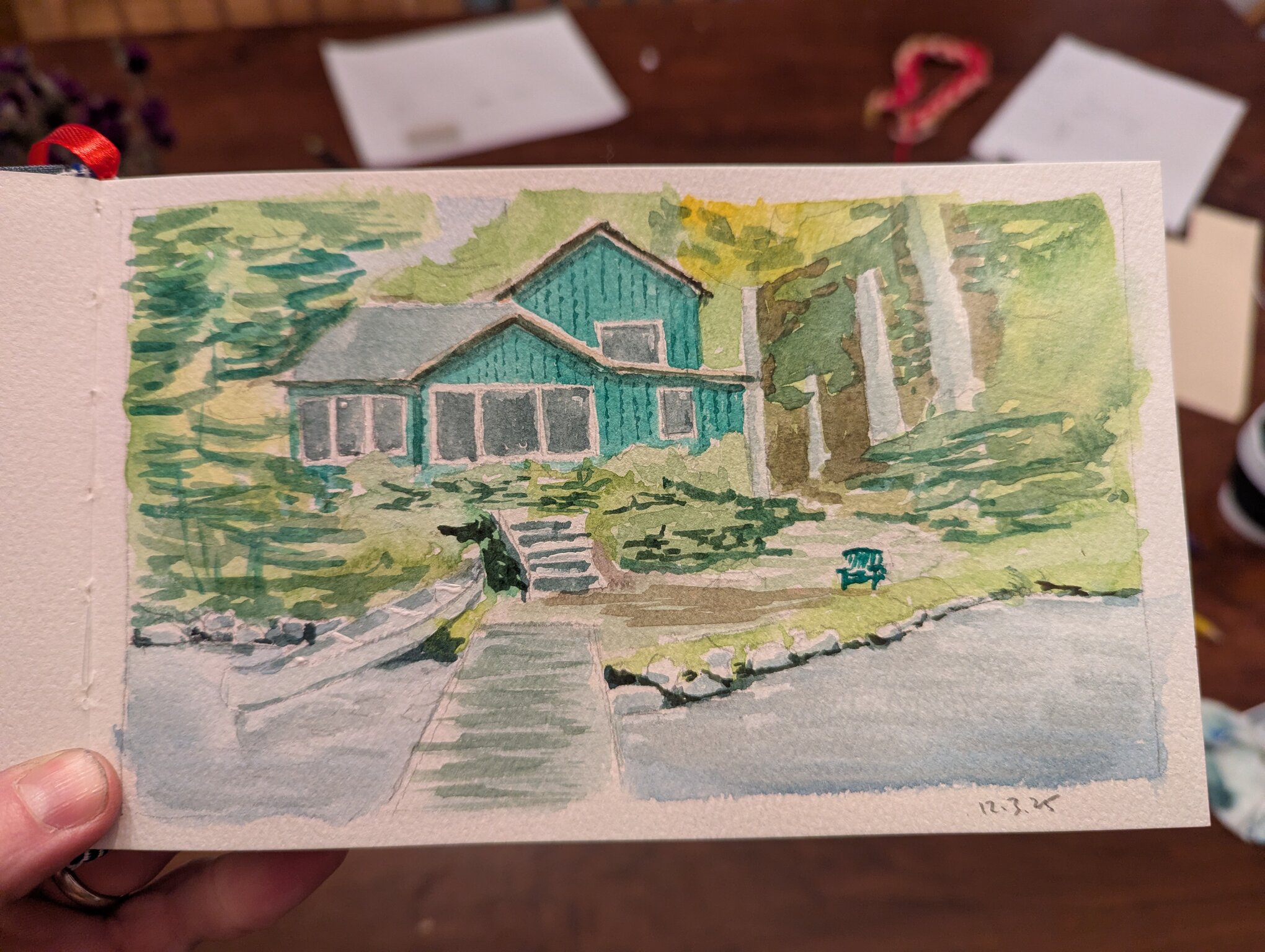
I'm making progress with blending, mixing colors, and taking advantage of watercolor's softness, but I still have a way to go on managing moisture in the paper and brush and painting light, mid, and dark values to build depth into the pieces. I did this the best on a painting done in early December of the lake cabin we used to visit growing up.
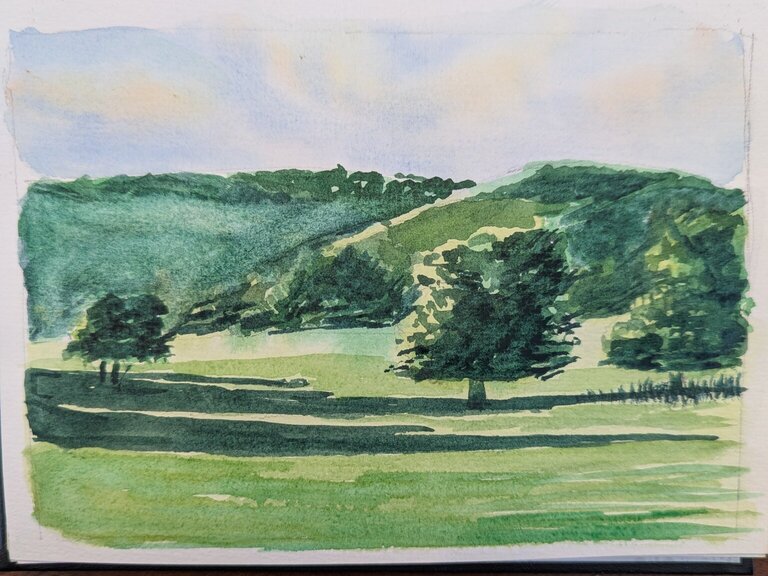
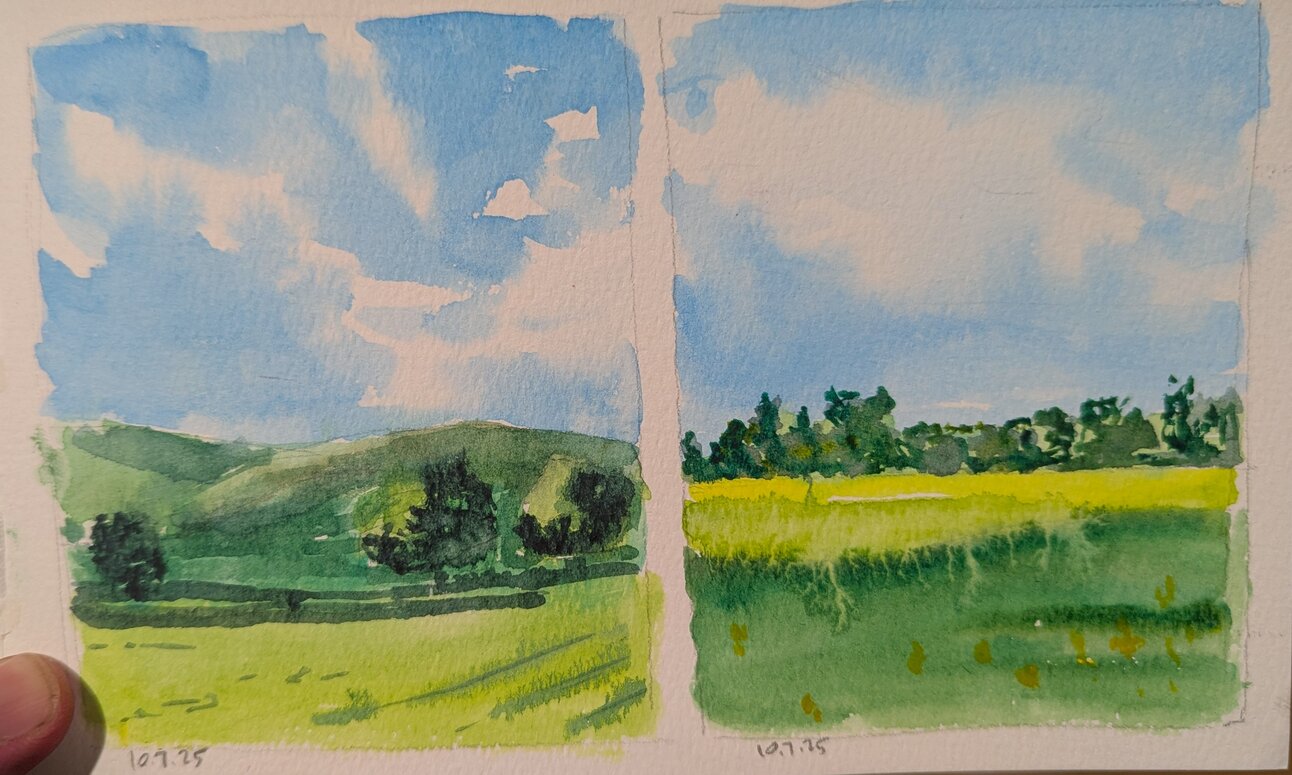
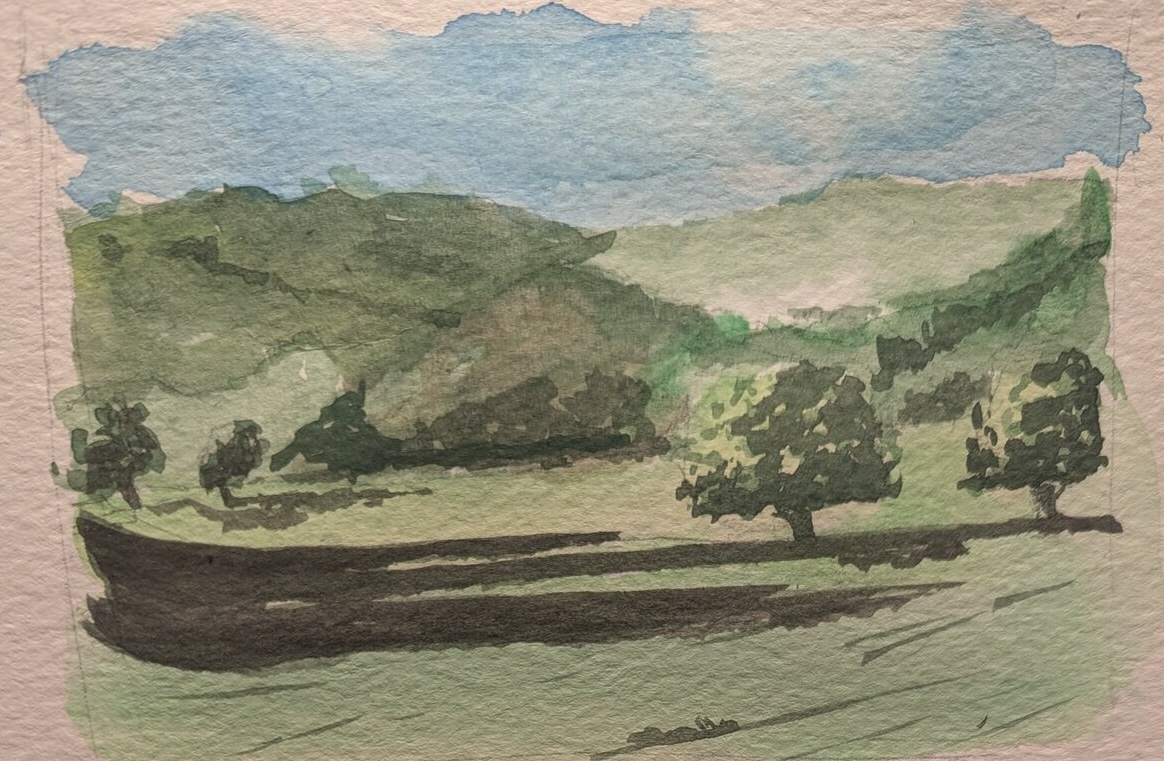
All said, I think my favorite painting of 2025 is this field that I have painted several times, trying to get just right. I don't think I was ever disappointed with a piece, but I kept getting drawn back into the scene, trying to capture it in different ways.
It's been a good year of growing in skill and confidence. I got a lot of supplies for Christmas gifts this year and I'm looking forward to filling those books up.
So many books over winter break! A couple were short, but they still count.
The Wilder Life - Wendy McClure
I'm reading the Little House series to my middle daughter before bed, so I grabbed this on a whim. It went on a little long, but McClure realized that a) the life on the prairie wasn't always as quaint as was portrayed, and b) hunting for that life now paves over the complexities hidden in the children's story.
What If? Serious Scientific Answers to Absurd Hypothetical Questions - Randall Munroe
I used to read the What If page regularly, but had never picked up the actual book. I burned through this in a couple of days, giggling at how ridiculous some of the scenarios are. I especially loved the light-speed baseball this time around. It's an easy, approachable read for anyone.
The Art Thief - Michael Finkel
I'm really on a kick this year with thefts and anthropology. The Art Thief is one of those mouth-drops-open kind of stories where you just can't believe what the thieves pull off. Stéphane Breitwieser thinks he's invincible and he has little reason to doubt that assumption. He frequently makes off with artworks in broad daylight, even when cameras are around. The book read quickly and I found myself turning page after page waiting for his luck to run out.
A Christmas Carol - Charles Dickens
I'm not a fan of Victorian literature, but we watched The Muppet Christmas Carol this year with our kids and I decided to sit down and just read the original. I was surprised at how close the movie came to the original and just how much darker the book was. I lost the thread a couple of times in some of the descriptions of scenery and people, but overall, I enjoyed the short read.
A Thousand Pounds of Dynamite - Adam Higginbotham
In 1980, a man with a grudge built a highly-sophisticated bomb to blow up a casino he owed money to unless he was paid a $3 million ransom. Higginbotham is one of my new favorite authors because he is able to weave together each story into one compelling narrative.
This was a podcast episode, but the full text is the length of a short book and is still available on The Atavist.
https://magazine.atavist.com/2014/a-thousand-pounds-of-dynamite
I've had this little space up for a few weeks and I still haven't decided if I should migrate all of my existing posts over or not. I'm liking being able to fire off quick posts here and there, but I'm worried about losing the old stuff in a move. It would take some wrangling to make sure I don't break every link accidentally. I also don't love having two spaces to think about. What belongs where? Does it matter?